

As Diamond Sponsor of ANCOLD 2026, Entura will help lead the conversation on resilient dams and smart futures.
26-28 October 2026, Nipaluna Hobart
We’re excited to welcome the Australian National Committee on Large Dams (ANCOLD) to our home town to explore the challenges and opportunities of our evolving industry.
Our speakers
As we gather at the Hotel Grand Chancellor, we look forward to sharing our insights and collaborating with peers to help shape a sustainable, reliable future for the global dam industry.

Emergency dewatering outlets – do they increase the resilience of a dam or are they a maintenance nightmare?
Richard Herweynen and David Law (Wednesday 28 October – 2:27 pm)
Currently ANCOLD has no guidelines on the need for or design of dam emergency dewatering outlets. There are, however, several recognised international guidance documents on emergency dewatering outlets (USBR and UK Environmental Agency). In Australia, current practice is generally to consider the emergency dewatering outlet as part of a dam’s risk mitigation strategies. As a result, some dams do not have an operational and/or reliable emergency dewatering outlet. It’s important for dams professionals to consider whether a reliable emergency dewatering outlet would improve the resilience of the dam from an overall dam safety perspective, whether current practice is sufficient, and what the implications are for maintenance. Decisions made about emergency dewatering outlets can lead to ‘legacy risks’ for dam owners.
This paper explores international practice relating to emergency dewatering outlets and examines three contrasting case studies that highlight key lessons from a dam safety perspective. One is a new dam on a very large reservoir, where the cost and benefit of an emergency dewatering outlet did not justify its inclusion. The second case study explores dams with emergency dewatering outlets that end in ‘explodable domes’, where the risk of operation is now considered too high. The third case study presents a dewatering outlet on a dam more than 20 years old, which has never been operated and is now covered in sediment, as revealed by bathymetric survey.
The paper demonstrates how a risk framework can be used to assess the benefit of an emergency dewatering outlet. If the outlet is included as part of the risk mitigation strategy and provides emergency resilience, it is critical that the outlet’s operation is reliable. This paper will present observations and recommendations relating to the role, value and implications of emergency dewatering outlets in modern dam design, operation and safety management.

Unleash your potential energy: The powerful role of training in your Dam Safety Management Program
Dr Amanda Ashworth, David Wightman and Sally Fracalossi (Wednesday 28 October – 11:30 am)
Dam owners operate in an increasingly constrained environment shaped by ageing infrastructure, climate change and heightened societal and environmental needs. These constraints are further intensified by competing organisational priorities, statutory compliance requirements and rapidly evolving engineering standards and technologies.
Fundamentally, people at the heart of a dam safety management program must be sufficiently informed and capable of meeting these challenges. ANCOLD recognises this, and the critical role of training and education to build workforce capability and address the skills shortage facing our industry.
Various training methods can be implemented to equip owners and their personnel with appropriate knowledge, skills and awareness for their role, aligned with ANCOLD and regulatory guidance. These methods are explored in this paper, with a particular focus on the approach and outcomes of structured, competency-based training programs delivered by the Entura clean energy and water institute (ECEWI).
Feedback and themes emerging from ECEWI’s training programs in the Australian context are discussed, with an emphasis on the accredited training approach, delivery methods, methods of assessment, collating evidence of competency and a need for ongoing refresher training.
This paper highlights the value of embedding a training framework within dam safety management programs to strengthen long‑term safety outcomes and build and sustain a skilled professional workforce over time.

One size fits all … mostly: lessons in adapting standard designs to a new spillway
Dr Colin Terry and Sammy Gibbs (Tuesday 27 October – 11:30 am)
Spillway designs are often based on standardised arrangements that have been tried and tested. For example, an ogee crest and a United States Bureau of Reclamation (USBR) stilling basin. Adopting conventional or standard designs is ideal, as project budgets rarely allow for exhaustive physical modelling associated with an unconventional design. The upgrade of TasWater’s Pet Dam in northwest Tasmania provided an opportunity to test a pragmatic question: when using standard elements, where should limited hydraulic design effort be spent, and what value do hand calculations and computational fluid dynamic (CFD) modelling provide?
This paper uses a case study to describe the role of various processes in the design of an ogee crest and stilling basin for a spillway upgrade. Such processes include textbook hydraulics and hand calculations, and how they were used to diagnose the following contradiction: the USBR Type III basin relies on a subcritical tailwater control to form a hydraulic jump, but downstream conditions were supercritical. So who is really in control? The solution: an alternative outlet arrangement which turned a standard design into a functioning system.
The role of CFD in the case study is also discussed in the paper. Specifically, how it was applied to understand three-dimensional flow features, complex geometry interactions and to optimise geometry. Examples of these include the optimisation of the approach channel and crest profile, to maximise discharge efficiency and avoid adverse flow separation, and for rating curve modelling which revealed a subtle nonmonotonic feature in the derived weir coefficient-head curve.
The objective of the paper is to present a workflow that offers smart effort allocation for spillway design projects where budget is limited. The result is a spillway design that is both defensible and efficient in its design process, with transferable lessons for similar upgrades.

Are you triggered? The dam engineer’s role during emergency response
Michael Aboud (Wednesday 28 October – 1:45 pm)
Dam Safety Emergency Plans (DSEPs) play a critical role in dam safety management by providing structured actions to identify and respond to potential dam safety incidents. DSEPs identify emergency conditions (i.e. trigger levels), notification protocols, and escalation pathways that involve emergency management agencies to assist in the evacuation of downstream communities. Once emergency response is activated, emergency control frequently transitions away from the dam engineer and towards local authorities. However, this transition should not signal the end of the dam engineer’s active involvement.
Trigger levels within DSEPs are commonly set for multiple potential failure modes, with escalation thresholds designed to prioritise life safety, rather than to predict imminent failure. Activation of a high-level trigger for one failure mode, such as internal erosion, does not imply inevitable dam failure, nor does it preclude the development of other failure mechanisms, such as overtopping. In this context, continued technical oversight and monitoring by the dam engineer during an emergency remains essential.
The paper explores the role of the dam engineer during emergency response including ongoing surveillance, interpretation of dam behaviour, and adaptive decision-making once emergency services have been engaged. Through discussion of emergency scenarios and trigger interactions, the paper highlights how continued oversight can support timely intervention measures, improve situational awareness for emergency managers, and enhance overall response system resilience.
Continuous oversight by a dam engineer during emergency response helps asset owners better manage evolving risks, strengthen dam resilience and protect downstream communities.

Meadowbank Spillway Gate upgrade - managing spill risk during the outages
David Law (Wednesday 28 October – 2:20 pm)
Meadowbank Dam is a 43m high concrete buttress dam with a concrete face rockfill embankment on the right abutment. The dam was constructed in the 1960s as part of the River Derwent power development and impounds water for the hydroelectric power station downstream of the left abutment. The central section of the dam has a gated crest spillway with two bottom hinged flap gates, each 36.3m wide, 4.94m high, operated by 10 hydraulic cylinders. Over the years since commissioning in 1967, the mechanical and electrical equipment which operate the spillway gates had deteriorated to the point that a replacement project was initiated with the work substantially completed in 2024. The scope included the replacement of the hydraulic cylinders, hydraulic controls and the electrical controls.
This project presented multiple technical challenges, not just in the design and selection of new equipment, but also in planning the spillway gate outages. Upgrading each gate required it to be locked in the raised position to allow the hydraulic cylinders to be replaced. While in this position the lake level needed to be maintained for power generation and upstream irrigators. However, with one gate out of service, the discharge capacity of the spillway was reduced, and if the lake level rose to overtop the out of service gate, it could potentially be overloaded and fail.
This paper will explore the steps taken to plan and manage a complex project on the spillway of a ‘run of river’ dam with a small storage, while maintaining flow for power generation and downstream users and upstream irrigators.
It will cover the process undertaken to assess the flooding risk, the risk to the gate structures, and how operational plans were devised and tested to mitigate risks to workers, the dam, and the community during the site work.

Feet on the ground, eyes on the data: ground-truthing the future of dam monitoring on Tasmania’s wild West Coast
Aaron Kelly, Craig Tybell and Will Massie (Wednesday 28 October – 10:45 am)
In an era when digital monitoring, AI enhanced analytics and remote sensing promise unprecedented insight, one truth remains: a monitoring system is only as reliable as the field data it reflects – ‘rubbish in, rubbish out’. Poor measurements erode confidence in long-spanning data sets, unreliable telemetry reduces the visibility of real events, and failing sensors cause false alarms that disrupt operations and can lead crews to overlook genuine risks.
Entura has worked alongside clients on the west coast of Tasmania for decades, doing the often-invisible work that makes modern dam monitoring actually work: systematically ground-truthing and managing dam safety instrumentation. The rugged west coast presents unique challenges for dam operators in maintaining sustainable tailings dam operations whilst surrounded by UNESCO World Heritage forests.
Expensive in-situ water quality (WQ) sensors are constantly affected by the highly acidic water they measure, creating challenges for responsible release of water into the surrounding protected environment. The rugged environment itself poses unique issues for effective remote monitoring, where the failure of a single radio repeater has previously failed an entire network of dam monitoring equipment. The upkeep of instrumentation is difficult and costly in the remote, wet and cold environment, and failing sensors have resembled real, catastrophic failure events.
Entura has overcome these three challenges at a particular site by pairing camera imagery with regularly calibrated WQ sensors connected via satellite telemetry. This particular solution has provided comprehensive insight and effective alerting for a critical outflows site in one of Tasmania’s deepest, darkest gullies.
This paper demonstrates how aligning digital monitoring with rigorous, repeatable ground-truthing strengthens dam resilience, reduces operational risk and elevates confidence in the datasets driving safety-critical decisions. This approach can be applied by dam owners and operators to support a smarter, more resilient future for critical infrastructure.
This ultimately supports the vision of smarter, more resilient dam futures.

Resilient digital architectures for tailings dam monitoring and risk management
Baden Corr and Wijith Pathiranage (Wednesday 28 October – 1:07 pm)
The operation and stewardship of tailings storage facilities (TSFs) increasingly rely on digital geotechnical monitoring systems to support safe and informed decision-making. While dam engineers and their operational technology (OT) and information technology (IT) support teams now have access to unprecedented volumes of monitoring data, challenges remain in integrating and transporting data between systems, and in translating data into dependable, timely and actionable insight. These challenges have direct implications for managing risk and compliance and optimising the ongoing performance of TSFs.
Delivering an integrated geotechnical monitoring system requires coordination of a broad group of stakeholders, including operational teams, Engineers of Record, dam owners, internal IT and OT specialists, and external software vendors. Decision-making for modern TSFs now draws on a wide range of datasets in addition to traditional instrumentation, including camera feeds, InSAR, inclinometers, weather data, laboratory test results, inspection records and action tracking systems. Managing alert setpoints, responsibilities and derived metrics such as factor of safety across these diverse data streams introduces additional complexity and governance considerations.
A common and persistent assumption is that a single software solution can adequately address all monitoring, analysis and assurance requirements. This paper challenges this assumption. Drawing on Entura’s experience supporting owners of critical dam infrastructure, and a three-year collaboration with BMA and its OT/IT teams, the paper examines an alternative approach based on an adaptable digital architecture that selectively integrates multiple feature-specific, fit-for-purpose software tools.
The paper will present research into why significant volumes of monitoring data remain underutilised and will include insights drawn from interviews with TSF stakeholders about how they approach this challenge. The paper will also explore how TSF dam owners could better facilitate improved operational insight of their assets, from both the commercial and technical perspectives.
Given that digital change is inevitable, designing systems, teams and processes that can adapt over time is essential for safe and responsible dam management. Through this paper, the authors aim to contribute to a positive and enduring digital legacy aligned with ANCOLD principles.
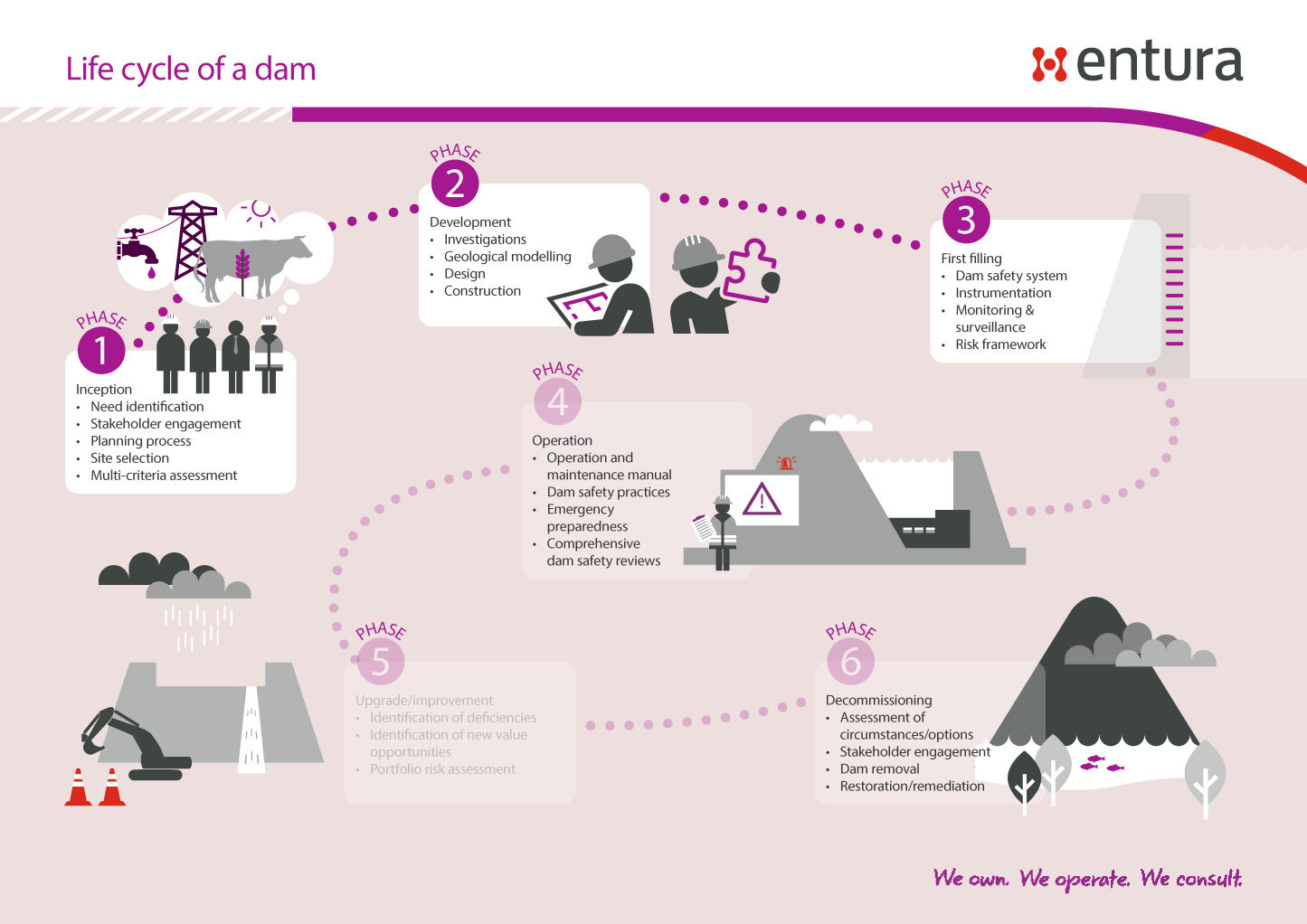
Click the highlighted stages to explore our articles. Grey stages will become available as new articles are published.


 +61 427 319 887