
THOUGHT LEADERSHIP
Risk is the word – reflections on the NZSOLD/ANCOLD 2025 conference

From 19 to 21 November 2025, industry experts from consultants to asset owners gathered in Ōtautahi Christchurch, New Zealand, to exchange insights, challenge thinking and strengthen connections ‘across the ditch’ and beyond. Here Entura’s Sammy Gibbs reflects on the conference …
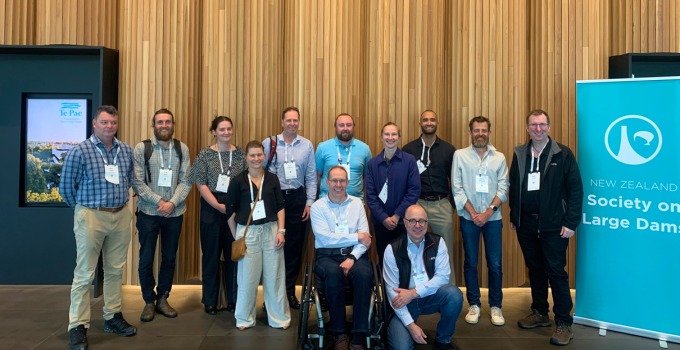
If I had dollar for every time I heard the word ‘risk’ across the two-day event, I might have been able to fund next year’s conference myself!
Why was this the case? As noted in many of the presentations and papers, the dam industry is facing the combined challenges of aging dam infrastructure, changing design standards, climate change impacts, community expectations and resource/cost constraints. As a result, the industry is shifting more towards risk-informed decision-making/frameworks, compared to traditional standards-based approaches,to manage and design dam infrastructure.
No dam is 100% safe and all risks can never be designed out entirely, but a sophisticated understanding of their risk can inform our decisions and actions so that we can target key issues cost-effectively and ensure resilience in our dams and water infrastructure.
Risks in asset ownership
In his opening address, Andrew Watson, Director of Dam Safety & Generation Asset Planning at BC Hydro in Canada, provided valuable insights into how BC Hydro uses a risk-informed framework to manage its dams. He discussed the use of a ‘vulnerability index’ to understand the significance of identified physical deficiencies in the dam portfolio. The higher the index, the greater the likelihood that the deficiency would result in poor performance. This index allows BC Hydro’s dam safety team to understand the overall risk profile and prioritise future works. It left us contemplating how the ANCOLD 2022 Risk Assessment Guidelines and ALARP process may be enhanced by integrating components of this approach. This could be a useful way of measuring how far the dam is from meeting ‘best practice’ and hence enhance the justification for further risk reduction or accepting the position as ALARP.
Later in the conference, Andrew Watson was joined by Peter Mulvihill, Lelio Mejia and Barton Maher to discuss legacy risk and how to manage it. Legacy risk is relevant for many asset owners (nationally and internationally) as our sector faces the complexities of inheriting aging facilities, acquired from past organisations/owners. A key challenge with these legacy structures is the transfer of knowledge to new asset owners. Important records such as monitoring data, design and construction information are often lost (or were never developed), making it difficult to understand and quantify the current risk position of the structure. These aging facilities are also unlikely to meet current design standards or withstand climate change impacts. Risk-informed decision making and phased approaches become critical in such instances, as does asking the question ‘Does it matter?’ when it comes to unknowns. Like tying surveillance programs to key failure modes, unknowns should also be associated with credible failure modes.
It was noted that for some of these structures the most appropriate solution is decommissioning, as the risk imposed by the structure (and the cost to mitigate it) may outweigh the economic benefit of the asset itself. In such instances, this decision can provide social and environmental benefits and are worth investigating.
Risk in surveillance monitoring
The conference reaffirmed the critical role of risk-based surveillance monitoring and the importance of understanding how dam instrumentation relates to key failure modes and/or performance. The most effective tool to support this is an event decision tree.
Entura’s Diego Real reiterated the importance of understanding key failure modes when implementing instrumentation upgrades. His paper presented a staged approach for the upgrades, providing clients with a cost-effective, practical solution that assists in managing dam safety risks.
Although there was discussion about various ways in which surveillance programs can be optimised, our industry is aligned in recognising the criticality of undertaking routine inspections as the first line of defence when it comes to identifying potential failure indicators.
Risk mitigation solutions
Several presenters shared examples of bespoke solutions responding to dam risks – including Entura’s Jaretha Lombaard, who highlighted how a Swedish berm was used to mitigate risks associated with piping failures at an earth and rockfill embankment dam in Tasmania.
Other risk mitigation solutions presented included non-physical works such as improvements in surveillance and monitoring. In one example, alarm systems in rivers are being used effectively to warn and evacuate the public in a swimming pool downstream in the event of a flood. Instead of relying solely on costly capital-intensive physical upgrades, the most effective strategy for reducing societal risks may lie in enhancing the speed and reliability of early warning systems.
Sharing knowledge to tackle similar problems
NZSOLD/ANCOLD 2025 was an excellent opportunity to see how specialists are tackling the complex challenges facing the dams industry. Walking away, my mind was full of phrases involving the word ‘risk’, but I felt reassured that we are all facing similar problems and by sharing our knowledge and innovations we’re continually improving our ability to design, monitor and maintain dams.
This conference will be a tough act to follow, but I look forward to the 2026 ANCOLD conference to be held in Lutruwita/ Tasmania (where I live and Entura originated).
ABOUT THE AUTHOR
Sammy Gibbs is a civil engineer with 7 years of consulting experience and joined Entura’s Dams and Geotech Team in May 2021. Sammy has a diverse background in dam and water engineering and works on a range of projects including consequence category assessments, hydrology studies, hydraulic design, risk assessments and dam design projects.
10 December, 2025


 +61 439 010 172