
Life cycle of a dam – phase 2: development – turning a preferred option into a reliable dam

By Tim Griggs
As we’ve discussed previously, a dam’s life cycle moves through inception, development, first filling, operation, upgrade/improvement and eventually decommissioning or repurposing.
The development phase expands the investigation and design begun in the inception phase, resolving all the necessary details for construction. It results in a constructed asset, ready for Stage 3: first filling.
In this article, Principal Civil Engineer Tim Griggs shares his insights into the second stage in a dam’s life, and how a rigorous development phase led to the successful completion of Meander Dam in Tasmania, which is owned and operated by Tasmanian Irrigation.
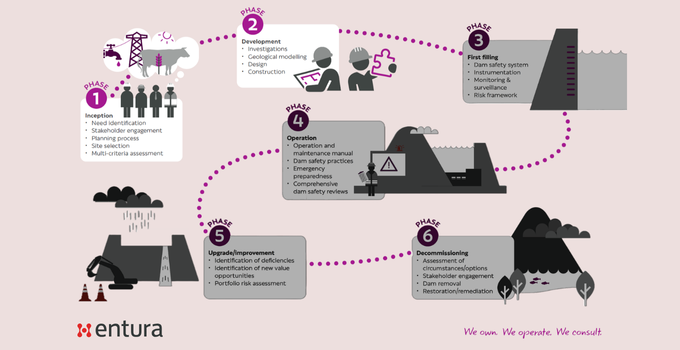
Once a dam project moves beyond the inception phase, the need has been identified, the site has been selected and the preferred option has enough confidence to proceed. The next phase, development, is where the site-specific risks identified during inception are properly understood, where a concept becomes an engineered solution, and where that solution is built to the standard the community will rely on for the next 100 years and beyond.
The big questions at this stage are managing risks, resolving the fine details of how the dam should be engineered and constructed, and ensuring that the design intent will be achieved on site. This sets a dam up for success in Phase 3 (first filling) and Phase 4 (operation).
Extend the understanding of the site
There’s no universal answer to what type of dam suits a given location. This emerges from the hydrology, geology, topography, the materials available, the hazard category and the construction constraints of that particular site. In the inception phase of the project, the preferred site and option will be identified. The development stage then tests the preferred option against the physical reality of the site.
Earlier planning should have identified the most important geological questions but will usually have avoided gathering unnecessary detail too early. Development must now unearth the right detail in the right places to reduce the uncertainties that matter – like those affecting potential failure modes and therefore the safety of the dam, cost, constructability or long-term performance. The resulting geological model informs potential failure modes, stability analysis, foundation treatment, seepage controls, excavation requirements, material selection and construction sequencing.
Consider the realities of construction
A design that’s appropriate for the site and geology and that meets the relevant standards and minimises the risk position still needs to be buildable. Some of the most valuable decisions in development are those that simplify sequencing, reduce construction risk, shorten the program, improve quality control or take work off the critical path.
Design should anticipate the realities of construction, with its dependence on weather, river diversion, site access, safety of personnel, availability of plant and materials, placement rates and quality assurance. Careful consideration of these factors early in design is more likely to result in a safe, timely, cost-effective and quality build.
Optimise and innovate to improve construction and performance
Ideally, the designer and constructor should work together to identify and implement solutions that optimise the design to improve construction outcomes. The constructor provides key inputs on cost and time savings that are integral to making such decisions to modify the design.
Similarly, the eventual dam operator should be consulted and modifications made to ensure efficient operation and maintenance over the dam’s life cycle. Formal reviews, such as hazard and operability reviews, can facilitate such input.
Design to standards and for resilience
Dam design must keep pace with evolving standards, guidelines and leading practice – however, climate change adds a new level of uncertainty. Extreme flood estimates should be treated as an uncertainty band rather than a single value. Dam designers need to make assumptions clear, test sensitivity and build in resilience where future conditions may change the risk profile. Dam owners should be consulted to ensure they are comfortable with the assumptions made.
Understanding the specific hazards for the particular dam site is important because the design of a dam needs to be robust and be able to withstand these hazards during the dam’s life.
Ensure sound technical governance
Regardless of a dam’s size or profile, sound technical governance during design and construction is crucial. An independent review panel will challenge assumptions, probe key risks and help the project team avoid blind spots – focusing on the matters that most affect dam safety, performance and constructability. Common focuses include geological uncertainties, use of unproven materials or technology, and any proposed changes during the construction phase.
The level of conservatism and technical scrutiny should be shaped by the risk profile of the dam, including the potential consequences of failure, flood hydrology, foundation conditions, seismic loading, operational requirements and downstream context.
It’s crucial for the independent review panel to include the right mix of specialists who are engaged early and maintained through to the end of construction, properly briefed, aligned in their understanding of the project objectives and the panel’s scope, and able to communicate effectively.
Provide the right people on site during construction
Having the right experience on site – people who have experienced it all before – isimportant for ensuring that construction methods are suitable and appropriate actions are taken to rectify any issues.
It’s also important to maintain a degree of continuity from design to construction, with some design support present throughout the construction phase. This ensures that appropriate action is taken when the conditions on site are different from the design assumptions and that non-conformances where works don’t meet the required specifications are resolved.
Make construction quality visible and traceable
Quality assurance in construction provides evidence that the constructed asset meets the design intent. This requires clear specifications, inspection and test plans, materials testing, compaction controls, records of foundation treatment, verification of lift joint quality and proper management of any departures from design.
Disciplined recording of quality assurance during construction is crucial for later stages of the dam’s life – including first filling, operation and maintenance, future assessments and long-term dam safety management.
Provide a suitable level of monitoring that targets key failure modes
Instrumentation design for a new dam should be based on the identified failure modes for the asset. Dam instrumentation needs to be designed so that it tells you what you need to know. This will be critical for validating the design and construction during first filling, where instrumentation can demonstrate that the dam is (or isn’t) performing as expected.
DEVELOPMENT PRINCIPLES IN PRACTICE: MEANDER DAM
Meander Dam in northern Tasmania demonstrates these principles in action. It is a 50 m-high, 43,000 ML roller-compacted concrete dam owned and operated by Tasmanian Irrigation. It was built between 2005 and 2007, with Entura involved from feasibility through to construction completion.
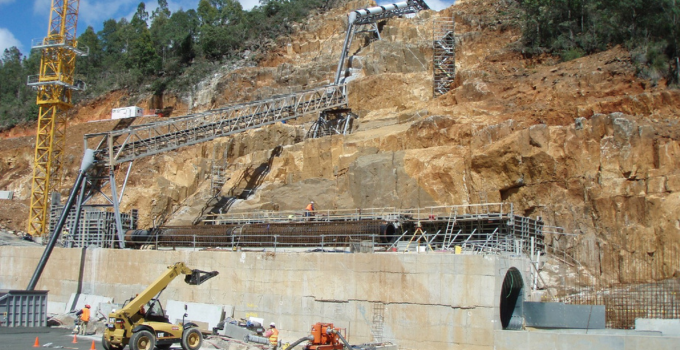
The site itself drove many of the key design decisions. The dam is located in a relatively narrow valley on the Meander River and is founded entirely on dolerite: a hard, high-strength rock that is jointed and locally weathered along joint planes. Those conditions supported the selection of a concrete gravity dam using roller-compacted concrete (RCC) that would allow significant floods to be passed through a central spillway rather than needing a large excavation into a steep abutment for a side spillway.
The geological investigations examined the access road alignment, dam footprint, reservoir area and availability of construction materials. Investigations identified that dolerite quarried near the left abutment could supply the RCC aggregate, though achieving a well-graded mix from the dolerite crushing operation proved more difficult than expected, requiring the aggregate to be supplemented with crusher dust to meet the specification.
The use of RCC allowed a more economic river diversion strategy (as the partially completed dam could be overtopped) and a faster construction program (as RCC can be placed rapidly using earthmoving-style plant rather than the slower cycles of conventional mass concrete).
A dambreak and consequence assessment also fed into the development phase. This established Meander Dam’s consequence category under the ANCOLD guidelines, which in turn shaped the level of conservatism applied throughout design and the design flood requirements.
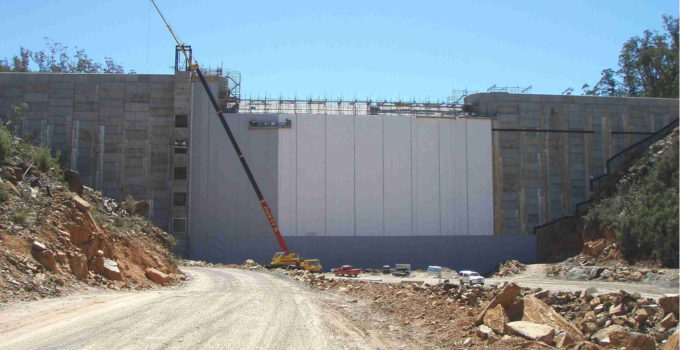
Design at Meander Dam followed ANCOLD’s Guidelines on Design Criteria for Concrete Gravity Dams, with stability checked against normal, unusual and extreme load combinations – including floods up to the Probable Maximum Precipitation Design Flood (PMP DF) and a 0.2g maximum design earthquake. Seasonal flood frequency data for the 160 km² Meander River catchment was integral to the sizing of the upstream and downstream cofferdams.
Meander Dam’s design also considered optimisation of the general arrangement to best pass large floods. A 60 m-long secondary spillway was incorporated on the right abutment (overtopping in a 1:100 AEP event), which reduced peak flood levels and therefore the height (and cost) required of the abutments – while still allowing the dam to safely pass a PMP design flood peaking at 2,630 m³/s.
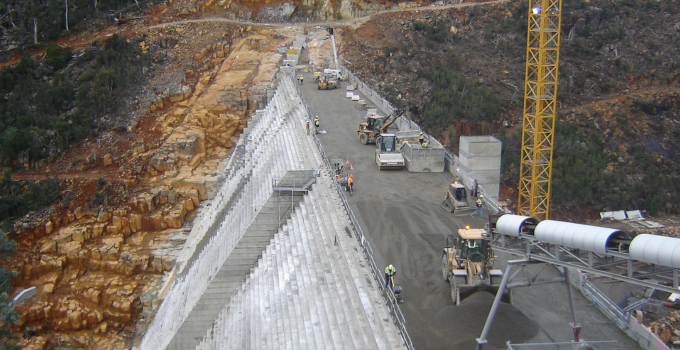
The independent reviewer played a key role in the design process and ensured that decisions were challenged appropriately. This included a detailed review of the selection of a PVC membrane most suited to installation and ongoing performance on a vertical upstream face.
A number of other construction-focused innovations were built into the design. Precast upstream panels acted as permanent formwork, speeding construction. An external, exposed geomembrane allowed RCC placement to continue without interrupting the critical path. Precast L-shaped downstream blocks doubled as spillway formwork and a durable, stepped downstream face. A conveyor delivery system on the left abutment helped minimise the time between batching and placement so the RCC could be spread and compacted within its workable window.
Each of these features was a direct response to a risk or a construction constraint identified earlier in the development phase, whether that was foundation geology, program, cost or lessons carried over from previous projects.
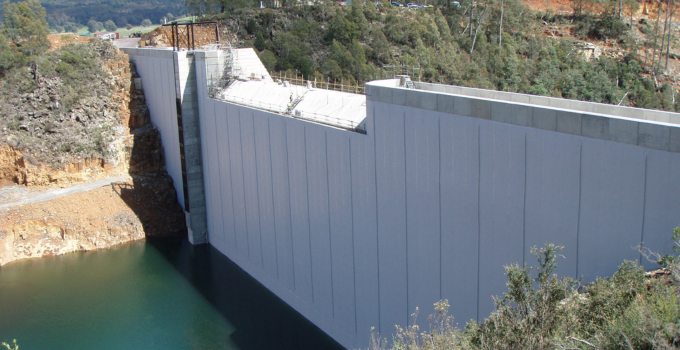
Phase 2 at Meander Dam ultimately turned a preferred option into a reliable asset. Construction was completed in 2007 and the dam continues to support reliable irrigation supply in the Meander Valley.
In our next article in this series, Technical Director Richard Herweynen will share his insights into the third stage in a dam’s life, and the first filling of Murum Dam in Malaysia and Wyaralong Dam in Queensland.To see the full picture of the life cycle of a dam – all in one place – check out this article.
ABOUT THE AUTHOR
Tim is a Principal Civil Engineer at Entura with 30 years of experience in hydropower and dams across the full asset lifecycle, including feasibility, preliminary and detailed design, construction and ongoing operation and maintenance support. His experience in roller-compacted concrete dams is highly regarded. Tim’s projects span Tasmania, mainland Australia, Malaysia, Philippines, Papua New Guinea, Uganda and Costa Rica. He leads multi-disciplinary teams and delivers complex projects that contribute to water security and the energy transition. Tim shares his expertise in technical papers, conference presentations and thought leadership articles. He mentors young professionals and promotes strong international working relationships.
14 September, 2026


 +61 427 319 887