
Life cycle of a dam – Phase 3: First filling – When a dam is tested for the first time

By Richard Herweynen
A dam’s life cycle moves through inception, design and construction through to operation and maintenance, and potentially to upgrades, decommissioning or repurposing.
In this article, Entura’s Technical Director Water, Richard Herweynen, shares his insights into the important third stage in a dam’s life – first filling – with examples from Malaysia and Queensland.
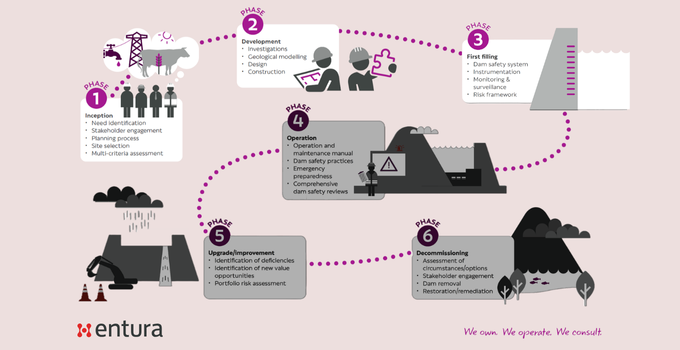
The first filling is an exciting milestone in the life of a dam but it is also one of the highest-risk stages. It is the first time the design assumptions, construction quality, foundation conditions, materials, instrumentation, operating systems and dam safety processes are tested together as a system under real water load.
In this sense, first filling sits on the high-risk side of the ‘bathtub curve’, where risk is highest at the beginning of a dam’s life and at an advanced age. However, with clear governance, well-targeted and well-functioning instrumentation, close surveillance and robust emergency preparedness, any unexpected behaviour can be detected early and investigated and managed appropriately.
Following the principles below, first filling should be a carefully managed and observed confirmation that the dam is performing as expected.
Determine readiness to impound
As construction concludes, the design manager or responsible engineer will undertake a final inspection to confirm that all engineering works have been completed to the required standard. This includes civil works, mechanical and electrical systems, outlet works, instrumentation, closure arrangements and any other systems needed for safe impoundment. Non-conformances need to be closed out or accepted through an appropriate engineering process, and the documentation needs to support the conclusion that the dam is ready to fill.
To gain a regulator’s approval to impound a reservoir, the dam owner will need to demonstrate that all relevant engineering conditions have been satisfied as well as any environmental, social and regulatory conditions.
Apply a risk-based framework to the readiness to impound assessment
Using a structured risk-based framework for the readiness to impound assessment, ensures that the attention is focused on the issues that matter prior to impoundment occurring.
The action list, often supported by a simple traffic-light system, can help owners, designers, regulators and contractors clearly understand and communicate what remains to be done, what is acceptable, and what must be resolved before filling begins. It provides a transparent and defensible basis for deciding whether a dam is ready to impound.
Check instrumentation and behaviour
First filling is the first opportunity to compare the dam’s actual performance with the behaviour predicted during design – which makes instrumentation a core focus. Before impoundment, the required instruments need to be installed, commissioned and functioning well. Depending on the dam type and the risks that need to be monitored, instrumentation may include piezometers, seepage measurement devices, deformation monitoring, settlement points, uplift pressure monitoring or other systems that are relevant to the dam’s potential failure modes. The key is not simply to collect data, but to ensure that the data is meaningful and demonstrates the dam’s actual performance as the reservoir rises.
If the dam behaves as expected, confidence grows that the design assumptions and construction outcomes are sound. Data that deviates from expectations should trigger investigation. The design engineers need to understand why the readings are different and whether any additional monitoring or responses are needed.
Seepage from an embankment dam is a good example. If seepage is observed during first filling, it’s not necessarily a cause for immediate alarm, but it must be monitored and investigated. If the seepage stabilises and remains clear, ongoing monitoring may be enough, perhaps with extra instrumentation added. If seepage increases, becomes cloudy, or is associated with movement or other concerning signs, it may indicate internal erosion, the early stages of a piping failure mechanism. In that case, a more active response is likely to be needed.
Be prepared with dam safety emergency planning
A well-designed and well-constructed dam should fill safely. However, dam engineers are inherently conservative which is appropriate, given the consequence of dam failure can be catastrophic. This is why emergency preparedness must be in place before impoundment begins.
A dam safety management plan should set out how the dam will be operated, monitored and inspected during first filling. This must clearly identify a designated dam safety manager or other responsible person. A dam safety emergency plan should also be prepared, with defined trigger levels, roles, communication pathways and escalation processes. Although there is a high expectation that the dam will perform as designed given the systems and process adopted in Phase 2 of the dam’s life, it is important to be prepared for all scenarios as this is good dam safety practice.
In practice, potentially concerning observations may move through stages of response. A minor anomaly may trigger internal review and closer monitoring. A more serious or deteriorating issue may trigger expert inspection and intervention. If the situation reaches an emergency threshold, the emergency plan must be ready to activate, including communication with emergency services and downstream communities if required.
Develop a comprehensive first filling report
At the end of first filling, good practice is to prepare a detailed first filling report. This report records what was expected, what actually happened, how the dam performed, what anomalies were observed, how they were assessed, and what baseline conditions should inform future surveillance. The first filling report is an important handover into the next stage of the dam lifecycle: operation. It provides the reference point for future inspections, instrumentation reviews and surveillance reports.
PRINCIPLES IN PRACTICE: MURUM DAM, MALAYSIA
Murum Dam is a 146 m-high roller-compacted concrete dam in Sarawak, Malaysia, and forms part of the 944 MW Murum Hydropower Project. Entura was engaged by the regulator as independent dam safety engineer to provide a holistic assessment of the dam’s readiness to impound.
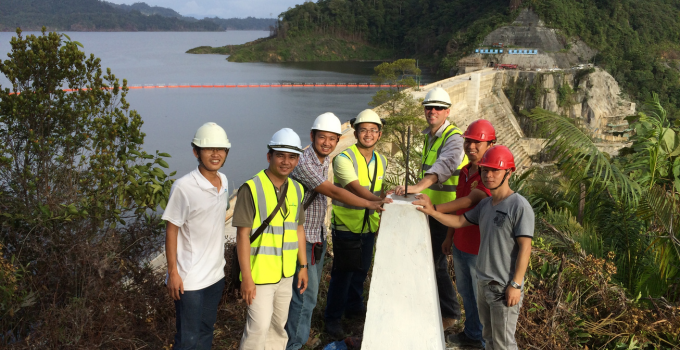
Entura’s role covered the pre-impoundment, impoundment and post-impoundment stages. The team reviewed design and construction documentation, inspected the site, identified potential failure mechanisms, and we used a risk framework to identify and prioritise key dam safety issues that needed to be addressed before impoundment could begin.
The process separated critical items from less critical items. Activities essential for safe impoundment were tracked, including physical works, dam safety systems and processes, instrumentation and emergency preparedness. Less critical items were also tracked, but were not necessarily conditions for commencing impoundment.
The risk framework helped us clearly communicate progress to the regulator for the dam’s readiness to impound. We could rate items according to their status, making it clear what remained unresolved, what was acceptable for filling, and what had been completed. Once we were satisfied from a dam safety perspective, we informed the regulator that we believed the dam was ready to impound. The regulator then considered other matters, including social and environmental issues outside Entura’s scope, before approval to impound was issued.
Murum’s reservoir took more than a year to fill, and we remained involved through first filling and into the first year of operation. Site visits and instrumentation reviews confirmed that the dam was performing as expected. At the end of that period, the dam could move into the owner’s ongoing portfolio management arrangements with confidence that it had passed through the first filling stage safely.
PRINCIPLES IN PRACTICE: WYARALONG DAM, QUEENSLAND
Wyaralong Dam in south-east Queensland was developed to improve water storage and contribute to long-term reliable water supply for the region. Entura was part of the alliance that designed the 50 m-high, 490 m-long roller-compacted concrete dam, which includes a centrally located ungated primary spillway, a stilling basin, a secondary spillway, outlet works and a fishway.
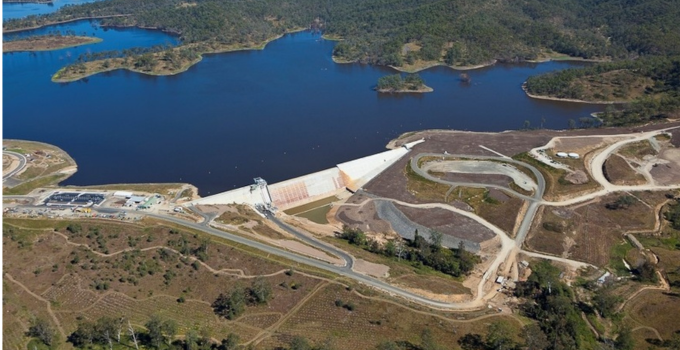
For first filling, the process followed a typical pathway from construction completion into formal impoundment approval. During construction, a design representative was on site full time to take care of any design changes as a result of actual conditions, ensure that the design was constructed in accordance with the specifications, and address any non-conformances identified. As design manager and the responsible Registered Professional Engineer Queensland (RPEQ), I signed off that the design-related requirements had been met and the dam had been constructed in accordance with the design. This included confirming that construction issues and non-conformances had been closed out, systems were in place, instrumentation was installed and operating, and the dam was ready to be closed and filled. That sign-off formed part of the submission to the regulator.
Unlike Murum, Wyaralong filled very quickly. Floods occurred soon after filling began, and within about a month the dam was spilling. This meant the dam was tested not only by first filling, but also by spillway operation very early in its life. We captured this performance in the first filling report and established a baseline for ongoing operation and surveillance.
Wyaralong shows how first filling can quickly become more than a gradual reservoir rise. Natural inflows may accelerate the process and test multiple parts of the dam and its operating systems sooner than expected. This reinforces the importance of having the engineering sign-offs, instrumentation, surveillance processes and emergency arrangements ready before impoundment starts.
In our next article in this series, Senior Civil Engineer Chris Flack will share his insights into the fourth stage in a dam’s life: the long period of safe operation and ongoing maintenance.
To see the full picture of the life cycle of a dam – all in one place – check out this article.
ABOUT THE AUTHOR
Richard Herweynen is Entura’s Technical Director, Water. He has more than 3 decades of experience in dam and hydropower engineering, working throughout the Indo-Pacific region on both dam and hydropower projects. His experience covers all aspects including investigations, feasibility studies, detailed design, construction liaison, operation and maintenance, and risk assessment for both new and existing projects. Richard has been part of a number of expert review panels for major water projects. He participated in the ANCOLD working group for concrete gravity dams and was the Chairman of the ICOLD technical committee on engineering activities in the planning process for water resources projects. Richard has won many engineering excellence and innovation awards (including Engineers Australia’s Professional Engineer of the Year 2012 – Tasmanian Division), and has published more than 30 technical papers on dam engineering.
21 September, 2026


 +61 429 705 127