
LATEST NEWS
Entura’s design innovation impresses client and contractors, making a difficult project easier
7 May, 2026
Entura’s innovative design solutions have simplified the complex replacement of a 1960s hydropower trash rack, enabling our client to balance operations and stakeholder needs.
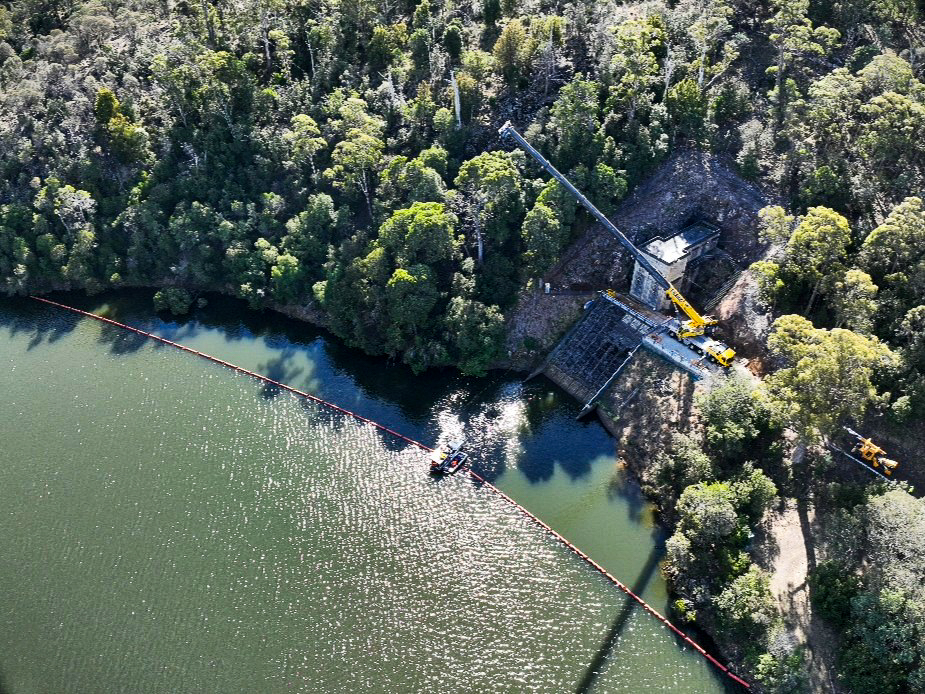
Entura was engaged by Hydro Tasmania to provide mechanical engineering input into the replacement of the trash rack that protects the Trevallyn Power Station turbines from large debris. The replacement project had an unusual set of constraints and required a unique approach.
Although replacing a trash rack would usually be easier in dry conditions, draining Lake Trevallyn was not considered an option because the shared water resource is used by Hydro Tasmania for power generation as well as by TasWater for Launceston’s drinking water, by local farmers for irrigation, and by recreational users.
Replacing a trash rack without draining a lake isn’t unheard of, but this project presented a new challenge because the original steel support beams had been cast directly into the concrete intake structure.
‘They couldn’t be unbolted,’ explained Entura design engineer Eli Pharaoh. ‘They were literally part of the concrete, so you’d have had to cut them out underwater and then somehow install something new in their place.’
The solution was a design approach that Entura had already been considering but had not yet applied in practice, known as the ‘big frame’ idea.
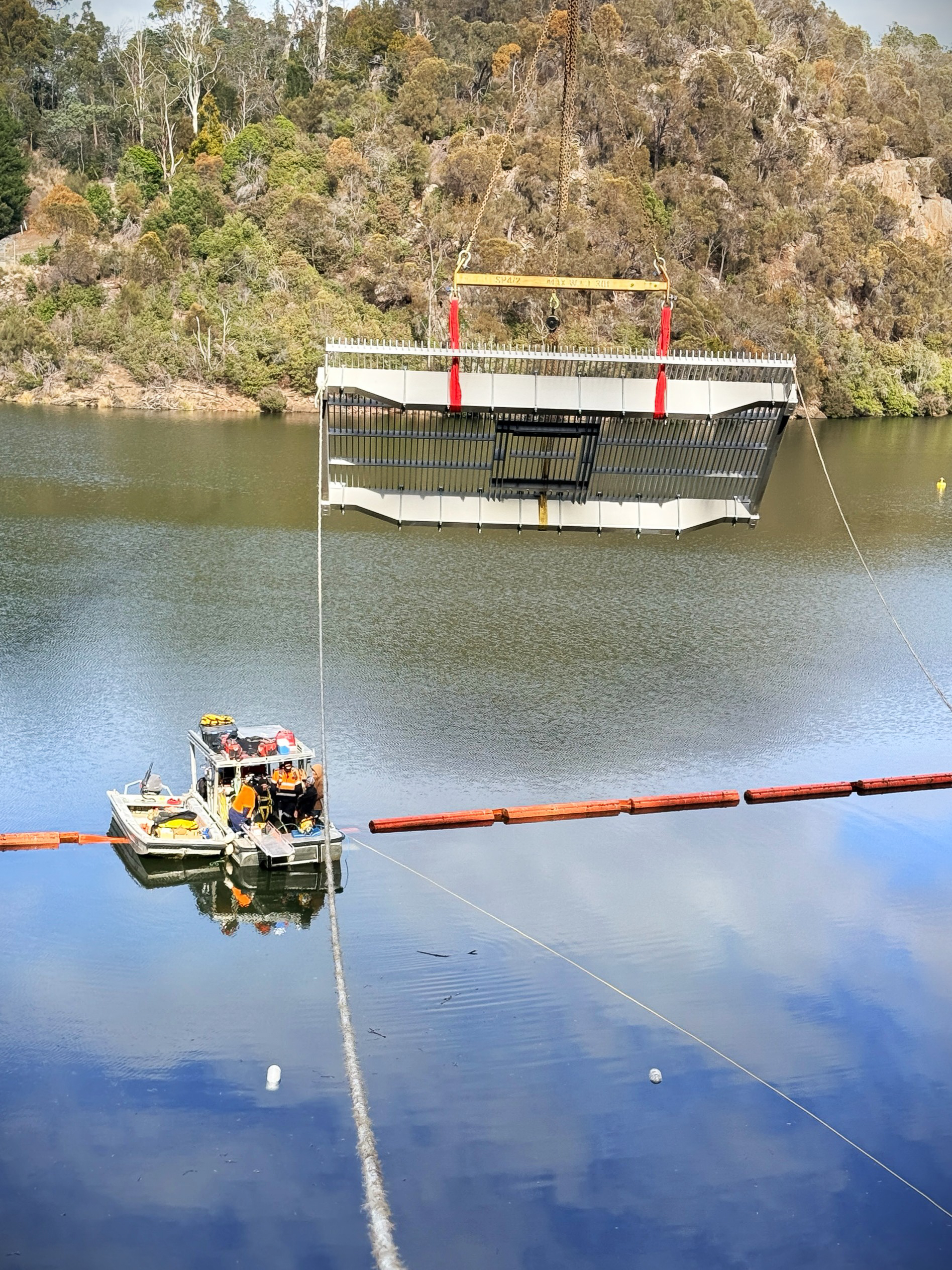
Rather than replacing the trash rack beams and panels one by one, the new design uses a 14 m by 12 m prefabricated steel frame that fits around the opening of the power station intake. The frame provides precise mounting points for the new beams and the 8 screen panels, regardless of how uneven or imperfect the original concrete might be.
‘As long as the frame goes in square, everything else lines up,’ said Eli.
Designing around divers
A specialist diving team from Tasmanian Divers Group installed the new frame, with Billings Cranes carrying out the lifting operations, lowering the frame down to divers who carefully installed it underwater.
Underwater work is difficult, slow and risky, so the design leaned heavily into reducing the amount of work required in the water.
‘Everything is harder underwater,’ Eli said. ‘The divers can’t see much more than half a metre in front of their face, they don’t have drawings with them, and everything has to be talked through from the surface. They also have to play all the roles at once: they’re riggers, fitters, welders and surveyors, and they’re doing it by feel as much as sight.’
To minimise underwater work, large sections were assembled in a workshop by The Engineering Company.
‘That alone reduced something like 150 underwater bolts down to about 30,’ Eli said. ‘Every bolt avoided is time saved and less exposure for the divers.’
Eli’s design allowed the frame to be installed while the old trash rack stayed in place. This meant the divers could work safely with one machine running to clear sediment so that they could still see, and the station could go back to full service overnight, minimising lost generation.
Dive supervisor Lachlan Osborne from Tasmanian Divers Group said, ‘I was a saturation diver for 20 years in oil and gas and I didn’t see anything this technical that went in this well and was this well thought out.’
A winning outcome
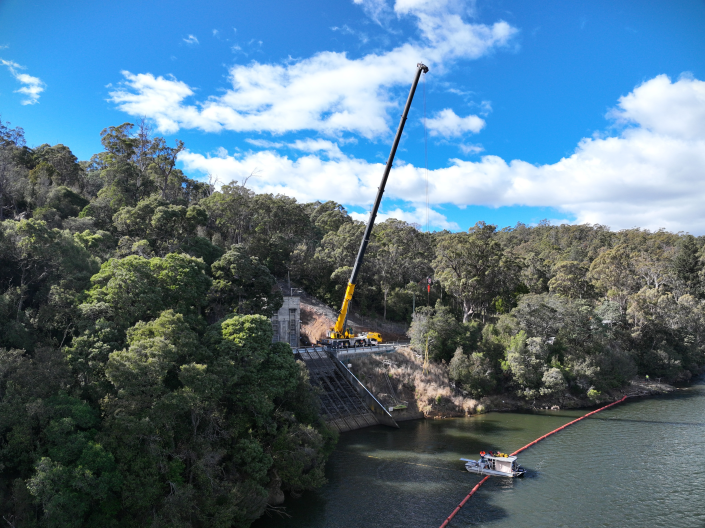
The new trash rack is now fully installed, with a special protective paint coating.
‘It’s been a win for safety, a win for operations, and a win for stakeholders,’ said Hydro Tasmania Project Manager Andrew Rumsby. ‘We’ve kept the lake functioning, kept water available, and avoided a long, costly outage.’
Eli explains that the ‘big frame’ approach won’t be right for every site. It relies on a very specific combination of constraints: shared water use, cast‑in beams and limited outage windows. But the thinking behind it can be applied more broadly.
‘It’s not a brand‑new idea,’ Eli said. ‘But taking something that existed on paper and turning it into something real under multiple constraints — that’s the innovation.’
Entura’s General Manager, Wayne Tucker, said, ‘Entura is always proud to support Hydro Tasmania and our clients throughout Australia and the Indo-Pacific with clever, practical solutions to complex asset management challenges, like this one. When we help keep hydropower assets safe and resilient, we’re building a more sustainable future.’
Note: As well as our mechanical engineering input into the trash rack replacement, our hydraulic specialists recently conducted studies relating to the implications of debris pressure on the Trevallyn trash rack. They estimated the relationship between water surface differential (between the lake level and water level in the gate shaft) versus station output (MW) to update the power station’s intake protection systems – an important contribution to preserving the integrity of the trash rack.


 +61 439 010 172