
LATEST NEWS
Entura’s expertise and efforts shine as new wind turbine blades arrive safely on King Island
5 March, 2026
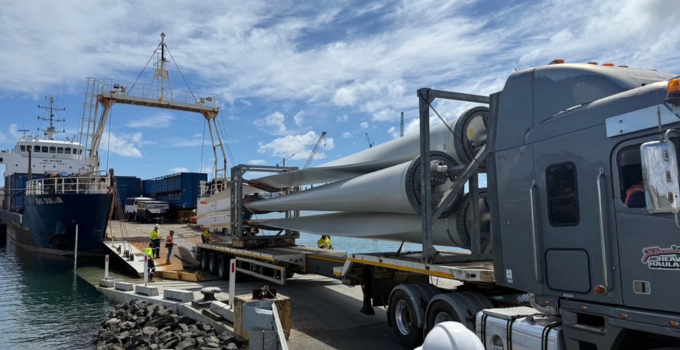
Since 2021, Entura has been integral to the repowering of the Huxley Hill Wind Farm – one of Australia’s oldest wind farms, located on remote King Island in Bass Strait (between Tasmania and mainland Australia).
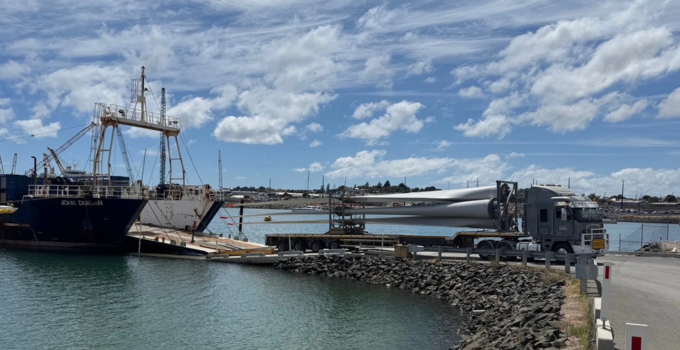
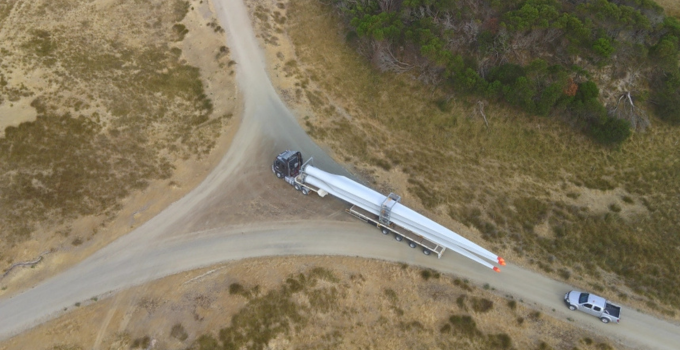
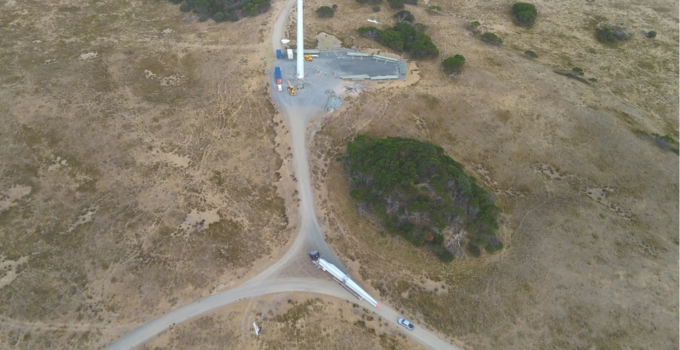
This month, a major milestone has been achieved, with the safe arrival of 3 blades, each 25 m-long, to replace the damaged blades on one of the wind farm’s 5 turbines.
On behalf of the wind farm’s owner, Hydro Tasmania, Entura has project managed the delivery process, which involved shipping the blades safely from Denmark to Tasmania’s Devonport and then on to King Island, where they have now been trucked to the project site.
This delivery allows the next stage of repair works to begin, taking the full wind farm repowering project another step further towards completion which will firmly maintain the system as a world-leading example of high-penetration renewables.
The next stage of the works on the damaged turbine includes repairing the tower and concrete foundation, replacing the nacelle with a refurbished unit and installing the new blades.
Entura Renewables Engineer Kristian Payne, who has taken on the role of project manager, says the complex logistics of transporting components at this scale required careful planning, coordination and collaboration. He adds that the transport of components is, however, only one part of a much broader project management role and of Entura’s ongoing multidisciplinary support for Hydro Tasmania’s wind, solar and energy integration assets on King Island.
Early steps: exploring turbine condition and techno-commercial feasibility of repowering
In 2021, Entura was engaged by Hydro Tasmania to conduct a feasibility study for redevelopment of the wind farm, as the 3 Nordex N29 250 kW wind turbines installed in 1998 had nearly reached end of life and 2 Vestas V52 850 kW wind turbines installed in 2003 were expected to reach end of life in 2028.
“We explored options for the power system to meet demand when the current equipment reaches end of life, and considered potential changes in demand,” says Kristian.
“We led the development of wind, solar PV and energy storage options to replace the current system, including techno-commercial modelling and a planning assessment.
“The feasibility study included a very detailed condition assessment of the turbines to make sure they could actually be repowered successfully. This involved a lot of effort from our civil, structural, geotechnical and spatial teams to be sure the investment in their refurbishment was justified.”
In 2022 Hydro Tasmania embarked on replacing the nacelle of one of the wind turbines. Entura managed the works on behalf of Hydro Tasmania including procuring the new nacelle, engaging contractors and coordinating activities such as tower condition assessment and survey, and the installation contractor’s works.
The 3 Nordex N29 250 kW wind turbines have been replaced with new nacelles and work continues to refurbish the 2 Vestas V52 850 kW wind turbines.
“We were very pleased to be able to minimise the number of new blades required for the project as most were in good condition relative to their age and required only minor repairs that could be done on site,” said Dr Andrew Wright, Entura’s Senior Principal, Renewables and Energy.
“This meant we only needed to replace the mechanical parts, gearboxes and generators. The 3 blades that have now arrived on King Island are the only ones that needed to be procured new and transported to the site. This has been a significant benefit to the project.”
Small, but not simple
Andrew says that the most complex part of the project has been identifying, selecting, engaging and managing the huge range of contractors and equipment involved in the project, from crane operators and excavators to people doing paint repairs and blade repairs, specialists in corrosion protection, structural engineers, materials specialists and more.
“Even though there are only several turbines rather than the dozens a big wind farm might have, this project still has a great deal of complexity, especially managing to secure contractors in a remote environment and without the economies of scale of a larger project,” he says.
“The weather was also a significant challenge because it restricted the windows of opportunity to achieve certain tasks with all the right people together on site.”
Ongoing efforts to enhance King Island’s energy system
The wind turbines contribute renewable energy to King Island’s hybrid off-grid power system, which includes wind, solar, battery energy storage and other enabling technologies. Entura’s people have been involved in the innovative project ever since the first wind turbines were installed in 1998. The system is among Australia’s earliest examples of remote high-penetration hybrid renewable energy systems and is capable of achieving significant periods of 100% renewable penetration. This was a world-leading breakthrough at the multi-megawatt scale.
More recently, to add 1.5 MW of solar PV into the system, Entura undertook the project management and tender process on behalf of Hydro Tasmania, including design reviews; allocating responsibilities and coordinating interfaces between parties; scoping, designing and coordinating the high-voltage connection package; monitoring the contractor’s performance; and commissioning the solar farm.
“We’re very proud of our role in delivering the recent upgrades to King Island’s wind farm and the new solar farm, which will help maintain the sustainability, security and reliability of King Island’s power system and enable the island to continue its record of greenhouse gas reduction and zero-diesel operation,” says Andrew.
Applying local learnings to other remote places
“What we learned from our ground-breaking success on King Island, we then applied to the Flinders Hybrid Energy Hub, and we didn’t stop there,” says Andrew.
“We applied our Bass Strait experience, multidisciplinary expertise and ongoing innovation to isolated communities including Coober Pedy and Rottnest Island, as well as on a number of Pacific islands and at remote sites. And we continue supporting the decarbonisation of a number of Australian mining operations, such as the Agnew Hybrid Renewable Energy Project in Western Australia.
“These hybrid systems are providing clean, reliable energy and reducing reliance on diesel fuel – with its high carbon emissions, volatile prices and challenging logistics.”
The King Island renewable energy system can be viewed in real time via an app developed by Entura, at
https://www.hydro.com.au/our-energy-system/our-power-stations/bass-strait-islands.
Facing the challenges of aging
Andrew says that wind farm owners should explore repowering opportunities long before equipment deteriorates.
“Given that wind farms usually have a design life of anywhere between 15 and 30 years, many of the early wind farms are now reaching retirement age, so we’ll be seeing many more wind farms beginning to grapple with the options to decommission, rejuvenate or repower,” he says.
“We suggest that owners of older wind farms act now to deepen their understanding of the condition and present value of their assets, and explore the full range of short-term and long-term options available through a feasibility and options study.
“In such a dynamic market and technology landscape, and with the potential for aging assets to deteriorate or fail more quickly than expected, it’s better to be prepared early for possibilities and implications.”
For more on Entura’s work on King Island, read our case studies:
King Island Renewable Energy Integration Project
King Island’s Huxley Hill Wind Farm and Solar Farm
King Island Wind Farm verticality survey
For more insights on wind farm repowering, read our thought leadership articles:
Is there still a role for small wind turbines in hybrid systems?
Breathing new life into Australia’s aging wind farms
To learn more about Dr Andrew Wright, check out his podcast in Entura’s Behind the Scenes series.
To talk with us about wind repowering, contact Andrew Wright, Patrick Pease (Australia) or Shekhar Prince (Indo-Pacific).


