
Hydraulic modelling for central Hobart flood mitigation
Client: Hobart City Council
Location: Tasmania, Australia
Services: Detailed survey, Hydraulic assessment and design, 3D computational fluid dynamics (CFD) modelling
Applying CFD modelling to resolve urban flooding issues and de-risk the design of critical stormwater upgrades.
Background
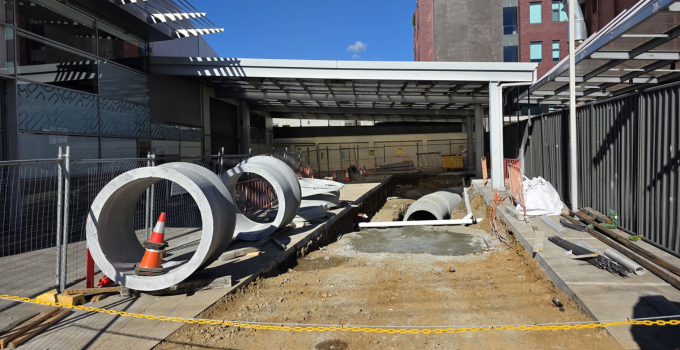
As part of a building development near 250 Murray Street, an existing DN1050 concrete circular pipe was replaced with a 1500 × 1500 mm reinforced concrete box culvert (RCBC). Following the upgrade, surface flooding was observed during large rainfall events, which exceeded what had been anticipated in the original system.
The flooding was identified as surcharging from a downstream manhole where the new box culvert transitions into a circular DN1200 reinforced concrete pipe located within an adjacent private car park. The interaction between the box culvert, downstream pipework and side‑entry connections created complex hydraulic behaviour that could not be readily explained using conventional 1D or 2D hydraulic modelling approaches.
Hobart City Council found high construction costs to replace the DN1200 with a box culvert, leading the Council to investigate the issue of the pits efficiency to provide a more cost-effective solution. The Council required a detailed investigation of the hydraulic performance of the upgraded culvert system and identification of practical options to reduce surcharging and improve flood performance.
Solution
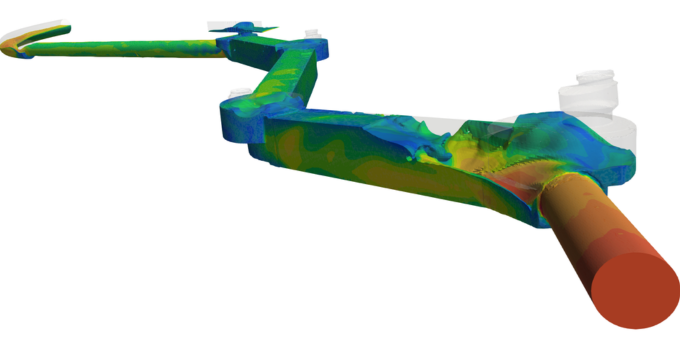
Entura undertook a detailed hydraulic investigation using 3D computational fluid dynamics (CFD) modelling to diagnose the flow behaviour within the box culvert and downstream transition.
High‑resolution spatial data was a critical input to the modelling. Entura’s spatial team completed a detailed laser scan of the box culvert, providing an accurate representation of internal geometry, transitions and surface features. This dataset was used to develop a 3D CFD model capable of resolving complex flow patterns that are not captured in simplified hydraulic models.
The CFD model was run across a range of flow conditions to assess hydraulic restrictions, internal flow behaviour and the influence of downstream controls. The modelling identified complex internal flow patterns at moderate to high flows, including lateral sloshing of the water surface around bends and sensitivity to whether side‑entry pipes were vented to atmosphere.
A series of conceptual design options were then tested within the CFD environment, including alternative manhole geometries, lining the box culvert with a circular formliner, and duplication of the downstream culvert incorporating a hydraulically efficient bifurcation and confluence.
Outcome
The CFD modelling demonstrated that the observed surcharging was driven by complex three‑dimensional flow behaviour and downstream constraints that would not have been identified using traditional 1D or 2D modelling alone.
By testing multiple design options in the CFD model, Entura was able to provide Hobart City Council with recommendations to improve hydraulic performance. The preferred solution involved duplication of the downstream culvert with an improved bifurcation and confluence arrangement, which offered the most effective reduction in surcharging risk.
The client has since progressed to detailed design based on this option with construction underway, using the CFD results as a robust technical basis for decision‑making and stakeholder confidence.
Key benefits
- Identification of complex internal flow behaviour not captured by conventional modelling
- Targeted use of high‑resolution spatial data to improve model accuracy
- Efficient testing of multiple mitigation concepts within a CFD framework
- Clear options to improve flood performance and reduce surcharging


 +61 409 270 816