
Making defensible dam engineering decisions in an ever-changing world

New technology, evolving climate science, aging infrastructure and workforce turnover are reshaping what it takes to design, assess and manage dams responsibly.
In this article, two of Entura’s dam professionals outline key considerations that today’s dam engineers should keep firmly in mind when making dam engineering decisions.
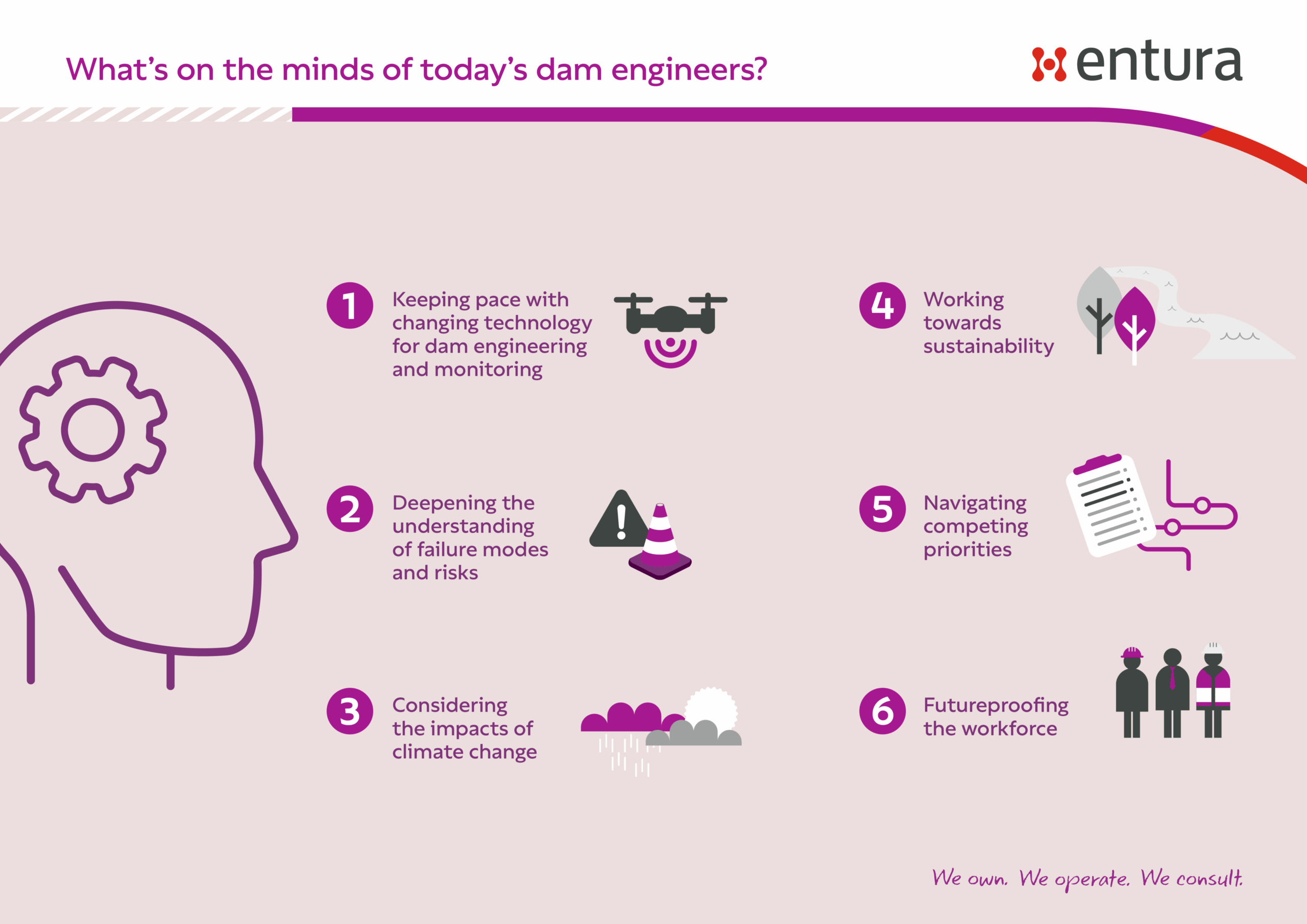
1 Keeping pace with changing technology for dam engineering and monitoring
Dam engineers now have access to far greater computing power and analytics than ever before, which means we can estimate extreme flood behaviour, seismic loads and complex structural responses in unprecedented detail.
But, as the saying goes, with great power comes great responsibility. Highly sophisticated models can create a false sense of certainty, but models are only as good as their inputs and assumptions. It’s up to us as dams engineers to use sound engineering judgement to interrogate model reliability, to identify uncertainty and to understand the limitations of the modelling in decision-making.
Advances in monitoring and surveillance have been equally rapid and sophisticated, with remote sensing and automated, near-real-time data acquisition allowing earlier and more precise detection of potential issues. The challenge, though, is managing an immense flow of data to filter and interpret.
Artificial intelligence (AI) could be a game changer for efficiently collating and interpreting data, helping detect trends and anomalies. However, using AI as a decision-making tool has limitations and its outputs could be misleading. There’s also a risk that overreliance on AI could erode our opportunity to independently exercise and apply professional engineering judgement.
Against a backdrop of advancing technology, dam engineers must still bring a holistic understanding of a dam’s underlying design philosophy, the performance of structures under various load conditions, and the impacts of construction practices on dam behaviour.
2 Deepening the understanding of failure modes and risks
Risk-based dam safety practices are now firmly embedded in Australian and international dam safety guidance. Failure modes analysis and risk assessment form the foundation of prioritised risk-based dam safety surveillance programs and dam design.
Assessing failure modes demands a multidisciplinary perspective and collaboration. Geological and foundation conditions, climate conditions and the implications of construction sequences and historical modification could result in vulnerabilities that are not apparent in routine inspections.
Tools such as LifeSim and TotalRisk quantify social, economic and environmental risks – which can help inform, justify and clearly communicate decision-making about the timing and scope of risk mitigation works.
3 Considering the impacts of climate change
For dam engineers, consideration of environmental factors is nothing new. However, the potential for significant changes in climate, and the consequences of these changes and associated uncertainty, are increasingly important and complex concerns.
Updated climate projections and hydrological guidance, including the most recent update to Australian Rainfall and Runoff (Ball et al. 2019), have altered design flood estimates in many regions. In some cases, this has reduced flood capacity margins and prompted reassessment of spillway adequacy and flood tolerability for both near-term and long-term climate scenarios.
In addition to increased rainfall expectations, we also need to consider the impacts on dams during prolonged periods of low rainfall, such as drying and cracking of the clay core material in embankment dams.
Today’s dam engineers need to consider a wider range of plausible future scenarios and engage explicitly with uncertainty across the asset’s remaining life.
4 Working towards sustainability
Sustainability is an increasing focus for dam owners and regulators. Dam upgrade and remediation projects need to consider expectations around reducing carbon emissions, lowering the environmental footprint, and improving the process and outcomes for local communities.
For dam engineers, this means thinking beyond traditional approaches and being prepared to challenge long-held assumptions. Can the construction and carbon footprint be reduced? Can existing materials be reused onsite to reduce haulage and waste? Are there options to improve safety outcomes? How can works be designed to improve, rather than degrade, local biodiversity or downstream environments?
To answer these questions, we need to engage as early as possible with industry best practices, and collaborate with environmental specialists, experts in carbon accounting, peak standards bodies and stakeholders. We should also learn from projects that are demonstrating innovation and successful outcomes.
5 Navigating competing priorities
Scrutiny by the community, stakeholders and dam safety regulators with respect to the safety and sustainability of dams and upgrade works continues to increase, but at the same time many dam owners face constrained budgets and competing priorities across their infrastructure portfolio, which may mean staging dam upgrades.
Many large dams are now more than 50 years old and may be inadequately monitored or in need of remediation works. However, the limited budgets of public and private sector dam owners can constrain their ability to fund comprehensive surveillance programs and dam safety remediation works.
Dam engineers, therefore, have a complex advisory role. Our recommendations need to be risk‑informed, prioritised, staged where appropriate, and defensible in technical, economic and societal terms. Clear communication of residual risk, uncertainty and long‑term implications is critical.
As in any infrastructure project, meaningful engagement with communities and stakeholders can improve the process and the outcomes. Explaining clearly why certain works are prioritised, how risks are being managed, and what communities can expect during upgrade construction grows trust and can help defuse conflict. This may not sound like the role of the engineer but it is our inputs, translated into plain language, that will help create accessible, honest narratives that help stakeholders and communities understand what’s happening and why.
6 Futureproofing the workforce
Ultimately, safe and sustainable dams depend as much on skilled and experienced people as on technology. But a global skills gap is emerging as experienced dam engineers retire, taking with them invaluable institutional knowledge of older assets, construction practices and surveillance practices and priorities. This is certainly the case in Australia, given that new dam construction has declined steeply over the last few decades, reducing opportunities for first-hand experience.
Preserving design knowledge, construction understanding and institutional memory is important, and it won’t happen by accident. Investing in mentoring and knowledge transfer will be key to ensuring that younger and emerging dam engineers learn as much as possible from experienced senior engineers before they retire. Tailored training from experienced engineers and providers can also help bridge context gaps. Where local experience is limited, there may be opportunities to draw on international expertise or related industries.
We encourage all dams engineers to get involved in industry initiatives led by organisations such as ANCOLD and Engineers Australia, including emerging professional networks and mentoring programs, so that together we can grow capability across our sector.
ABOUT THE AUTHORS
Jaretha Lombaard joined Entura as a Senior Dams Engineer in January 2024. She has a range of experience in dam and water resource engineering in Southern Africa and Australia. She is experienced in numerous aspects of dam engineering, including dam design, tender and construction support, dam safety assessments and inspections. She has also been involved in developing dam safety emergency management plans, operations and maintenance manuals, and is actively involved in facilitating dam safety training through the Entura Clean Energy and Water Institute (ECEWI). Jaretha has taken lead roles on various projects, including as the design manager for the Bradys Dam upgrade and Meadowbank Dam upgrade projects.
Sally Fracalossi is also a Senior Dams Engineer. She joined Entura’s Dams and Geotech team in 2020, following 5 years in a multinational private consultancy where she gained a broad civil engineering and project management experience. Sally is experienced in numerous aspects of dam engineering, including dam design, dam safety assessments and inspections, risk assessment and construction support. She has also been involved in developing dam safety emergency management plans, operations and maintenance manuals, and is actively involved in facilitating dam safety training through the Entura Clean Energy and Water Institute (ECEWI). Sally was project manager for TasWater’s dam safety surveillance program which encompassed over 50 referable dams in the north and south of the state during 2020–22.
11 June, 2026


 +61 427 319 887