
Life cycle of a dam – Phase 1: Inception – Setting a dam project up for success

By Jaretha Lombaard
A dam’s life cycle moves through inception, design and construction through to operation and maintenance, and potentially to upgrades, decommissioning or repurposing. In this first article in our forthcoming ‘Life cycle of a dam’ series, Senior Civil Engineer Jaretha Lombaard shares her insights into the important first stage in a dam’s life, and how a strong inception stage has shaped a new pumped hydro project proposal.
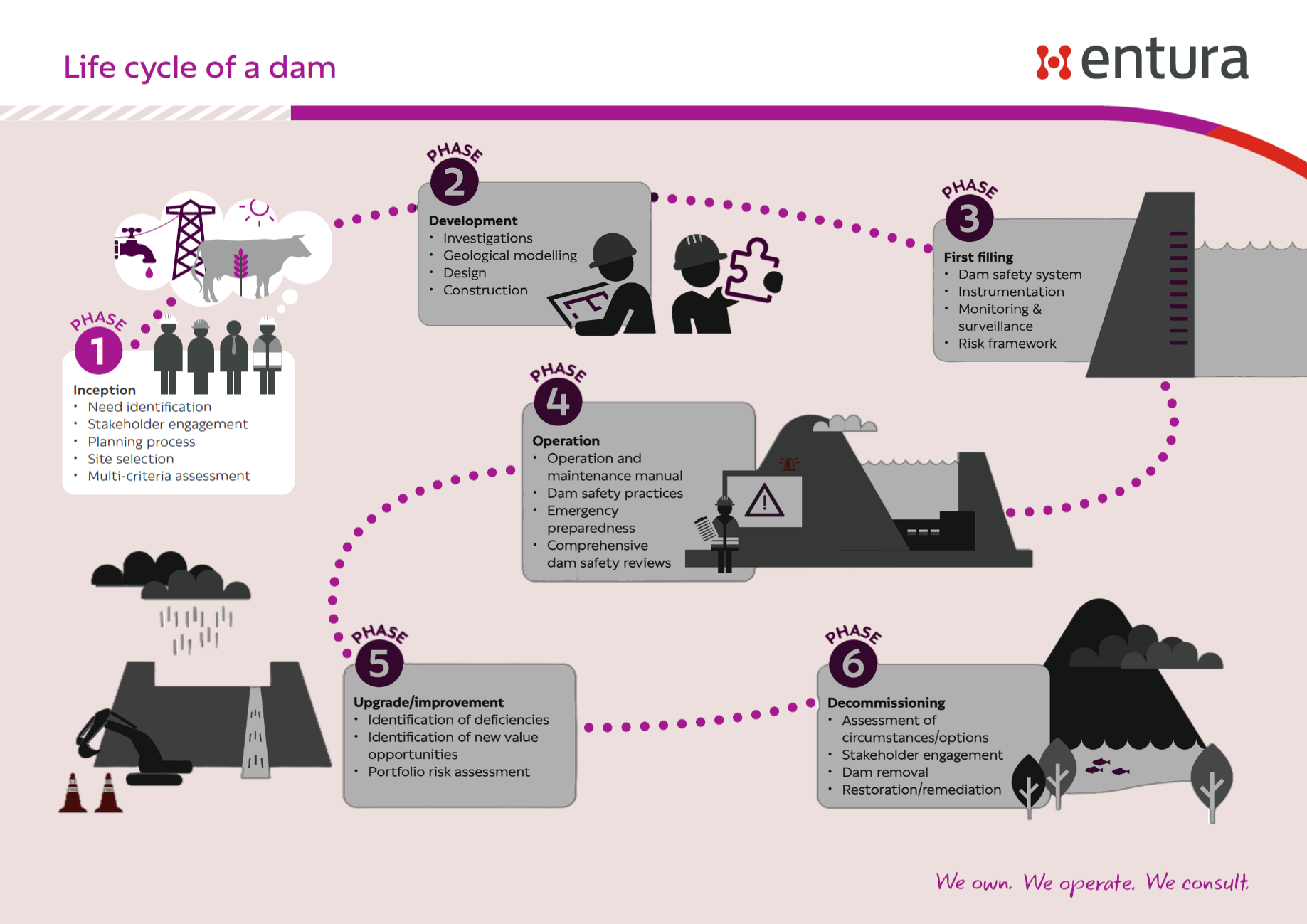
Infrastructure’s ability to successfully serve communities for generations depends heavily on good beginnings. To me, a ‘good beginning’ for dam-specific projects looks like this:
Know your ‘why’
The first step in any infrastructure project is usually to clearly define needs, objectives and key benefits. In the case of water and energy infrastructure, the need may be residential, industrial or environmental water supply, irrigation, flood mitigation, river regulation, energy generation and storage, or a combination. Once the need is clear, we should explore the best way to meet the need – rather than assume that a dam is necessarily the right answer. If the ‘why’ is unclear, momentum can build around a technical solution before the real objective has been tested. When the ‘why’ is clear, every subsequent decision has a stronger basis.
Start broad
If the right answer is a dam, we now need to probe deeper – from the ‘why’ to the ‘where’, ‘how’ or ‘what’. This is the time to brainstorm a range of high-level options and then investigate whether they’re technically feasible, practical and capable of meeting the project’s objectives. How much water, energy storage or flood mitigation is required? How often must water or energy be available? Should we be considering a smaller or larger storage, an off-stream storage or a multipurpose project? Where could the dam be located? What type of dam could suit the available sites? Can the project be safely constructed? What are the main environmental and social constraints, and the possible risks?
Align multidisciplinary expertise
Engineers should work alongside geologists, hydrologists, environmental scientists, ecologists, heritage and social specialists and dam safety practitioners from the earliest stages so that potential impacts can be identified early and addressed right from the start. The planning and concept stages have the greatest influence on a project’s long-term outcomes. This is when decisions about site selection, dam type, reservoir level, spillway configuration, operational rules and mitigation measures are still open to improvement. Once the project moves into later phases, changes become more constrained and often more costly to implement.
Engage stakeholders early
Stakeholder alignment should always begin early to confirm the need, identify constraints and priorities, reveal local knowledge and alternative ideas, and test whether options are likely to be acceptable. Some stakeholders may seem less prominent at first but could become highly influential if their needs or concerns are missed. Once stakeholders are aligned, it’s important to ensure transparency and ongoing communication to build and maintain trust.
Gather the right level of information at the right stage
Options need to be developed to a comparable level. Too little information makes meaningful comparison difficult. Too much detail wastes effort on options that may not proceed. The focus should be on the factors most likely to determine the preferred option, such as technical feasibility, environmental and social impacts, constructability and approvals risks. Effort should be spent where and when it will make the biggest difference to the outcome. This means focusing on the key knowledge gaps and risks that will drive the technical feasibility, cost, delivery timelines, and stakeholder acceptability.
Carefully size and stage investigations
Geology and geotechnical characteristics are key inputs for early decision-making around technical feasibility and cost of a dam project, but the timing and scale of investigations need to match the maturity of the project. A staged investigation program may begin with desktop geological and topographical reviews, engineering geology site walkovers, and non-destructive, low-impact methods such as geophysical surveys and geological mapping. As the options narrow, more intrusive investigations such as test pitting and drilling can be targeted where they will provide the most value. Drilling too early can create its own problems. If too many options are still under consideration or general site conditions area not yet well understood, investigations may need to cover a very large footprint, which means more cost and more disturbance. A staged approach helps balance decision-making needs, investigation costs, and risks by progressively refining the understanding of site conditions as the project matures.
Use a consistent, defensible method to compare options
A structured, risk-based multi-criteria analysis can help compare options more transparently by keeping material risks visible. High risks should not disappear within averaged or low weighted scores. Decision-makers need to see the trade-offs clearly, especially where environmental, social, technical and financial considerations point in different directions. The strongest options are usually those that perform consistently across multiple criteria. They may still have uncertainties, but those uncertainties are understood, recorded and can be effectively managed.
Keep good records
Dam projects often span many years, during which project teams, stakeholders and decision-makers, as well as regulations, can change. A well-maintained record of decision-making is essential. It provides transparency and rationale around why options were excluded, preferred pathways selected and constraints addressed, including the risks, uncertainties and opportunities that influenced those decisions. It also reduces the likelihood of revisiting issues that have already been assessed.
Involve independent reviewers early
An independent reviewer or review panel can be one of the most valuable contributors during project inception and development. The individual or panel should have the right balance of technical expertise, be able to communicate well in a collaborative manner, understand their scope of work and be well briefed. An early and ongoing engagement enables reviewers to develop a strong understanding of the project’s original ‘why’s, ‘what’s and ‘how’s, enabling them to provide informed advice and constructive challenge throughout project development.
Don’t try to do everything at once
Not every detail needs to be resolved to 100% when comparing potential options or even once the preferred option has been established. That resolution and optimisation can happen in the ‘detailed design’ phase, which we’ll talk about in our next article. However, by the end of the preliminary design or ‘reference design’, the preferred option should be workable, costable and suitable for approvals and investment decisions, with the key aspects robust enough for the project to move forward with confidence.
INCEPTION PRINCIPLES IN PRACTICE: THE PROPOSED CETHANA PUMPED HYDRO PROJECT
The proposed Cethana pumped hydro project in Tasmania is a large energy storage project with a generating capacity of 750 MW and a storage capacity of 20 hours. It proposes using the existing Lake Cethana as the lower storage and building a new upper storage, underground power station, and underground tunnels connecting the storages. If approved, it will be the first pumped hydro project in Tasmania.
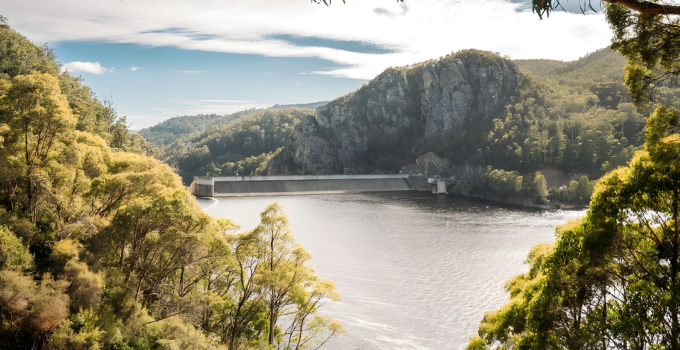
The inception phase of the project demonstrates how the principles discussed in this article have been applied in practice.
Entura contributed to the prefeasibility and feasibility studies that identified 14 possible pumped hydro sites in Tasmania and narrowed these to the three most promising, and then to Lake Cethana as the preferred option for final feasibility. The options were assessed against technical, environmental, social and economic factors using multicriteria analysis. The Lake Cethana option was selected as the preferred project option because it offered deep storage capacity, greater cost certainty, less potential environmental and social impacts, and more flexibility in sizing and capacity.
By the time I became involved, the upper storage site had already been selected, but there were still aspects to resolve. My focus was on revising the layout and embankment material zoning of the upper storage so it could best fit the available space, reduce the environmental impacts, balance cut and fill volumes, reduce spoil, preserve the required storage volume and hydraulic head, and maintain efficient flow to the intake.
An understanding of the geology and geotechnical conditions was central to refining the layout and internal embankment zoning. Some areas included highly compressible soils which directly informed the quantity of material to be excavated and spoiled, the construction phasing required to limit post-construction settlement to acceptable amounts, and ultimately construction cost estimates.
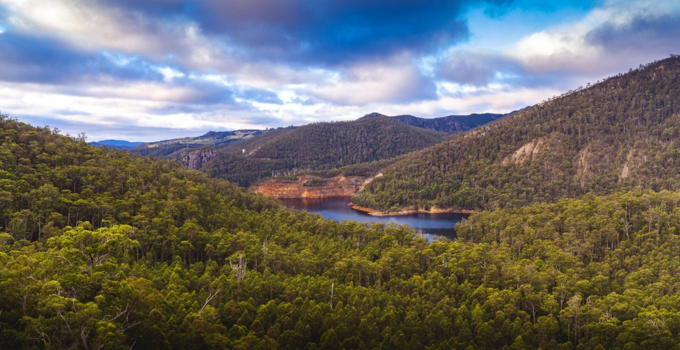
The outcome was a reference design for the upper storage that supported the overall project cost estimate, based on available information, and provided a clearer understanding of the key considerations for the next stages of design.
The team did not need to solve everything at this stage of the design, but it did need confidence that the main concept would work. For example, the project needed a technically sound and workable approach to lining the storage, maintaining the liner, monitoring performance and detecting potential leakage. Although some opportunities for improvement were carried forward to the future stages of the design process, the fundamentals needed to be strongly in place at this stage.
This is the purpose of inception: It should move a project from a broad need to a robust and defensible preferred option. At its core, inception is about progressively reducing uncertainty, allowing decisions to be made with increasing confidence while keeping options open long enough to identify the best path forward. When done well, it provides owners, stakeholders and reviewers with confidence that the project is worth taking forward.
In our next article in this series, Principal Civil Engineer Tim Griggs will share his insights into the second stage in a dam’s life and how a rigorous development phase led to the successful completion of Meander Dam.
To see the full picture of the life cycle of a dam – all in one place – check out this article.
ABOUT THE AUTHOR
Jaretha Lombaard is a senior dams engineer with more than 12 years of diverse experience across southern Africa and Australia. Her expertise includes dam design, tender and construction support, dam safety assessments and inspections, with a strong focus on safe, sustainable infrastructure. Since joining Entura, she has contributed to major projects including as design manager for major dam upgrades. She is highly regarded for her commitment to technical excellence, leadership, proactive problem solving and collaborative delivery. Passionate about best practice, continuous improvement and professional growth, she actively supports mentoring, knowledge sharing and training.
3 September, 2026


 +61 427 319 887