
Life cycle of a dam – Phase 6: Decommissioning – Ending well

By Joey Scicluna
This article completes our ‘Life cycle of a dam’ series, which has explored inception, development, first filling, operation and upgrades and now turns to decommissioning.
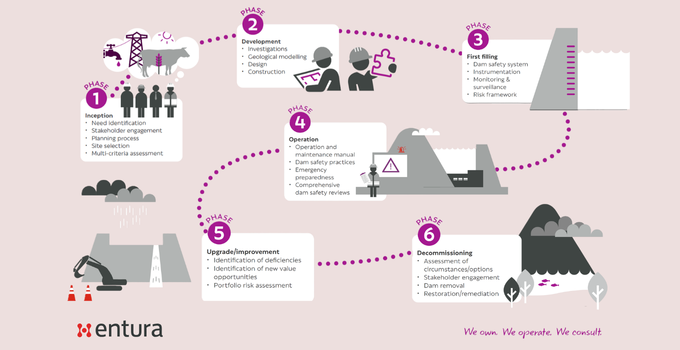
An asset may eventually reach a point where its future needs to be reconsidered. A dam may no longer serve its original purpose, safety risks may have increased, or the cost of maintaining the asset may outweigh its benefits. In some cases, the most responsible decision isn’t another upgrade, but bringing the asset’s operational life to a close.
When it becomes the right option, decommissioning isn’t a sign that a dam has failed. It’s simply another stage in the life cycle, requiring the same planning, risk-based decision-making and long-term considerations as every phase that came before.
The dam owner must return to some of the same questions considered at the start of the project: What outcomes are we trying to achieve? What risks are acceptable? How will the surrounding environment and community be affected? What legacy do we want to leave?
Conduct a risk assessment
The decision to decommission a dam is usually informed by a comprehensive risk assessment. These assessments identify potential hazards and failure modes, evaluate the likelihood and consequences of failure, assess whether risks are as low as reasonably practicable, and compare the effectiveness of potential risk reduction measures.
In many cases, the preferred outcome will be an upgrade rather than decommissioning. When upgrade options are being assessed, however, decommissioning is often evaluated alongside them. This allows owners to compare not only cost, but also the level of risk reduction achieved, future operational requirements and the long-term value of each option. The objective is to identify the option that delivers the greatest long-term benefit for owners, communities and the environment.
Assess the options and the broad context
The options assessment is rarely based on engineering considerations alone. Over decades of operation, a dam becomes part of a wider environmental, social and economic system. It influences waterways, ecosystems, recreation, cultural heritage and nearby communities. Removing a dam therefore requires an understanding of how these interconnected systems may respond.
Successful decommissioning balances engineering requirements with environmental, social and heritage considerations. Cost, future operational requirements, environmental impacts, community expectations and the degree of risk reduction achieved all contribute to the final decision. Achieving the best outcome often requires input from engineers, hydrologists, environmental scientists, heritage specialists, planners, regulators and stakeholders to ensure the project is technically sound while also delivering broader environmental and community benefits.
Design for a new condition
Before deciding how to remove the dam, the project team needs to define the future landscape and what the site should become. Some projects focus on restoring natural landforms and river processes; others create new community assets. Whatever the objective, it should be established early to inform the design process.
The engineering challenge is to create a sustainable, low-risk future condition. This may involve determining the appropriate breach width and geometry, modifying or removing outlet works, assessing downstream flood behaviour, managing inflows during construction, and controlling erosion and sediment movement. A dam may also provide incidental flood mitigation even when that was not its primary purpose, so it’s important to understand the downstream hydraulic consequences of removal.
Sediment requires particular attention. Reservoirs can contain deposits accumulated over decades, and exposing or remobilising them may affect water quality, river stability and downstream habitat. The design therefore needs to consider how sediment will behave, how the waterway will adjust and how vegetation, ecological restoration and future community use will be established within the former reservoir.
Manage the transition carefully
Even a well-developed design can’t anticipate every condition that could emerge during decommissioning. Lowering the reservoir may expose sediment deposits, previous drainage paths or site constraints that affect how the works should proceed.
Careful staging, monitoring and construction supervision allow the project team to test assumptions against actual site conditions and adjust the works where necessary. This adaptive approach is particularly important while flows are being redirected, landforms reshaped and rehabilitation established. It helps manage short-term construction risks without losing sight of the site’s intended long-term condition.
Leave a positive legacy
When decommissioning is the appropriate option and is done well, it should leave behind a site that remains safe and functional. It’s also an opportunity to consider how the site itself could continue to provide value in new ways. The dam may have reached the end of its operational life, but the site itself can continue to provide value in new ways.
PRINCIPLES IN PRACTICE: TOLOSA DAM
The decommissioning of Tolosa Dam demonstrates how the final chapter of a dam’s life can become the beginning of something entirely different. Entura supported this project with multidisciplinary services from start to finish.
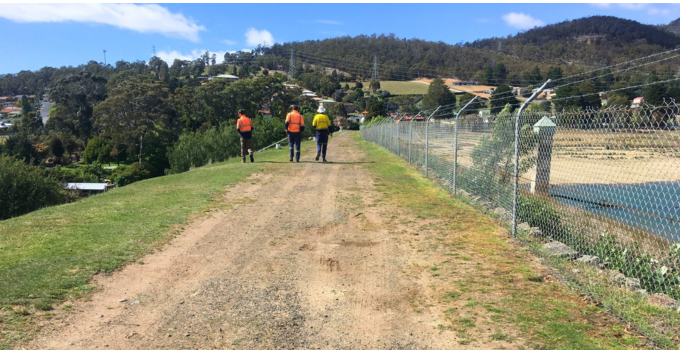
Constructed in 1880 and later raised in 1915 and 1922, the dam had long since fallen into disuse as a water supply asset. Risk assessments found it no longer met contemporary safety requirements and needed to be removed. The central question was what role the site should play in the future.
Located beside residential neighbourhoods, a school and existing public open space, the reservoir occupied land with significant community potential. TasWater’s decision to decommission the dam and return the land to Glenorchy City Council created an opportunity to rethink the site and its purpose.
The work involved environmental and heritage assessments, erosion and sediment control planning, rehabilitation planning, hydraulic investigations and stakeholder engagement alongside engineering design. As plans for the future parkland evolved, the decommissioning design evolved alongside them, ensuring that the future use of the site shaped the way the works were undertaken.
An important part of the process was recognising that although the dam had reached the end of its operational life, its history still mattered to the community. Rather than removing every trace of the former reservoir, sections of the embankment were retained and incorporated into the final park design. Visitors can still understand the footprint of the original dam and its role in Glenorchy’s development. Five ornamental ponds were also incorporated into the landscape, maintaining a connection with the site’s water management history.
This project highlights the importance of carefully managing transition. Water, sediment and erosion required active management throughout construction. The site’s landforms were progressively reshaped to direct runoff towards temporary sediment-control ponds, allowing water quality to be managed while works proceeded. Construction supervision ensured that the works aligned with both regulatory requirements and the broader objectives for the site’s future use.
Today, the former reservoir has become a community destination. Safety risks have been removed, environmental impacts have been managed and a redundant asset has been transformed into a new public space. Perhaps the most important lesson from Tolosa is that the success of a decommissioning project is often defined less by what is removed than by what replaces it.
Similar themes can be seen in other decommissioning projects our teams have delivered. At Waratah Dam, extensive environmental and heritage investigations informed a strategy that balanced dam safety requirements with the restoration of natural river processes. At Pioneer Dam, environmental monitoring, adaptive construction management and rehabilitation planning helped restore the flow of Bradshaws Creek while supporting the continued recreational use of Pioneer Lake. Each project had a different context and different objectives, but all required careful consideration of what should follow the dam itself.
This concludes our 6-part ‘Life cycle of a dam’ series. However, our dams specialists have more to say. We’ll shortly be bringing you an article on a crucial, cross-cutting element for dam safety across the life cycle: investing in the training and development of dam professionals.
To see the full picture of the life cycle of a dam – all in one place – check out this article.
ABOUT THE AUTHOR
Joey Scicluna is a civil engineer with 6 years of experience across dam engineering, water infrastructure and project delivery. His work includes dam safety reviews, surveillance inspections, risk assessments, engineering analysis and the evaluation of dam performance and condition. Joey combines technical expertise with practical construction and project management experience, helping clients make informed decisions about the safety, performance and future management of their assets. He is particularly interested in finding practical solutions to complex engineering challenges and working collaboratively to achieve the best outcomes for projects and communities.
13 October, 2026


 +61 427 319 887