
Life cycle of a dam – Phase 4: Operation – maintaining safety and value for decades

By Christopher Flack and Paul Southcott
The fourth phase in a dam’s life cycle is usually (and is intended to be) a very long period of operation, but it can never be ‘set and forget’. A dam may have been designed and built decades ago, but the responsibility of the owner to understand and manage its risks is always current.
In this article, Senior Civil Engineer Christopher Flack and Senior Principal Paul Southcott explain why active stewardship, risk-informed decision-making and continual investment in maintenance, people and preparedness are essential to keeping dams safe and reliable over the long term.
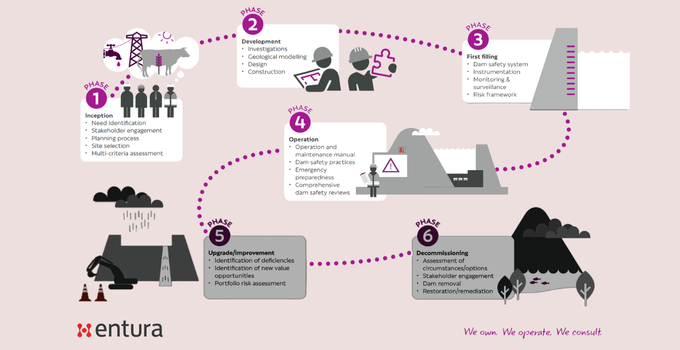
The operational stage of the dam life cycle is when the benefits (e.g. water supply, flood mitigation, recreation, etc.) of the dam continue to accrue after the large upfront capital investment has been committed. This phase of a dam’s life can last decades, and often much longer, but constant vigilance is required. Climate patterns and catchments change, downstream communities and industries develop, infrastructure ages, regulatory expectations increase, technology advances and workforces cycle. In all of this change, a dam owner’s challenge is to understand how risks are changing and ensure the dam continues to perform its primary functions safely and reliably.
Dam owners need to know how their dams are expected to perform, how they are actually performing, what could go wrong, what needs to be done before small issues become major risks, and how to manage emergency scenarios. Surveillance, maintenance, record keeping, training and emergency preparedness need to be integrated into a single risk-informed dam safety management system, rather than treated as separate activities.
Prioritise the biggest risks
Most dam owners’ resources are finite, so the key is knowing where effort, funding and attention will have the greatest impact. Portfolio risk assessments and regular reviews help owners understand failure modes, consequence profiles and relative priorities across their assets, which provides a sound basis for allocating resources and planning future work. Without a current understanding of portfolio risk, it becomes difficult to know whether surveillance programs are appropriate, whether maintenance budgets are being spent effectively, or whether recommendations for improvements and upgrades are targeting the most important issues.
Monitor what matters
The most effective monitoring and surveillance programs are developed considering potential failure modes and reviewed regularly. More data isn’t necessarily useful if it isn’t relevant or of good quality. What we’re looking for is reliable, targeted data that reveals emerging issues and long-term trends that tell us whether a condition is stable, seasonal, reservoir-level dependent or changing in a way that needs intervention. Telemetry, automated instrumentation and remote monitoring are good investments that can fill the knowledge gaps between routine manual inspections. When combined with engineering judgement, an effective monitoring and surveillance program will significantly improve understanding and enable earlier intervention.
Keep good records
Good records make dam safety reviews far more efficient and effective and reduce the uncertainty about how the dam is performing. Critical dam records come in many forms including design and construction reports, geological and geotechnical records, hydrometeorological records, consequence assessments, as-constructed drawings, photographs, inspection reports, surveillance data and monitoring data. All these sources help the reviewer understand what was built, why it was built that way and how it has performed since. Where records are missing, owners may need additional investigations, surveys, testing or analysis, often at greater cost and complexity because the dam is already operational.
Regularly review and update operations and maintenance manuals
Operations and maintenance manuals are equally important. They provide a clear reference point for operators, engineers and maintenance personnel, defining responsibilities, procedures, alarm thresholds and escalation pathways. One of the more common challenges across the industry is that these documents are not always reviewed and updated regularly enough to reflect changing conditions, renewal and modifications to the dam and evolving operational and organisational requirements.
Take a structured approach to managing recommendations
Inspection and assessment regimes generate recommendations for action that can accumulate into dozens or even hundreds for a single dam. But they’re no use if they’re buried in a spreadsheet or database that’s not managed and reviewed regularly. Important recommendations risk being overlooked among large volumes of outstanding (and possibly no longer relevant) items. It’s helpful to use a structured process to continuously review and consolidate recommendations, close out completed actions, identify duplication and prioritise work according to risk.
Invest in operators and staff
Well-trained, skilled people remain the first line of defence in maintaining dam safety. Effective maintenance and operation depend on operators having a good understanding of the value of their role, how the data they collect is used, what’s unusual, and when to escalate. Similarly, effective surveillance depends as much on experience, training and engineering judgement as it does on instrumentation and technology. Training should therefore be integrated into the dam safety management system. It should support surveillance activities, emergency preparedness and operational decision-making while also addressing longer-term workforce challenges such as succession planning and retention of institutional knowledge. It’s also not a ‘once and done’. Regular refreshers matter – and their frequency should be guided by level of experience and the risk position of assets.
Don’t underestimate routine maintenance
Seemingly simple actions – like vegetation management, drain maintenance, instrumentation upkeep, gate exercising, valve testing and maintaining safe access for inspections – can all be critical enablers of dam safety. Poor maintenance can obscure developing issues, reduce the effectiveness of inspections and compromise the reliability of important systems. Routine maintenance is often what allows operators and engineers to identify changes before they become significant problems.
Be ready for emergencies
Floods, earthquakes, equipment failures and dam safety incidents do happen – often without much warning. A dam safety emergency plan should clearly set out who does what, when decisions need to be made, how response levels escalate, and how communication occurs with emergency services, regulators, operators, the media and affected communities. It also needs contingency plans for power outages, communications failures, SCADA outages, limited site access, fatigue, backup resources and alternative means of communication. Because conditions around a dam are always changing, the emergency plan must be updated regularly and stress-tested through exercises.
Promote public safety around the dam
Dam safety risks are not limited to failures of the dam structure. Public safety risks include falls, swift currents near intakes and spillways, sudden water level changes, turbulent flow and hazardous hydraulic conditions around structures such as low-head weirs. Operators should take a practical approach: site-specific risk assessment, clear responsibilities, physical barriers where needed, effective signage, audible or visual warnings, public education, staff training, incident reporting and periodic review.
Read our articles:
- Planning for the future – the challenges of dam inspection and maintenance
- Safer dams are a matter of priority
- Portfolio risk assessment takes dam safety programs to the next level
- What can dam owners do to better manage floods and avoid the blame game?
- How robust is your emergency preparedness?
- Keeping close tabs on your dams
- Keeping safe around dams
- Are you investing in your most valuable asset?
- Making more of your monitoring
Operational principles in practice: TasWater’s dams portfolio
TasWater’s dam safety journey demonstrates how these principles work together in practice. Following the consolidation of Tasmania’s regional water authorities and council-owned water assets, TasWater inherited a diverse portfolio of dams with varying levels of available information about condition, performance and risk.
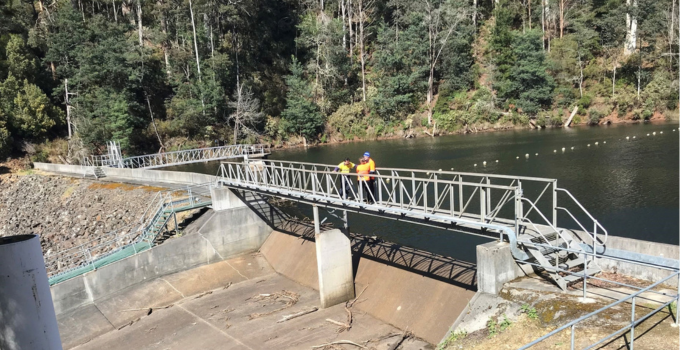
To establish a consistent understanding of risk, Entura undertook portfolio risk assessments, quantifying potential failure modes, updating consequence assessments and providing risk-informed priorities for future investment.
To improve operational visibility, Entura subsequently reviewed, designed and implemented upgraded monitoring systems across multiple Tasmanian storage sites, including instrumentation improvements, telemetry solutions and data collection systems aligned with contemporary dam safety guidance.
Those improvements supported a broader surveillance and dam safety program that included intermediate inspections, comprehensive surveillance reviews, deformation surveys, specialist instrumentation monitoring, updates to operation and maintenance manuals, updates to dam safety emergency plans and support for risk-based prioritisation tools.
Our registered training organisation, the Entura clean energy and water institute (ECEWI), delivered operator training to TasWater personnel through classroom learning, field inspections and workplace-based assessment, helping operators understand not just what information to collect, but why it matters and how it supports decision-making. The training was delivered to multiple cohorts and contextualised to TasWater’s own procedures, templates and reporting tools.
This range of activities is a great example of an integrated dam safety program: assessing the portfolio risk, upgrading the monitoring, inspecting and interpreting performance, maintaining good records and procedures, and training people. Each element strengthens the others. Together they create a practical framework for keeping dams safe, reliable and resilient over the long term.
In our next article in this series, Principal Civil Engineer Shao Ng and Senior Civil Engineer Sally Fracolossi will share their insights into the fifth stage in a dam’s life, showcasing a number of dam upgrades.
To see the full picture of the life cycle of a dam – all in one place – check out this article.
ABOUT THE AUTHOR
Christopher Flack is a Senior Civil and Dams Engineer with technical depth, practical site experience and strategic project leadership in dam safety, design, risk assessment, surveillance, construction and asset management. He has acted as project manager and lead author on numerous surveillance programs and dam safety reviews for clients across Australia, consistently ensuring high-quality outputs, sound engineering judgement and effective client engagement. Chris has also been design manager and technical lead on major dam upgrade and design projects, including Pet Dam and Bronte Dam upgrades in Tasmania.
Paul Southcott (Senior Principal – Dams and Headworks) is Convenor of ANCOLD’s ‘Guidelines for Dam Instrumentation and Monitoring Systems Working Group’. He has nearly four decades of experience in civil and dam engineering, with an exceptional depth of technical knowledge and extensive industry experience. Paul’s expertise is a crucial part of Entura’s ongoing support for dam upgrade and safety works for our clients’ extensive dam portfolios. He has contributed to many major dam and hydropower projects throughout Australia and the Indo-Pacific region, including for Hydro Tasmania, TasWater, Snowy Hydro and numerous councils and water utilities including SeqWater, Sun Water and SAWater. Paul was named Tasmania’s Professional Engineer of the Year in Engineers Australia’s 2021 Engineering Excellence Awards.
24 September, 2026


 +61 427 319 887