
Life cycle of a dam: Training – Human capability is the asset behind every dam

Throughout our ‘Life cycle of a dam’ series, we have explored the physical journey of a dam, through inception, design and construction, first filling, operation, upgrades and decommissioning. Every stage depends on people who understand the asset, recognise emerging risks, make informed decisions and pass knowledge on to its future custodians.
Here, two of our nationally accredited trainers with the Entura clean energy and water institute, senior civil engineers Sally Fracalossi and David Wightman, share their insights about knowledge sharing, capability building and training in the dams industry.
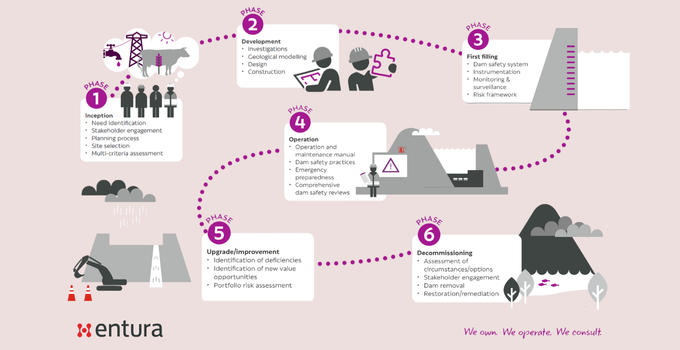
Integral to the safety, resilience and ability of a dam to fulfil its purpose throughout its long life cycle is the capability of the people and organisations responsible for it. While the physical dam structure may endure for generations, the workforce and operating context will continually evolve as infrastructure ages, the climate shifts, standards change and communities downstream grow.
Dam owners need to preserve knowledge, strengthen judgement and ensure that the next generation inherits both the asset and the ability to manage it well.
Treat capability as a dam safety control
Most dam owners have structured approaches to monitoring, inspections, safety reviews and emergency planning. Capability can be harder to quantify and assess.
Dam safety depends on people recognising changes in asset behaviour, interpreting evidence, escalating concerns and making sound decisions under pressure. Operators and surveillance personnel are often the first to notice that something has changed. If they lack the knowledge, confidence or authority to respond, even well-designed systems may not provide the protection intended.
Capability should therefore be managed with the same discipline as other dam safety controls. It requires consideration of the dam, its credible failure modes and consequences, the decisions required to manage the associated risks, and the people entrusted with those decisions.
Match capability to risk and responsibility
Capability requirements should be tailored to each role within a dam owner’s organisation. Executives need to understand dam safety risk and governance obligations. Engineers require appropriate technical competence. Operators and inspectors need the practical ability to recognise, document and escalate abnormal conditions. These requirements should reflect the complexity and consequences of the assets being managed.
Clear accountabilities are essential. If an organisation has not defined who is responsible for critical activities and decisions, it will struggle to determine what capability is required or understand the dam safety risks arising from identified gaps.
Preserve knowledge before it is lost
Much of the knowledge about a dam is learned over many years: how it behaves, seasonal changes or trends, why previous decisions were made, and which observations warrant closer attention. Some of this knowledge is documented, but much remains with individuals and can be lost when experienced personnel leave.
Knowledge transfer must be deliberate. Mentoring, succession planning, shared inspections, technical reviews and handovers help turn personal experience into organisational knowledge. Documentation matters, but it rarely captures the judgement behind a decision. That judgement must also be discussed and passed on.
Build future capability before it becomes urgent
Training needs should not be based only on current roles and gaps. Owners should consider what expertise and leadership they will need as assets age, operating conditions change, technology develops and experienced practitioners retire.
This long-term view creates time to develop people through mentoring, practical exposure and increasing responsibility. It also helps owners decide which capabilities they need to develop internally and which specialist expertise to source externally when required.
Test competence, then keep it current
For critical dam safety roles, dam owners need evidence that people can apply knowledge in practice, manage related responsibilities and respond appropriately when conditions depart from expected behaviour. Accredited assessment can provide defensible evidence of competence.
A valid accreditation or qualification does not necessarily mean that a person retains the same level of knowledge as time passes. Competence can weaken when tasks are performed infrequently, procedures change or knowledge is not refreshed. Refresher cycles should reflect asset consequence and complexity, task exposure, individual experience, audit findings and changes in roles or procedures.
Reinforce learning through practice and feedback
No single development method is sufficient. Formal training provides foundations, while mentoring, site experience, emergency exercises, peer learning and participation in inspections develop judgement and asset-specific understanding.
Feedback is particularly important. Operators and inspectors are more likely to recognise the value of surveillance when they understand how their observations are used, what investigations followed and why escalation mattered. Without that feedback loop, surveillance can become a routine compliance task rather than an informed contribution to dam safety.
Senior leaders set the conditions for this learning to endure. They determine whether capability gaps are treated as governance risks, whether knowledge transfer and refreshers are resourced, and whether learning is connected to everyday decisions.
Throughout this series, we have followed the physical lifecycle of a dam from inception to decommissioning. At every stage, safe stewardship depends on people who understand the asset, recognise emerging risks, exercise sound judgement and pass knowledge on. A dam may endure for generations, but good stewardship only endures if capability is developed and sustained too.
PRINCIPLES IN PRACTICE: THE ENTURA CLEAN ENERGY AND WATER INSTITUTE (ECEWI)

Around the world, dam owners are grappling with how to retain critical knowledge, strengthen governance and prepare the next generation of practitioners. Increasingly, the focus is shifting from delivering isolated training events to building sustained organisational capability.
The Entura clean energy and water institute (ECEWI) supports this through programs shaped around the risks, roles and operating context of each organisation. The objective is to help organisations strengthen their own capability and capacity over the long term.
One example is ECEWI’s involvement in the South Asia Regional Infrastructure Connectivity (SARIC) initiative. Through this Australian Government-supported program, ECEWI has delivered dam safety training programs for engineers and senior executives from water and hydropower organisations across South Asia. Participants explored topics including dam safety risk management, surveillance, inspection, monitoring and emergency preparedness, supported by site visits and engagement with industry practitioners. Bringing together participants from multiple countries and organisations created opportunities to compare approaches, build professional networks and strengthen understanding across the region. The focus was not simply on individual learning, but on building knowledge that participants could take back into their organisations and apply within their own governance and operational frameworks.

In Malaysia, ECEWI has worked with MYCOLD, UNITEN and industry partners to contribute to the development of a Certified Dam Safety Inspector program. This covered surveillance, inspection, monitoring and reporting with practical site-based experience and formal assessment. The program created a structured pathway that local organisations could continue to refine and sustain. In this respect, the program illustrates the difference between training people and strengthening institutions. The capability remains even after the original training has finished because it is embedded in recognised competencies, assessment processes and local ownership.
ECEWI has also developed long-term capacity-building partnerships. ECEWI’s work with Sarawak Energy has evolved over many years into structured learning pathways across multiple technical disciplines. Dam safety surveillance officer training has supported the development of local capability through accredited learning and train-the-trainer approaches designed to sustain knowledge within the organisation.
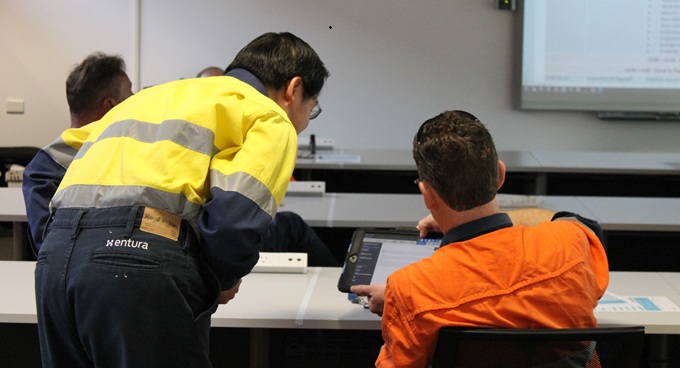
Closer to home, ECEWI has worked with Australian water utilities and irrigation authorities to analyse gaps and then design and deliver bespoke training aligned with each organisation’s dam safety needs. ECEWI customises the training to the specific asset portfolio of each organisation, with their particular operational challenges, regulatory obligations and potential scenarios, making training relevant and immediately applicable in practice.
Although these examples differ in scale and context, they are all based in the recognition that dam safety depends on more than sound infrastructure. It depends on capable people, supported by capable institutions, making informed decisions throughout the life of the asset. Building knowledge through formal training can be an important part of the journey of building organisational capability, but it must be part of a broader system that also focuses on retaining knowledge and passing it on from one generation of dam professionals to the next.
This concludes our ‘Life cycle of a dam’ series. However, our dams specialists always have more to say. Keep an eye on our socials and our website to keep up to date with all our thought leadership articles.
ABOUT THE AUTHORS
Sally Fracalossi is one of Entura’s senior dams engineers. She joined Entura’s Dams and Geotechnical Team in 2020, following 5 years in a multinational private consultancy where she gained broad civil engineering and project management experience. Sally is experienced in numerous aspects of dam engineering, including dam design, dam safety assessments and inspections, risk assessment and construction support. She has also been involved in developing dam safety emergency management plans, operations and maintenance manuals, and is actively involved in facilitating dam safety training as a certified trainer through the Entura clean energy and water institute (ECEWI).
David Wightman joined Entura’s Dams and Geotechnical Team in 2019 as a Senior Dams Engineer. David has had a 25-year career in engineering and has worked for asset owners and as a consultant. At Entura, he is involved in dam safety inspections, reporting writing and reviews, and mentoring emerging engineers. He has a particular interest in review of dam safety programs, including prioritising of dam deficiencies and upgrades, and optimising surveillance and monitoring to suit relevant failure modes. David is actively involved in facilitating dam safety training as a certified trainer through the Entura clean energy and water institute (ECEWI).
19 October, 2026


 +61 427 319 887
