
Breathing new life into Australia’s aging wind farms
The wind industry, well-established in Europe for decades, took baby steps onto Australian soil in the late 1980s and 1990s. By the early 2000s, Australia’s new wind industry was ready to take off. Given that wind farms usually have a design life of anywhere between 15 and 30 years, our earliest wind farms are now reaching retirement age. The industry therefore faces a new set of challenges. Can these older wind farms continue to serve their important role in Australia’s clean energy transition or are they at their end of life?
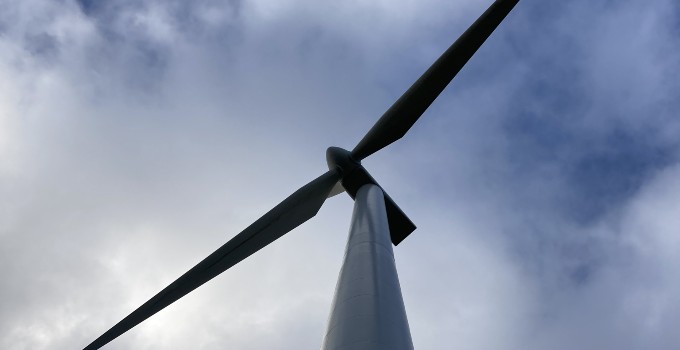
So far, few wind farms in Australia have been decommissioned, dismantled and removed from the land. With many of our older wind farms sited to capture the best wind resources, there’s every reason to try to continue using these sites to harness wind energy.
One option is to squeeze more years out of the wind farm through effective maintenance and supportive analysis to ensure it is safe to do so while accepting that there may be increasingly frequent outages and increased maintenance costs to keep the wind turbines in service. However, although operation beyond the nominal life of a wind turbine is theoretically feasible, old wind turbines can’t keep spinning forever and will need to be stopped at some stage.
Other options for aging wind farms are refurbishment of some parts of the turbines, or full ‘repowering’ with completely new machines. This could also include a full redesign to accommodate larger turbines or to incorporate solar or battery energy storage systems.
An example of rejuvenation
Small grids may be some of the first to need to consider what to do about old wind farms. As an example, Hydro Tasmania’s Huxley Hill Wind Farm on King Island has three 250 kW wind turbines that were installed in 1998, and two 850 kW wind turbines that were installed in 2003.
For Huxley Hill Wind Farm, the King Island electricity load has not changed much over time, and offsetting diesel using renewable energy continues to make perfect sense.
For this site, the owner opted for a like-for-like replacement of nacelles (generator, gearbox, yaw system) of the Nordex 3 x N29 250 kW and potentially for the 2 x Vestas V52 850 kW wind turbines. This decision was partly about the good economics and sustainability of reusing existing infrastructure, and also because wind turbines of this size continue to suit the project so well.
When the wind farm was constructed 20+ years ago, the installed wind turbines were considered modern, large wind turbines. These days, the same suppliers do not offer anything less than 2 MW in capacity, with rotor diameters greater than 110 m. The lack of availability of what are now considered smaller wind turbines (say 1 MW) poses challenges for some small projects. At the scale of less than 1 MW, there are now few proven wind turbine options. At an even smaller scale (<100 kW), solar PV now dominates.
When any existing infrastructure is to be retained to support life extension of old wind turbines, such as at Huxley Hill, it’s crucial to confirm that it is still suitable and safe. This can include various techniques and activities, including:
- physical inspection by technicians and engineers
- excavation of the foundation backfill cover to reveal the tower-foundation joint and inspect corrosion and remediation
- surveying the tower and blade condition using drones
- surveying the tower verticality
- surveying the thickness of tower sections
- ultrasonic testing of bolts
- eddy current testing of welds to detect any flaws
- reviewing data from the turbines to refresh understanding of the actual wind regime, reassess fatigue loads and estimate remaining life.
Another important consideration when rejuvenating older wind farms is to consider the potential for adding solar or battery energy storage. With solar now more viable than when Huxley Hill Wind Farm was conceived, a 1.5 MW solar farm has been added to augment the wind generation.
Starting over with full repowering
Because the Australian wind industry is still relatively young, there is not yet an established practice or precedents for full repowering. However, in Europe, hundreds of wind farms have been repowered, often massively increasing output by using fewer but much larger modern turbines.
Repowering at around 25 years seems the most likely timeframe for most Australian wind farms – but few have yet reached this age. Ultimately, market factors will determine when repowering provides the best financial return.
Even though we’re still just on the brink of Australia’s repowering journey, it’s never too early to start considering the complexities and implications and assessing all options.
Repowering won’t be simple or quick. The development process for repowering NEM-connected wind farms is likely to be just as challenging as developing a new wind farm on a greenfield site.
The concept of ‘repowering’ involves a range of options for replacing old wind turbines and associated footings and electrical balance of plant with new, but it’s unlikely that much of the existing infrastructure and balance of plant will be able to retained if larger, modern turbines are selected. The layout of the wind farm is also likely to need revision to accommodate longer blades.
Planning approvals need to start just as early, as should the process of renegotiating with hosts, neighbours and communities. People may be concerned about the impacts of much taller turbines and the logistical issues of getting them to the site, as well as arrangements for the dismantling, removal and disposal of the superseded technology and infrastructure.
Repowering with bigger and more powerful turbines is also likely to involve re-permitting and negotiating a new grid connection agreement – neither of which are certain, given the cumulative impacts that may have emerged over time and any changes to rules and regulations since the wind farm was first developed.
By planning early for repowering, developers can get ahead on these issues as well as on condition assessment of the assets, decommissioning plans for old turbines, new studies that might be needed (such as bird monitoring), and new wind measurements for taller, modern wind turbines, perhaps using modern wind measurement technology such as lidar.
While some repowered wind farms will very likely incorporate new battery energy storage systems (BESS), they are less likely to deploy large-scale solar as a default, given that many of the best original wind sites in Australia are coastal or hilly, particular those in the south of the country. Nevertheless, the potential for co-located renewable generation, storage and loads is worth exploring.
Don’t wait for trouble – start planning now
We suggest that wind farm owners take action now to deepen their understanding of the condition and present value of their assets, and explore the full range of short-term and long-term options available through a feasibility and options study. After all, in such a dynamic market and technology landscape, and with the potential for aging assets to deteriorate or fail, decisions about end of life may need to be made earlier than expected.
About the author
Andrew Wright is Entura’s Senior Principal, Renewables and Energy Storage. He has more than 20 years of experience in the renewable energy sector spanning resource assessment, site identification, equipment selection (wind and solar), development of technical documentation and contractual agreements, operational assessments and owner’s/lender’s engineering services. Andrew has worked closely with Entura’s key clients and wind farm operators on operational projects, including analysing wind turbine performance data to identify reasons for wind farm underperformance and for estimates of long-term energy output. He has an in-depth understanding of the energy industry in Australia, while his international consulting experience includes New Zealand, China, India, Bhutan, Sri Lanka, the Philippines and Micronesia.
MORE THOUGHT LEADERSHIP ARTICLES
Designing dams for an uncertain climate future
Dams are critical infrastructure for water supply, irrigation, energy production, flood protection, or multiple purposes. They are usually designed to last at least 100 years, yet with good maintenance and appropriate dam safety practices, dams can continue to perform as designed for centuries. But what about climate change? The circumstances in which a dam operates may be very different in the coming decades – and exactly how these changes will play out in different regions is impossible to predict with certainty.
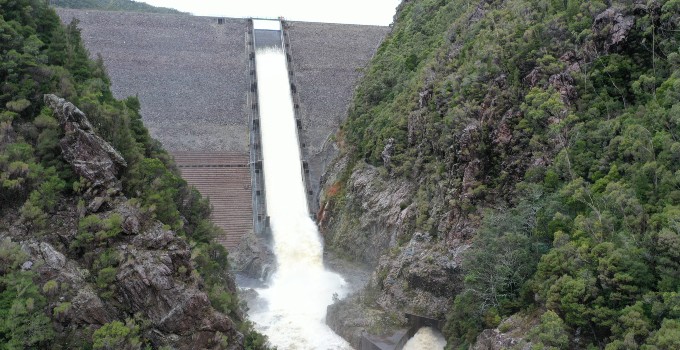
Dams are designed to continue to perform safely in extreme events, such as major floods and earthquakes, to avoid the high economic, environmental, and social consequences of dam failure. When the consequence has the potential to be extreme, the flood that the dam will need to be designed for is, in Australia, the ‘Probable Maximum Flood’ (PMF), while in some other parts of the world it is often the 1:10,000 annual exceedance probability (AEP) flood.
But even if standards or guidelines are clear about the ‘return period’ of flood that the dam should be designed for – is it still as simple as reading the magnitude of the flood discharge off the flood frequency curve as has been done in the past? These days, it is not so simple.
Exploring the inherent uncertainty in the flood frequency curve
Part of the reason for more complexity is that we have greater computing power today to be able to explore the uncertainty in our flood frequency curve. Predicting extreme flood events (such as the PMF) is not an exact science and involves many variables which are often not well characterised. As a result, there is significant uncertainty in predicting floods, particularly extreme floods. If this uncertainty is presented, the flood frequency curve is no longer a single line but a band. The more extreme the flood event, the wider the uncertainty band. Although the flood frequency curve shown below is fitted directly to measured flow data, the uncertainty bounds are similar regardless of the approaches implemented to derive the flood frequency curves.
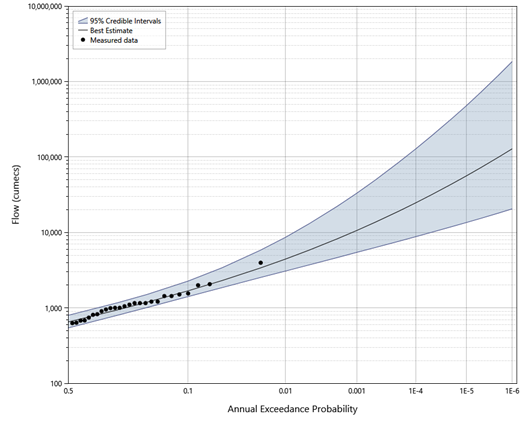
So, what flood should the dam be designed for? Should it be the median best estimate, or should it take into account some of the uncertainty? This is the first challenge, and it is there whether we consider climate change or not.
Adding the extra uncertainty of climate change
Climate change doesn’t stand still. This adds even more complexity to the flood prediction challenge. What is the impact of climate change on extreme events now, and what will it be as time goes by? Numerous studies of climate change impacts suggest that there will be greater variability in extreme temperatures and extreme rainfall, and that extreme events may become more frequent. As a result, the magnitude of extreme flood events, for which dams must be designed, will likely increase with time.
Changes in the magnitude or frequency of extreme floods will depend on projections of future temperature, emission scenarios and the models used to simulate the changes. Even with a ‘middle of the road’ emission scenario (such as the IPCC’s SSP2–4.5 scenario) that results in a median global temperature increase of 3 °C (compared to preindustrial temperature baseline) by the end of this century, there could be a 23% increase in 24-hour extreme rainfall depth. But this is only one of the scenarios; some are more extreme, some show less increase, some show more. The increase is greater for higher emission scenarios and for shorter duration storms. Ultimately, an increase in rainfall depths results in an increase in flood magnitudes.
Guidance on climate uncertainty in dam design is limited
Currently, most standards and guidance documents are silent on how climate change should be applied in the design of spillway capacities for dams to safely pass these extreme flood events. However, the International Commission on Large Dams (ICOLD) Bulletin 142 on the Safe Passage of Extreme Floods (2012) indicates that there is uncertainty associated with the resulting flood estimates because of uncertainties in the hydrometeorological data used in determining the design flood. In addition, there may be changes in future methods for the development of design floods, changes in the future condition of the catchment (e.g. due to deforestation), and changes in rainfall conditions due to climate change. All of these have the potential to increase the magnitude of the future design flood.
This 2012 bulletin encourages strategies for planning spillway arrangements with consideration of floods exceeding the design flood (i.e. checking the robustness of the spillway flood design capacity from a dam safety risk perspective). This demonstrates that more than a decade ago the international dam engineering community was already promoting consideration of climate change resilience when designing new dams and upgrades of existing dams.
The more recent ICOLD Bulletin 170 on Flood Evaluation and Dam Safety (2018) states that although projected changes in climate are generally expected to increase flood risk in many parts of the world, understanding the impact on flood risk is subject to considerable uncertainty. It states that one of the main impacts of climate change will be to increase the uncertainty associated with the estimation of extreme floods.
There are tools available now that can be used to look at climate change impacts on extreme rainfall events, mainly around changing rainfall inputs to rainfall–runoff models based on climate advice, or else through using stochastic climate generators. However, this 2018 ICOLD bulletin also warns about complex numerical modelling and the ‘black box effect’ of accepting results without verification or critical consideration. It stresses that the intrinsic hydrological uncertainty will always remain no matter how clever or complex the numerical modelling.
Practical suggestions for dealing with uncertainty
Given that dams are designed for the long-term, it is crucial to consider the uncertainty of floods and the potential impacts of climate change. Climate impacts are being discussed increasingly by dam owners, dam engineers and dam regulators – and guidance on how best to deal with climate change will come eventually. This review article, ‘Climate change impacts on dam safety’, provides a good summary and some thoughts about approaching the issues in a framework based on dam safety risk.
In the meanwhile, we’ve developed some practical suggestions for dealing with intrinsic hydrological uncertainty and the increased uncertainty due to climate change, whether you’re working on new dams or upgrades to existing dams:
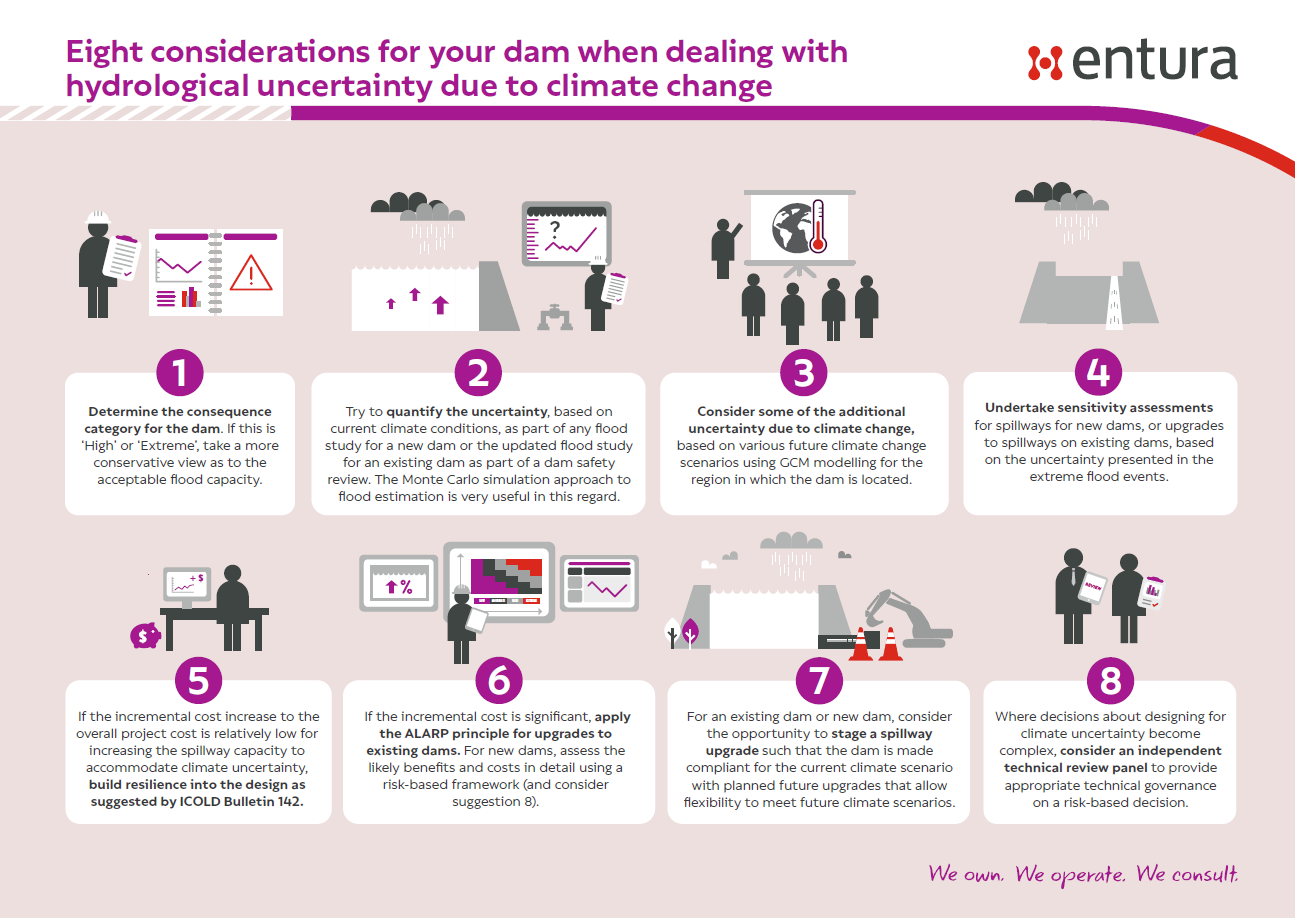
- 1. Determine the consequence category for the dam. If this is ‘High’ or ‘Extreme’, take a more conservative view as to the acceptable flood capacity.
- 2. Try to quantify the uncertainty, based on current climate conditions, as part of any flood study for a new dam or the updated flood study for an existing dam as part of a dam safety review. The Monte Carlo simulation approach to flood estimation is very useful in this regard.
- 3. Consider some of the additional uncertainty due to climate change, based on various future climate change scenarios using GCM modelling for the region in which the dam is located.
- 4. Undertake sensitivity assessments for spillways for new dams, or upgrades to spillways on existing dams, based on the uncertainty presented in the extreme flood events.
- 5. If the incremental cost increase to the overall project cost is relatively low for increasing the spillway capacity to accommodate climate uncertainty, build resilience into the design as suggested by ICOLD Bulletin 142.
- 6. If the incremental cost is significant, apply the ALARP principle for upgrades to existing dams. For new dams, assess the likely benefits and costs in detail using a risk-based framework (and consider suggestion 8 below).
- 7. For an existing dam or new dam, consider the opportunity to stage a spillway upgrade such that the dam is made compliant for the current climate scenario with planned future upgrades that allow flexibility to meet future climate scenarios.
- 8. Where decisions about designing for climate uncertainty become complex, consider an independent technical review panel to provide appropriate technical governance on a risk-based decision.
If you would like to speak with us about how climate change could affect your new or existing dam, please contact Richard Herweynen or Prafulla Pokhrel.
About the author
Richard Herweynen acknowledges the input of his colleagues Prafulla Pokhrel (Principal Consultant, Hydrology) and Paul Southcott (Senior Principal, Dams and Headworks) in writing this article.
Richard is Entura’s Technical Director, Water. He has more than three decades of experience in dam and hydropower engineering, and has worked throughout the Indo-Pacific region on both dam and hydropower projects, covering all aspects including investigations, feasibility studies, detailed design, construction liaison, operation and maintenance and risk assessment for both new and existing projects. Richard has been part of a number of recent expert review panels for major water projects. He participated in the ANCOLD working group for concrete gravity dams and was the Chairman of the ICOLD technical committee on engineering activities in the planning process for water resources projects. Richard has won many engineering excellence and innovation awards (including Engineers Australia’s Professional Engineer of the Year 2012 – Tasmanian Division), and has published more than 30 technical papers on dam engineering.
MORE THOUGHT LEADERSHIP ARTICLES
Monitoring tailing dams with unified data visualisation
This article is based on a recent presentation by Richard Lindqvist, a data integration specialist with Entura, at the ANCOLD Tailings Dam Operators Forum 2023. Richard describes the need, opportunities and barriers to adoption of advanced monitoring systems.
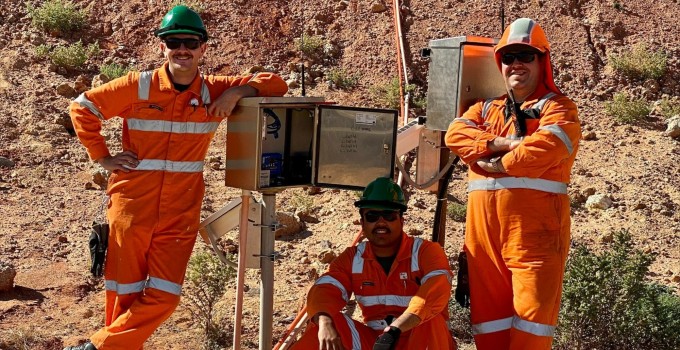
Tailings facilities are crucial for preventing any spread of mine tailings into surrounding land and waterways. Some tailings dams are among the largest engineered structures in the world. Like all dams, they must be managed to protect downstream communities and the environment from harm.
The catastrophic collapse of a tailings dam in 2019 in Brazil focused intense global attention on the safety of tailings facilities. In 2020, a new Global Industry Standard on Tailings Management (GISTM) was released.
The global standard emphasises the need for appropriate monitoring of tailings facilities throughout their lifecycle – from design to closure – to aid in the mitigation of risk.
Advanced monitoring systems can assist greatly in meeting and exceeding the requirements of the GISTM. Here we’ll discuss the potential of telemetry, automation and meaningful visualisation of monitoring data – and the benefits that can flow from implementing such a system at your site.
The GISTM sets the context for monitoring
Accurate, meaningful and continual data from monitoring systems forms an important part of a comprehensive and integrated knowledge base, which is a core principle of the GISTM, particularly with respect to Principle 7 of the standard.
Monitoring data is to be assessed at the frequency recommended by the Engineer of Record (EoR). Any conditions exceeding the dam’s critical operating parameter ranges (COPs) must be addressed promptly through trigger action response plans (TARPs) or critical controls.
The COPs are parameters that if exceeded have a real risk of leading to a dam safety incident. Each COP has a TARP. Careful and regular monitoring of COPs can identify early signs of a potential safety issue and allow rapid intervention before the trigger level is reached.
These requirements set the context for monitoring methods, and reinforce the importance of accurate, up-to-date, meaningful information that tells a clear and timely story about the facility’s current state, trends and potential concerns.
New technologies have changed the face of monitoring
As technology has progressed, new opportunities have arisen for monitoring tailings facilities, with enormous benefits in efficiency, immediacy and accuracy. Now, COPs, TARPs and data quality can be assessed in near-real-time using automated processes – enabling efficient and early identification of faults, such as during construction activities. Time spent collecting field data and maintaining systems is minimised, and the saved time can be reallocated to dam inspections and deeper assessment of data trends. End-to-end connectivity allows multiple sources of telemetry data and operational data to feed immediately into a unified and user-friendly visualisation platform, supporting understanding and decision-making. Monitoring data can also feed proactive and predictive maintenance in asset management and operations.
Opportunity abounds, but barriers remain
As with any new standards and systems, there are likely to be some barriers or challenges in moving from a design or concept to reality. In our experience, some common factors include resistance to change, the potentially significant cost to invest in the new technology needed for an efficient and integrated system, and the balance of resourcing between automated versus field data collection and processing. Other common hurdles are integration with existing systems and workflows and the data security and governance standards to be met. Staff training and succession planning can also be a challenge but are essential to maintaining the necessary knowledge base.
None of these challenges are insurmountable – and the effort to overcome them will be repaid by the immense benefits in operational intelligence, efficiency and reliability that advanced, automated, integrated systems can deliver.
A real-life example of an evolving monitoring system
Entura has been on a journey with a large mining client for nearly 15 years, continually improving the facility’s monitoring solutions. Initially, we used our own Ajenti telemetry loggers and Ajenti Data Management System (ADMS) before progressing to the integration of other vendors’ logger data to the ADMS. We are now moving forward in using OSI Pi to integrate a broad array of data sources for our clients, presenting them within an accessible and adaptable visualisation platform.
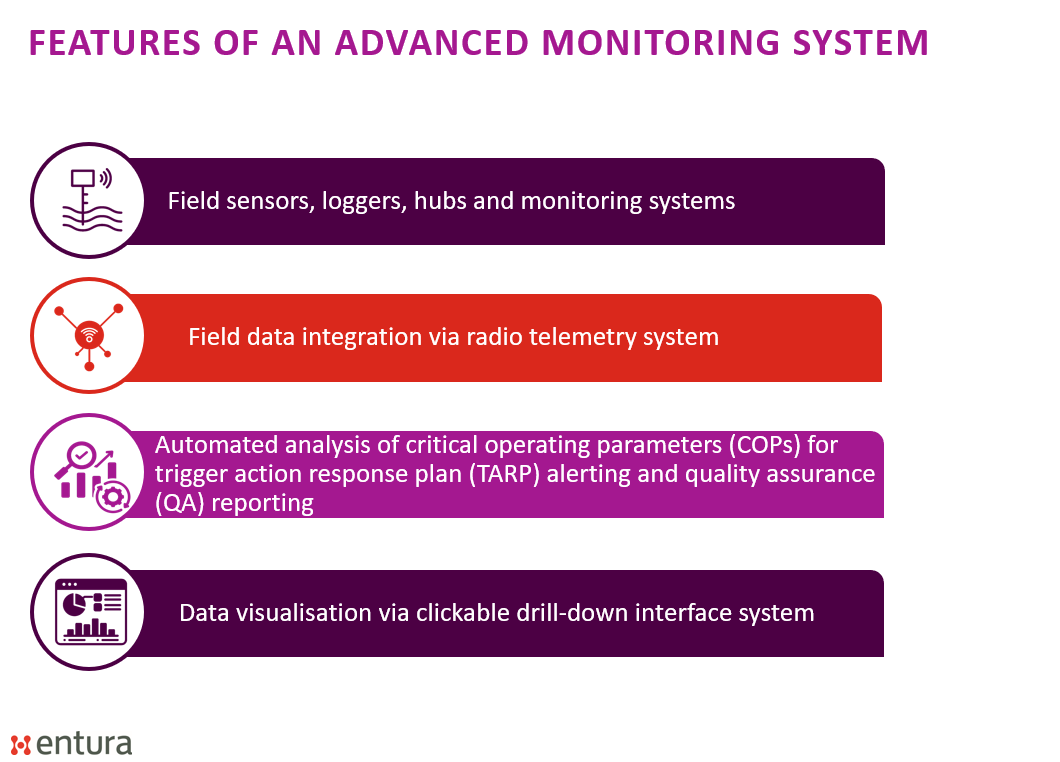
Historically, data was retrieved manually from field loggers for processing into spreadsheets and manual analysis of charts. With data retrieval via telemetry, along with automated analysis and visualisation, this time can now be spent reviewing TARP alerts and in-depth assessment of data.
System reliability and robustness has been another key factor in our work with our clients – with improvements such as fit-for-purpose enclosures (316 stainless steel), solar power installation and the ability to assess operational data such as battery voltage and signal strength. This is reducing the physical maintenance needs at monitoring sites and replacement of enclosures or batteries. The focus can now be on routine inspections of dam conditions rather than managing the monitoring network.
Effective record-keeping is essential when managing a large monitoring network. The new system enables a rich knowledge base to be compiled, stored and interrogated. Site metadata and documentation can be hosted on the visualisation platform, including calibration and installation reports, FATs and SATs (factory and site acceptance tests), analysis reports, memos, photos, field observations and general site maintenance requirements. Data from various field note sources (i.e. ArcGIS, fieldmaps, Iauditor and Fulcrum) can be brought into the visualisation system for ease of access and asset management. Electronic field note apps are used on mobile devices so that data can be recorded in the field and synced directly to the system.
We have also added value to the data repository by incorporating other technologies into the integrated system and visualisation interface. These include aerial survey overlays, weather monitoring, soil moisture sensors, camera imagery and operational data – and we are always working with our client to ensure that visualisations are intuitive and easy to interpret.
The visualisation interface provides real-time and trend data for users, and can hone in on individual sensors anywhere across the facility. Faults can be analysed onsite using analysis tools – and offsite using available data trends.
We’ve also worked with our client to provide a secure data ingress pathway for remote equipment, and we’re continuing work on integrating the new system with existing traditional and emerging SCADA systems.
Throughout the long evolution of this monitoring journey, we have continually added new innovations to best serve our client’s needs – and are always looking for new ways to deliver effectively.
Every system needs continuous improvement
The existing system has brought significant benefits to our client’s ability to analyse and visualise the facility’s data. Yet technologies continue to improve and evolve at speed. For our clients, we are now using OSI Pi and Pi-Vision as a primary integration and visualisation tool, and have developed a proof-of-concept for delivering the capabilities of the current system using OSI Pi and Pi-Vision. This will allow greater flexibility to bring on-site data into a single visualisation system – agnostic of the historical databases currently in use.
With the pace of technological advances likely to accelerate, clients and consultants should all stay attuned to new monitoring developments and alert to possibilities for improving their system’s functionality and integration with a broad range of sensors and control systems.
With the right data at the right time coupled with meaningful analysis and user-friendly visualisation, every tailings facility’s management should be better able to make earlier and more informed decisions to reduce risk.
To find out more about Entura’s data and water management solutions, contact Phillip Ellerton.
MORE THOUGHT LEADERSHIP ARTICLES
India and Australia can support each other’s clean energy journeys
The relationship between India and Australia goes far beyond our nations’ mutual love of cricket. We have deep people-to-people connections that have been formed over generations. At the beginning of the 20th century, around 7000 people of Indian descent lived in Australia. Now, Indian-born Australians number more than 750,000 – a number that has doubled over the last decade and continues to grow.
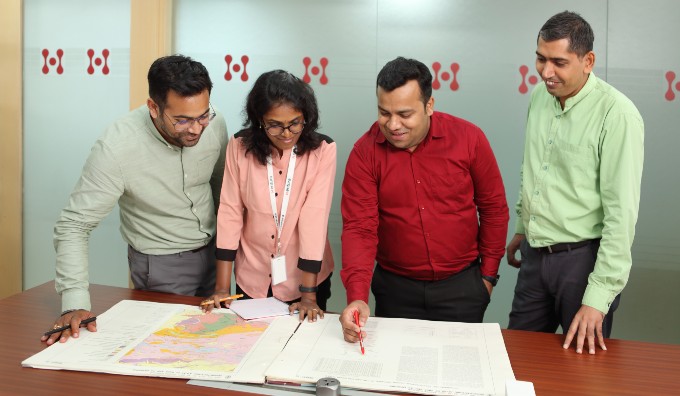
It’s natural that our two countries should have a strong relationship across many domains. We have strong strategic and political ties, and our economic engagement opportunities are massive. This will be strengthened even further with the Australia-India Economic Cooperation and Trade Agreement.
In a sign of the deepening India–Australia relationship, in 2023 Australia’s Prime Minister Anthony Albanese and India’s Prime Minister Narendra Modi have shared senior bilateral visits both in India and in Australia. One of the major themes in these meetings has been the potential for the two nations to support each other’s journeys towards a clean energy transition and net zero targets.
Building clean energy connections
I’ve been privileged to be involved in furthering the Australia–India relationship as a member of the Australian Senior Business Delegation to India and a subsequent Roundtable with business leaders in Sydney. During these meetings, I spoke about the potential our nations have, despite our radically different sizes, to work together to overcome challenges in our renewable energy sectors. I put forward the idea of a joint renewable energy council, which was well received. I am now on the Australia India CEO Forum’s Energy, Resources, Net Zero and Critical Minerals Joint Working Group, which had its first meeting this month. And this week, Entura has welcomed a visit from the High Commissioner of India to Australia, Manpreet Vohra, at our Hobart offices.

These opportunities have been realised after forging relationships with government officials across Australia and India over many years – and having maintained an Entura presence in India for more than 17 years with our highly skilled team based in New Delhi. Entura is a leader in the renewable energy industry and at present is the only Australia-based, government-owned business operating in the sector in India.
Entura is an excellent example of how Australia and India can support each other towards our clean energy goals. With India committed to net zero by 2070 and with 60% of its current energy production coming from coal, there are huge decarbonisation moves underway, including plans for 500 GW of renewable energy by 2030. Renewable electricity is growing at a faster rate in India than in any other major economy. Electricity demand is expected to double over the next decade and the share of wind, solar, hydropower, batteries and pumped hydro will lift as a proportion of the mix.
For Entura’s clients in India, we bring deep hydropower and pumped hydro capability and significant expertise in hybrid renewables systems, integrating distributed energy resources, resolving transmission challenges, and delivering bespoke, tailored training and capacity building through the Entura clean energy and water institute, with a particular focus on dam safety. For our projects in Australia, our India team brings a wealth of talent and a boost to capacity. They also have the local knowledge and connections that go a long way towards our success in clean energy and water projects across South Asia and South-east Asia.
Building on Entura’s long engagement with India, and from my involvement with the International Hydropower Association, I see the following areas as particularly important for our nations to focus on for mutual benefit in the energy transition.
1 Diversifying supply chains in critical minerals and renewable energy technologies
As both countries strive to achieve ambitious renewable energy targets, we will need to develop more diverse and resilient supply chains. The extraction and processing of critical minerals will be an essential area for cooperation. Mechanisms such as The India–Australia Critical Minerals Research Partnership and India–Australia Critical Minerals Investment Partnership will integrate Indian scientific, industry and government partners with CSIRO’s developing Critical Energy Metals Mission. This holds great potential to strengthen supply chains, add value to Australian exports, and support the commercialisation of critical minerals technology.
Another crucial factor in the success of Australia’s renewables, green hydrogen and green steel ambitions is the availability of components such as solar PV panels, batteries, electrolysers and electrical componentry. India is a powerhouse of manufacturing capability and could become a major supplier of these essentials to support Australia’s build-out of renewables. The announced joint taskforce on solar and the initiatives underway to collaborate on green hydrogen and green steel are encouraging developments.
2 People power and knowledge-sharing
Developing a skilled workforce, ready to take up the jobs of the future, is a make-or-break factor for the clean energy transition. As Entura has experienced, India has a deep pool of technical talent in renewable energy and a rising skilled workforce. To put it in context, India has over 1000 universities and some estimates suggest that these institutions are producing more than 1 million engineering graduates per year.
Australian businesses such as Entura benefit from having access to this talent – especially facing escalating skills and resources shortages in Australia – and we’ve found that with the right tools, methods and attitudes, our people across Australia and India can work seamlessly together in integrated teams, leveraging each other’s strengths on projects throughout the Indo-Pacific. Our India team adds diversity and capacity to our business – with the added bonus of optimising project delivery across time zones. We also benefit from the ability to build greater understanding of local conditions and regulations in India, and to forge strong networks and partnerships in the region.
Over the years, we’ve identified that despite the size of the potential renewable energy workforce, India still seeks greater skills development and expertise in hydropower, dam safety and the integration of renewable energy technologies. Entura’s clean energy and water institute (ECEWI) is a model of how long-term experience of developing and maintaining renewable energy assets, which we’ve gained through Tasmania’s century-long hydropower journey, can be shared across the world to build skills and capacity that extend far beyond the theoretical or academic.
Through ECEWI, we’ve delivered successful exchange programs, training workshops, and capacity-building initiatives in India, including dam safety training for India’s Central Water Commission as part of its Dam Rehabilitation and Improvement Project (DRIP) – and we’re now supporting the South Asia Regional Infrastructure Connectivity Framework (an initiative of the Australian Department of Foreign Affairs and Trade) by providing capability development on dam safety and cross-border power markets.
3 Innovation and best practice
There is enormous scope for Australia and India to work together to drive innovation in clean energy technologies and to share best practices and solutions. Many initiatives are already underway, drawing on Australia’s advanced technical expertise in solar and wind farms, energy storage solutions, and grid integration projects. For example, Entura is applying experience in India that we’ve gained in world-leading projects in Australia – such as our understanding of offgrid hybrid renewables systems gained from powering the Bass Strait islands, and the work our teams have led to identify and progress the first new pumped hydropower opportunities in Australia for decades in Tasmania and in Queensland.
As developers conduct concept studies and seek to secure licences for renewable projects, sharing international expertise such as ours will be an advantage. We are already applying our pumped hydro screening processes to identify new opportunities in India, and looking at the potential for repurposing disused mine sites for new renewable energy projects, as we are doing at the former Kidston gold mine in Queensland. We’re also applying our knowledge of repowering existing wind and solar farms in the quest for economical and sustainable approaches to boost electricity generation.
This brings me to another key area in which Australia can help to support a ‘fair’ clean energy transition in India. Australia has some of the strongest environmental and social requirements for clean energy projects in the world, and we’ve learned a lot about sustainability along the way. Entura has long been an advocate for sustainable projects conducted with integrity. In fact, I’ve just returned from the International Hydropower Association’s world congress, which reinforced this theme, announcing a new Hydropower Sustainability Alliance and the Bali Statement of Powering Sustainable Growth. Businesses like Entura can foster a fairer clean energy transition in India by promoting high standards of sustainability in all the projects in which we participate and the training we deliver.
Working together on the three factors I’ve discussed here will help build greater success, resilience and sustainability in all areas of the renewable energy transition. Lowering emissions in the global energy sector is an enormous and daunting endeavour that can’t be solved without international collaboration. But we’re at a very exciting point in the journey. We look forward to continuing the close and mutually beneficial relationship between our nations. Accelerating the global clean energy transition is the most important legacy we can leave today’s communities, future generations, and this planet we all share.
About the author
Tammy Chu is the Managing Director of Entura, one of the world’s most experienced specialist power and water consulting firms. She is responsible for Entura’s business strategy, performance and services to clients, and is part of Hydro Tasmania’s Leadership Group. As a civil engineer, Tammy specialised in the design and construction of mini-hydro and hydropower systems, project management, hydropower investigations, prefeasibility and feasibility studies, environmental assessments and approvals, resource investigations and resource water management. Tammy is a member of the Board of the International Hydropower Association. She was the first female and now past president of the Tasmanian Division of Engineers Australia, and was an Engineers Australia National Congress representative.
MORE THOUGHT LEADERSHIP ARTICLES
Who will develop and build our clean energy future – and what will it cost?
I have just ‘returned’ from the World Wind Energy Conference 2023, held just down the road from Entura’s Hobart office. At the conference there was an overwhelming sense that the energy transition from fossil fuels to renewables is well underway and the era of coal-fired power generation is coming to a close.
This has been reflected in the Australian Energy Market Operator’s most recent roadmap (the 2022 Integrated System Plan) which shows the need for a phenomenal increase in energy storage (batteries and pumped hydro), wind and solar generation. AEMO estimates that, by 2050, storage will need to increase by a factor of 30 (from 2 GW now to 61 GW in 2050), and that grid-scale solar and wind will need to increase 9 fold (from 16 GW now to 141 GW in 2050). Take a look at AEMO’s infographic which makes the scale of the energy transition challenge very clear.
This generational change offers many opportunities and challenges for the industry and the wider community. But technical challenges aside, the huge scale of what is needed has me pondering two non-technical questions: who exactly is going to develop and build so many projects, and what will it cost?
Who is going to do the work?
Regarding my first question, I think of the varied background of my colleagues and imagine where the next generation of engineers might come from. At Entura, we have renewable energy experts including an electrician turned civil engineer turned renewable energy engineer who is now pursuing his passion for battery projects and electric vehicles. We have a former manufacturing engineer, now with 15 years of experience as a wind engineer. We have an expert on space tether dynamics, now one of Australia’s most respected solar and battery experts. And we have an electrical engineer from the oil and gas industry who is now helping design and commission hybrid energy systems from outback Australia to Antarctica. The common thread is that we work with people who were willing to change track and pursue what they believe to be the new right course of action.
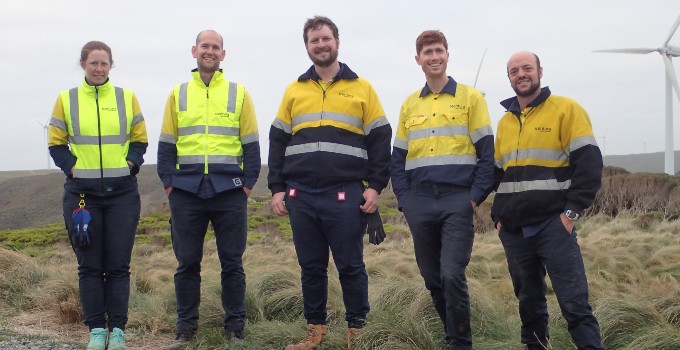
For renewables to achieve the necessary growth, we are going to need people from diverse technical and cultural backgrounds. Those of us in leadership positions need to be willing to employ new graduates and support people who may initially lack specific experience but will in short time become valuable contributors.
At the conference, Kane Thornton (Chief Executive of the Clean Energy Council) called on leaders in the industry to put aside their own propensity to try to carry the load, and instead focus on developing new leaders as a priority. With such ambitious targets for new renewable energy, this is the right, future-oriented approach. We all have a part to play, and the theme of the conference, ‘Symphony of the Renewables’, points to a collaborative, industry-wide approach rather than a zero-sum project-vs-project approach.
What will it cost?
On the question of cost, CSIRO (in collaboration with AEMO) issues an annual estimate of the cost of different forms of energy generation (GenCost: annual electricity cost estimates for Australia – CSIRO). This study suggests (with evidence) that wind and solar backed by storage technologies will be the cheapest way to replace coal-fired plants and meet new demand as our country grows.
This is worth celebrating, but the industry must also prepare society for the large expenditures needed to rebuild our energy system, and the cost increases that consumers may sometimes see in their energy bills. While wind and solar are comparatively less expensive than new coal, gas or nuclear, it will not be cheap to achieve the necessary build-out of wind, solar and energy storage that will takes us towards 100% renewable energy. By design, this system will have some infrastructure that will be idle during times of plentiful wind or sun but is vital to the security and resilience of the system overall. This will be a challenging feature of the system to communicate to people who might see in any given year an increase in their household electricity bill.
The overall message needs to be communicated, repeated and reinforced – that this is a once-in-a-lifetime rebuilding of our electricity system into something that is more reliable than we currently have, ready for the future, and cleaner and better for our towns and communities and the wider world.
If you would like to find out more about how Entura can help you optimise your wind farm, develop an asset management strategy, or support you with due diligence services for proposed or operational projects, contact Patrick Pease or Silke Schwartz on +61 407 886 872.
About the author
Andrew Wright is Entura’s Senior Principal, Renewables and Energy Storage. He has more than 20 years of experience in the renewable energy sector spanning resource assessment, site identification, equipment selection (wind and solar), development of technical documentation and contractual agreements, operational assessments and owner’s/lender’s engineering services. Andrew has worked closely with Entura’s key clients and wind farm operators on operational projects, including analysing wind turbine performance data to identify reasons for wind farm underperformance and for estimates of long-term energy output. He has an in-depth understanding of the energy industry in Australia, while his international consulting experience includes New Zealand, China, India, Bhutan, Sri Lanka, the Philippines and Micronesia.
MORE THOUGHT LEADERSHIP ARTICLES
A fast and fair energy transition demands a skilled, diverse workforce
The clean energy transition is set to create millions of new renewable energy jobs worldwide. It will, however, also bring major change for workers and communities who currently depend on carbon-intensive industries.
This leads to two major challenges:
- how can the clean energy sector find enough skilled workers to enable the mammoth task ahead of us?
- how can we make sure that no one is left behind so that the transition is both fast and fair?
These are enormous questions for the clean energy sector as a whole, not for hydropower alone. All players in the sector need to own our part of the challenge and act urgently to find and implement the solutions that are right for us.
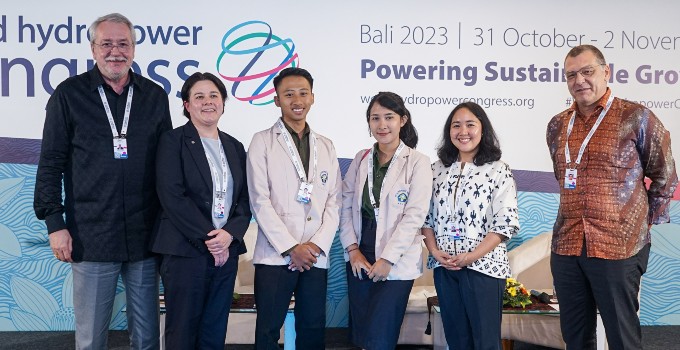
At the recent International Hydropower Association Congress in Bali, I facilitated a panel discussion on these issues. With hydropower globally already experiencing staffing and skills challenges, our panellists agreed that the sector needs to plan and act now on at least five fronts:
1 Retaining organisational knowledge
The sector will need a strong focus on knowledge transfer, especially as talented and deeply experienced professionals retire from the industry. It’s estimated that as much as 25% of the hydropower workforce will reach retirement in the next decade, taking their knowledge and skills with them.
2 Attracting and retaining a skilled workforce
All clean energy technologies will be competing for talent as the energy transition accelerates towards 2050 net zero targets. Hydropower will need to consider how to remain competitive in this tight employment market. The fact that hydropower plants are often located in remote areas can be a barrier to some people. Scholarships, subsidies and payment levels may help to offset some of the barriers, as will creating supportive, flexible and safe workplaces with attractive terms of employment.
There’s also a need to ensure, and promote, hydropower’s environmental and social sustainability, as more and more workers are increasingly motivated by purpose, values, integrity and sustainability. It’s important that we demonstrate how a career in hydropower can be enormously fulfilling, with so many opportunities to make a meaningful difference to society and a sustainable future.
Another important consideration is that we’re not talking about engineers and electricians alone, although priming the pipeline of STEM students and apprentices is particularly urgent in these areas. We’ll also need a vast range of other professionals, with skills in finance, law, project management, people management, IT, environmental science, planning, community engagement and more. Workforce planning needs to take these role into account.
3 Activating a range of options for skills development and training
We will need to ensure that we’ve got the right mix of different training options available – from formal tertiary and vocational training, through to customised and on-the-job training (such as the skills and capacity development that Entura’s clean energy and water institute provides) and less formalised upskilling. The next seven years will be critical here, so that the workforce is ready as we hit the major escalation of clean projects in the race towards 2050.
4 Mapping opportunities in the sector to support a ‘just transition’
What can we do to find mutually beneficial opportunities for workers and communities affected by changes in carbon-intensive industries? The transition to clean energy industries isn’t necessarily a straightforward switch for workers (for example, are the jobs of the right quality, in the right places, and at the right time?) – but could hydropower be an option for some? How can we support displaced workers to adapt to the jobs of the future? To drive policy, countries need to move quickly to analyse their current and future workforce capacity and needs, and their transition challenges and opportunities – as Australia is doing. Take a look at the recent report from Jobs and Skills Australia, The Clean Energy Generation: Workforce needs for a net zero economyand, to see what’s happening in this space around the world, read the International Energy Agency report on Skills Development and Inclusivity for Clean Energy Transitions.
5 Maximising women’s participation in the sector
It’s well recognised that women are still underrepresented in engineering, in the overall clean energy workforce, and in hydropower. The gender gap becomes larger at senior and managerial levels. Women also leave the hydropower sector more often than men (whether that’s changing sectors, changing companies, or leaving the workforce altogether). As I’ve said many times before, our industry simply cannot afford to miss out on the talent of half the population. We need greater action to maximise opportunities for women and other underrepresented groups in the hydropower workforce and access the widest pool of diverse talent.
So what can we do about this? We can:
- address the ‘pipeline problem’ – by raising the profile of STEM as a path for schoolgirls/ university students / apprentices
- create incentives to attract women into the industry (e.g. scholarships)
- ensure unbiased recruitment approaches
- adopt flexible, supportive and equitable workplace strategies to help attract and retain women in the industry, particularly women balancing caring responsibilities
- ensure that hydropower workplaces are secure and safe for women with appropriate facilities
- fix the pay gap
- create opportunities for networking and mentoring to encourage career progression and industry retention
- ensure that women are encouraged to apply for senior positions, and that women in senior roles are visible role models for others
- involve men in understanding and remediating existing gender barriers – a particularly powerful action, as identified in the recent World Bank report on gender equality in the hydropower sector
- think, talk and act on gender issues every day, not only on International Women’s Day!
In short, there’s no lack of action we can take to make the hydropower sector more inclusive and diverse, even if those actions look a little different or take more time in different regions. The most important thing is to move forward.I strongly recommend that you read Power with Full Force: Getting to Gender Equality in the Hydropower Sector, which has just been released by the World Bank. It’s a powerful study of these issues, and, for me particularly, a strong reminder that the conditions we might take for granted in countries like Australia, such as paid parental leave and anti-discrimination laws, are not enjoyed by all women in the global hydropower sector, particularly in developing countries.
Clearly, to secure the next-generation workforce needed to deliver the renaissance in hydropower, we’ll need to work together to tackle the challenges and make the most of the opportunities ahead. None of the five actions I’ve listed in this article are surprising and none are merely a ‘nice to have’ – they are all essential and urgent.
Talking about these issues at global conferences is important, but it’s not enough. Now is the time for meaningful and urgent action to turn observations into actions and intentions into results.
We would like to acknowledge the panel participants: Kate Lazarus, ESG Advisor – IFC, Martin Stottele, Team Leader of RESD (Renewable Energy Skills Development, Indonesia) Programme, and Josef Ullmer, Director Andritz Hydro, Andritz.
Click here for more information about the Entura clean energy and water institute. For more information on our work in sustainability and planning, please get in touch.
About the author
Tammy Chu is the Managing Director of Entura, one of the world’s most experienced specialist power and water consulting firms. She is responsible for Entura’s business strategy, performance and services to clients, and is part of Hydro Tasmania’s Leadership Group. As a civil engineer, Tammy specialised in the design and construction of mini-hydro and hydropower systems, project management, hydropower investigations, prefeasibility and feasibility studies, environmental assessments and approvals, resource investigations and resource water management. Tammy is a member of the Board of the International Hydropower Association. She was the first female and now past president of the Tasmanian Division of Engineers Australia, and was an Engineers Australia National Congress representative.
MORE THOUGHT LEADERSHIP ARTICLES
What is the best way to model complex water structures?
Understanding the behaviour of water as it flows in natural and constructed environments is fundamental to designing and managing many civil assets, and integral to reducing risk and cost in water infrastructure projects.
Water is such an intrinsic part of our lives that we all have a good observational understanding of what water is and what it does in many everyday situations, like falling from a tap or spiralling down a plug hole. But our intuition can only take us so far. When engineers design important infrastructure such as dam spillways, or inlets to pump stations, or need to understand issues such as fish passage for a low weir, they need to turn water into numbers and quantify its behaviour. Being able to quantify complex water flow is one way engineers can better understand the world and make a difference.
Modelling options
When water flow is complex and a deeper understanding of its behaviour is required, the two main options to help improve this understanding are physical scale models and computational fluid dynamic (CFD) models. But when should one be used over the other?

Physical scale models are created and used in a research laboratory, whereas CFD models are created using software and run on fast computers. Here ‘scale’ means the physical models are built at some fraction of the item of interest’s size. Historically, physical scale models have been the gold standard for helping understand complex water flow, but that’s not always the case now. Both methods have a place, and they can complement each other.
It’s generally better to use more advanced modelling techniques early in a project to better guide the design process or understand an existing system.
Has CFD killed the physical scale model star?
Knowledge about the physics of water flow has developed from centuries of physical observation with experiments run in hydraulics laboratories and the field, combined with theoretical calculations. Advances in computing performance in the last few decades have allowed these theoretical calculations to be solved in finer detail and with greater accuracy. But does this mean the end of physical scale modelling testing, in particular as computing power is growing faster than the number of research laboratories? Not for a while.
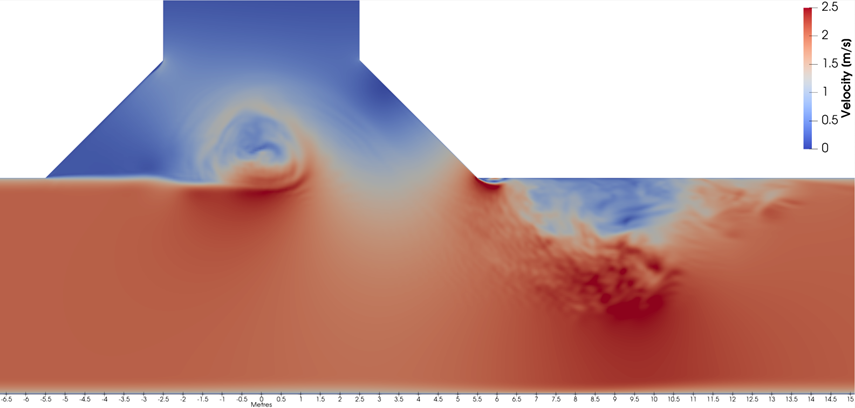
Even with advanced, powerful computing systems, the outputs of CFD software tools still need to be validated against physical measurements. For the physical scale of the civil engineering problems being solved (e.g. a dam spillway), the CFD models approximate the theoretical calculations, and these approximations need to be validated. Some water flow problems are dominated by well-defined forces, such as gravity, and these problems are easier to validate. But other problems are dominated by turbulence and multiphase flow, and these are harder to validate as the phenomena are more complex.
A note on turbulence and multiphase flow
In the aerospace and car industries, where the fluid of interest is air rather than water, a designer uses a combination of wind tunnel testing and CFD modelling to better understand the performance of a design. Small parts can be simulated in CFD with minimal approximations using direct numerical simulation (DNS) of turbulence. But for a full car and even more so for a large commercial aeroplane, it’s currently cost-prohibitive to only use DNS (e.g. millions of dollars per run), and some level of wind tunnel testing is still required. This is combined with non-DNS modelling CFD methods.
It’s similar in civil engineering. There are different physical sizes, stages of a project timeline, costs, and risks of getting the answer wrong. These drive the balance between CFD and physical scale model testing. Most work, in particular at a concept level, is done with CFD, but physical scale modelling is still recommended for critical infrastructure prior to construction.
A matter of scale
The size of most civil engineering infrastructure – such as spillways, rivers and large stormwater culverts – make it impractical to use DNS of turbulence (based on cost and timing).
Both physical scale models and CFD can be time-consuming tools to use, and for various projects it’s better to use one before the other. For the design of fish passages and recreational water systems (such as whitewater kayaking), doing small-scale, rough physical scale modelling can be efficient for design development of concepts. This is because designers can move 3D-printed shapes around in a hydraulic flume, and see and feel the direct impact on changes to the design. This is a very complex problem with few industry guidelines and without the same body of research as other civil engineering problems, such as dam spillways and energy dissipation.


Where there is a large body of knowledge on a topic, standard designs provide a starting point. Then, it’s often efficient to start with hand calculations or a concept-level CFD model. These calculations may lead to more detailed design, modifications of standard designs with detailed CFD modelling, and then, potentially, physical scale model testing. There are always iterations, and sometimes the CFD modelling can be used to inform the design of a physical scale model testing setup, and vice versa. CFD modelling is also faster and can more easily be used for design optimisation compared to physical modelling.
In some cases, using CFD alone is possible, particularly where there is a solid body of knowledge about a piece of infrastructure. The temptation is to use CFD more and more, as it can often be lower in cost. It is also important to note that physical scale model testing has its limitations. So there are cases where CFD modelling can provide more insight at a lower cost.
With physical scale model testing, the key limitation is in its name. The model is built at a much smaller scale than the feature being modelled – just a fraction of the expected final design or existing system size. Typically a coarse model of a dam or spillway may have a 1 in 200 scale, and a good one may be at a 1 in 50 scale. A 1 in 50 scale model of a spillway that was going to be 100 m high when finally constructed would need to be 2 m high as a model. This is okay for pure water models, but for aerated flow the ideal scale is closer to 1 in 10. So if aerated flow was important in that 100 m high spillway, then the model would be 10 m high. At that size it would not fit in a normal hydraulics laboratory and would be very expensive to build. So, typically, a compromise is made and a 1 in 30 model is constructed. The reason scale is important is that water behaves differently at different scales. For example, surface tension is important in a pipe that’s 5 mm in diameter but is not important in a large river flow.
How do you measure water?
Another limitation of physical scale model testing is measuring the flow during the experiment. There are some limitations on CFD as well but, compared to a physical scale model test, it is generally much easier to get the results from a CFD model accurately, in many more locations, and without disturbing the flow.
Complex models demand high-performance computing
Complex multiphase flows for fish passage and smaller whitewater kayak systems can be modelled well with scale models initially, as the system being modelled is relatively small. But when you’re modelling something that is much larger and has complex multiphase flows, scale model testing is harder. Model size is important for CFD models as well, and there is no free kick here. Larger systems where there is complex flow are computationally more expensive to model in detail using CFD. Typically, however, the budget of projects involving larger complex systems are also larger – and so, the modelling costs can be a similar proportion of the total project costs for small and large projects.
At some point in the future, such as when quantum computing becomes mainstream, CFD using direct turbulent simulation (i.e. DNS) of larger objects could completely replace physical scale modelling.
Room for both in pushing the knowledge envelope
Both physical scale modelling and CFD modelling require specialised facilities and experienced modellers. With the advent of lower cost computing services and increased CFD training in many engineering courses, CFD modelling has become the lower cost option for many civil engineering water modelling problems. But both physical scale modelling and CFD will continue to remain important for many years yet, and both approaches should be encouraged.
In general, what’s easy or difficult in physical scale modelling is often of a relatively similar level of difficulty for CFD modelling. Often the approach will come down to a modeller’s preference and access to either option, but in some cases it’s prescribed by standards. CFD is often cheaper and faster to set up for most civil engineering scale problems and, once set up, can be run on multiple computers at once and address more questions at once. Viewing the results of the CFD model is more flexible, but some prefer the touch and look of a physical scale model.
For novel phenomena at the edge of our understanding, there is still no substitute for a physical scale model. Over time, this will leave physical scale modelling mainly as a research tool and to aid community consultation and education, with CFD used for operational modelling in industry. Most projects will still use a combination of the two.
Like all good engineering projects, solving complex water modelling problems requires having adequate time and budget to provide a suitable quality result. When approaching a complex water flow problem, inform yourself of the solution options. The best model for your stage of understanding is the one that reduces uncertainty and improves knowledge to aid better decision-making.
If you’d like to talk with Entura about your water or dam project, contact Phillip Ellerton (Australia) or Shekhar Prince (international).
About the author
Dr Colin Terry is a civil engineer at Entura with three decades of experience in Australia and New Zealand. His experience includes modelling, planning, design and construction support. He has worked on multidisciplinary projects across various parts of the water cycle including catchment management, water supply, hydropower, land development, transport, and water quality in natural systems – with a focus on surface and piped water.
MORE THOUGHT LEADERSHIP ARTICLES
De-risking renewable energy projects is in everyone’s interests
The rapid transformation of the energy sector is exciting and ripe with opportunities. Inevitably, it also involves a level of complexity and a range of uncertainties. Phrases such as ‘decarbonising the future’, ‘net zero emissions’ and ‘energy security’ feature in almost every energy transition seminar, but what do they really mean when it comes to constructing and operating the projects necessary to support a cleaner and greener future? How can developers design and develop for sustainability across the whole project lifecycle?
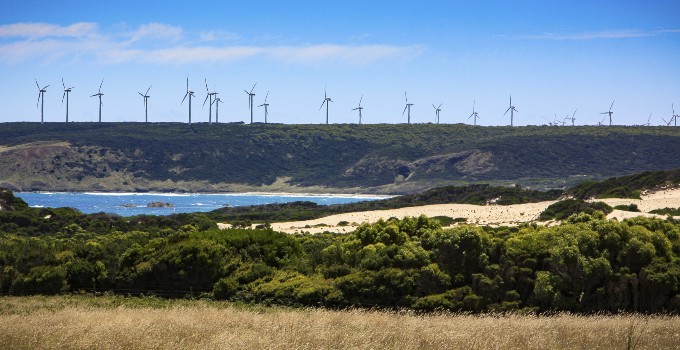
With over 6 GW of committed large-scale wind and solar projects in the development pipeline, many of which need external finance, it is crucial that projects are developed in a way that will qualify for financing and will align with contemporary sustainability standards. Many financial institutions are applying risk management frameworks such as the Equator Principles to determine, assess and manage environmental and social risks. Over 100 financial institutions globally, including key Australian banks such as Commonwealth Bank, ANZ and Westpac, have adopted the principles. The Equator Principles provide a framework for due diligence into whether the project has been or is being developed in an environmentally and socially robust manner including respecting human rights. Similarly, regulators require evidence of sound avoidance and minimisation strategies to reduce the footprint of disturbance, particularly through construction.
Environmental, social and governance (ESG) considerations throughout the whole project lifecycle, including supply chain considerations, are more carefully scrutinised than ever before. Poor management of ESG can lead to reputational, financial and legal consequences. Investors will want a thorough review of approval documentation and evidence of systems and processes to assess project risk regardless of whether projects are already approved or are still under assessment. The investor needs reassurance that the project will be, or has been, developed in a manner that aligns with their own ESG objectives.
To help your project progress smoothly through the approvals process, consider these points:
Each project’s risks, and their relationships, are unique
No two projects are the same. There are myriad ESG risks for any project, and the work to understand and quantify these risks is also project-specific. The interrelationship of the risks influences the risk profile of each project, which is pivotal to investment and acquisition decisions. Some examples of risks include changes in regulation between the time of construction and approval; changes in the conservation status of threatened species that alter operational monitoring requirements; community resistance post-approval; or lack of transparency throughout the supply chain amidst the risks of modern slavery.
Start early with thorough studies and engagement
From an approvals perspective, there is significant benefit in investing early and proportionately in environmental and social studies. It’s also important to invest in well-documented planning assessments that include building a relationship with the regulator as well as robust community and stakeholder processes. Meaningful and genuine engagement with First Nations communities is crucial, as projects are often developed on Country not previously subject to development. In terms of environmental and social risks, some projects may simply be too difficult or inappropriate to develop at the largest possible scale. As the number of projects being developed in a region increases, cumulative impacts are increasingly at the centre of communities’ and assessing agencies’ concerns, particularly in terms of noise, visual impacts and ecology.
Getting on the ‘front foot’ delivers results
It is important for developers and proponents to understand that the quality of work at this early stage is likely to impact on the due diligence process – for example, whether studies have been prepared to best practice or industry standards, and whether risks have been identified early and managed appropriately. Good early studies, actions and decisions can make a difference even before the project is approved – providing regulators with confidence that you’re being proactive when it comes to ESG risks, whether that be through design iterations or measures to manage construction and operation.
Investing early to de-risk may reduce the potential for disproportionate costs later in the project, such as re-work or offsets, and may increase the project’s likelihood of achieving finance. Due diligence throughout the approval process is likely to reassure a potential investor or buyer that the project has been de-risked as early and as thoroughly as possible. With the energy transition such an urgent priority in Australia and across the globe, it’s vital that generation, storage and transmission projects progress both rapidly and sustainably. A focus on early de-risking is undoubtably a key enabler of this goal.
Entura has led a number of supply/vendor and lender technical due diligence assessments nationally and internationally, assisting in the investment, acquisition and transaction for large portfolios of renewable energy projects, including solar, wind and battery energy storage systems. Reach out to Patrick Pease (Australia) or Shekhar Prince (international) to find out more about how we can support you with due diligence assessments.
About the authors
Cynthia Nixon
Cynthia’s experience and qualifications in environmental engineering, environmental law and communications provide an integrated perspective on sustainability risks for Entura’s clients. She has over 15 years experience implementing systems and managing compliance and risk, including auditing, risk assessment, training and reporting. She currently manages Entura’s Integrity Framework and supports clients to improve their sustainability performance. She has conducted due diligence assessments across hydropower, solar and wind farm projects and assessed performance against the Equator Principles and International Finance Corporate Performance Standards (IFC PS). She is a certified user of the Hydropower Sustainability Standard and Tools.
Bunfu Yu
Bunfu is a Senior Environmental Planner at Entura with diverse experience in strategic and statutory planning, environmental approvals and management, and engagement and consultation streams for small to large-scale projects across Australia and the Indo-Pacific. Working with public and private clients across the water, energy and infrastructure industries, she designs and leads fit-for-purpose approval strategies that consider the community, landscape and regulatory regime, and advises on acquisition, joint venture and/or purchase of portfolios in due diligence roles nationally and internationally. She was awarded the 2023 National Young Planner of the Year by the Planning Institute of Australia.
MORE THOUGHT LEADERSHIP ARTICLES
Dams are crucial to climate change response and the energy transition
At the recent ICOLD meeting in Gothenburg, Sweden, dam engineering experts from across the globe came together to share knowledge, discuss trends and issues, and engage with each other. One important topic of discussion was the role of dams in the international response to climate change and what that will mean for the dams industry. Richard Herweynen, Entura’s Technical Director, Water, shares his thoughts on this topic here …
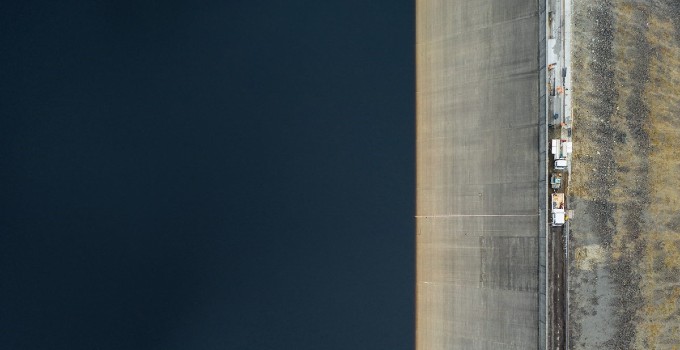
Why will dams play a critical role?
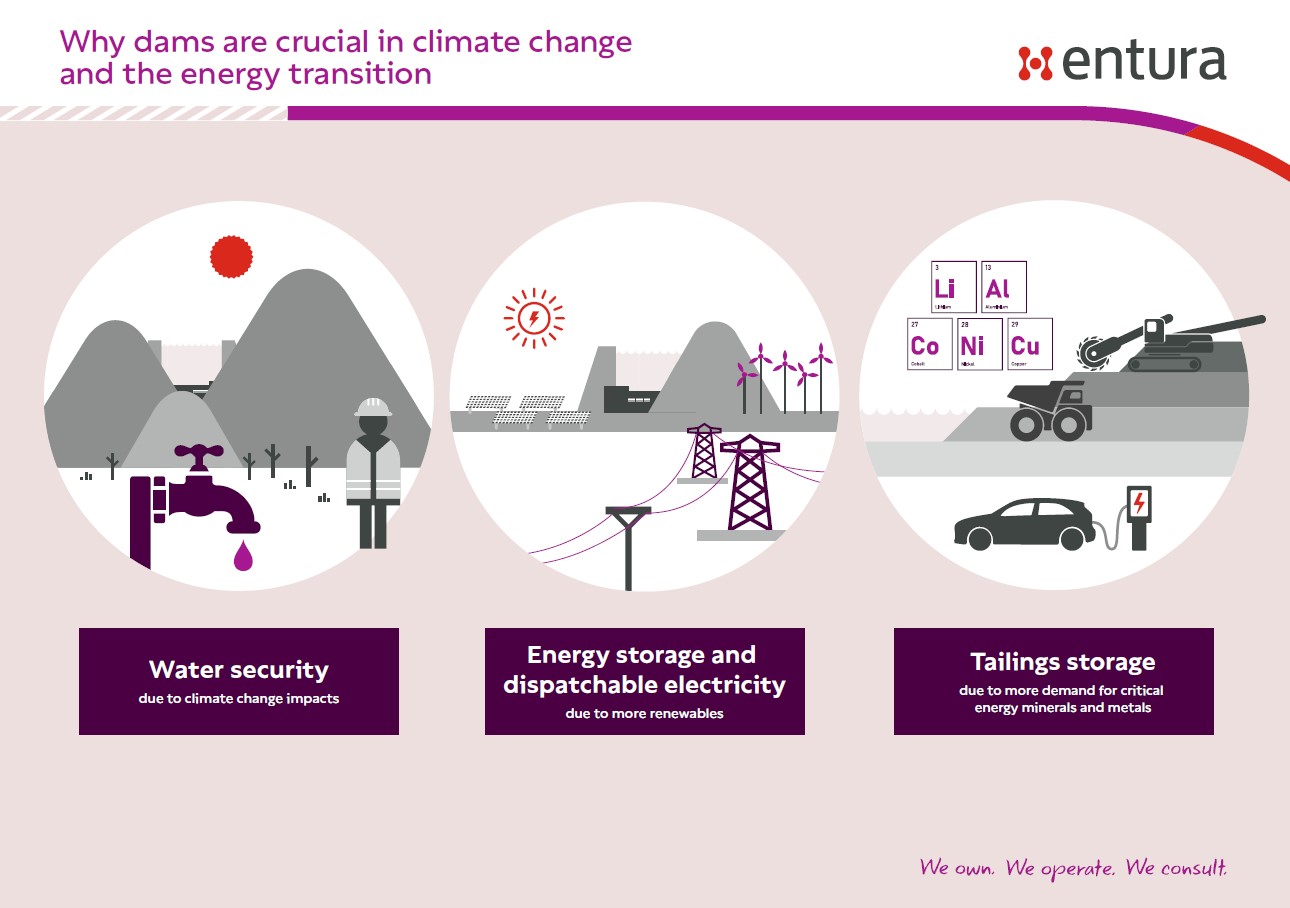
Three major reasons why dams will be crucial in the climate change response and energy transition are water security, dispatchability of electricity, and tailings storage.
- Water storages will be vital to provide the same level of water security
Water security is essential for humanity. With greater hydrological variability due to climate change, more storage will be needed to provide the same level of security of water, food and energy. Water storage is a fundamental protection from the impacts of a changing climate, safeguarding the supply of water, and the water–food–energy nexus, even during extended drought.
The effects of climate change are predicted to increase and to result in greater magnitude and frequency of hydrological extremes, such as prolonged droughts and significant floods. With prolonged drought, inflows to storages will reduce. If demand remains the same, stress on existing water storages will increase.
Water storages are used to regulate flows and manage this variability: storing water when there are high inflows (or floods) and then using this stored water during low inflows (or droughts). Dams are used to create these vital water storages.
- Hydropower and pumped hydro energy storage (PHES) are critical for the energy transition
A key response to climate change is the decarbonisation of the electricity sector through renewable energy. Wind and solar power now offer the lowest cost of energy, have low ongoing operational costs, and emit the least greenhouse gases across their lifecycle – and therefore hold the greatest potential for rapid decarbonisation of the energy sector. Of course, wind and solar PV output vary according to the weather and the time of day – but the electricity market needs the supply of electricity to match demand, or for these renewables to be dispatchable.
Energy storage is the key to smoothing out the variability of renewable energy generated by solar and wind. The power and duration of the storage are the two key variables in determining the most suitable solution. Low-power, short-term storage is currently more cost-effective using batteries, but longer periods and larger power requirements are likely to rely on bigger storage options, such as pumped hydro energy storage (PHES) and traditional hydropower. Smoothing out the daily variability in renewables can be achieved effectively through pumped hydro. Dams are used to create the water storages used in both traditional hydropower and PHES.
- The transition to renewables will demand more minerals and metals
The global energy transition will demand a major increase in renewable energy technologies – which in turn will require more of the ‘critical energy minerals’ and metals. The rising need for minerals such as copper, aluminium, graphite, lithium and cobalt will not be able to be met by recycling and reuse alone. Therefore, extraction and storage of minerals from mining operations will be essential to sustain the renewable energy transition.
According to a report by the World Bank Group, the production of minerals such as graphite, lithium, and cobalt could increase by nearly 500% by 2050 to meet the escalating demand for clean energy technologies. It is estimated that over 3 billion tonnes of minerals and metals will be necessary for the deployment of wind, solar, geothermal power and energy storage, all of which are vital for achieving a sustainable future with temperatures below 2°C.
However, this need for mining activity comes with a special responsibility for sustainable practices, including the proper management and storage of mining waste. Rock, soil and other by-products are left behind after the desired minerals have been extracted from the ore. Tailings facilities store this waste, playing a crucial role in mitigating the environmental impact of mining operations. Dams, in particular, are commonly used to create these facilities, as they provide an effective means of containing the waste.
Dams used in tailings facilities are designed to withstand the weight and pressure of the waste materials, prevent seepage of contaminants into the surrounding environment, and take into account factors such as stability, erosion control and water management. Dams that are well designed, constructed and monitored, adhering to stringent environmental and safety regulations, can help prevent the spread of mining waste into nearby water bodies, reducing the risk of water contamination and protecting aquatic ecosystems.
Working towards ‘good dams’
While there have certainly been some examples around the world of dams that have had adverse impacts, it is clear that dams will play a critical role in the international response to climate change and the decarbonisation of the energy sector. It’s therefore vital that dams are planned, constructed and managed appropriately and safely. With increasing understanding of impacts and far greater sophistication of internationally accepted sustainability protocols, it is now up to developers and planners to heed the lessons of the past and find the right dam sites for nature and communities.
It is important that we ensure the safety of existing dams as well as the safety of any new dams. Examples from around the world demonstrate the devastating consequences of dam failures. Safety must be every dam owner’s key concern, and should be managed through an active dam safety program.
Of course, the larger the portfolio of dams an owner is managing, the greater the demand on their resources; however, it is critical that dam safety risks for water storages and tailings facilities are managed appropriately across dam portfolios to protect downstream communities. The Portfolio Risk Assessment process increases the focus on potential failure modes and risk as drivers of the dam safety program and as the basis for deciding priorities for allocating operational and capital resources.
It will also be vital that dams engineers, owners and operators keep up to date with the latest developments in the dams industry worldwide through continuous learning and important global forums such as ICOLD.
If you’d like to talk with Entura about your water or dam project, contact Richard Herweynen.
About the author
Richard Herweynen is Entura’s Technical Director, Water. Richard has three decades of experience in dam and hydropower engineering, and has worked throughout the Indo-Pacific region on both dam and hydropower projects, covering all aspects including investigations, feasibility studies, detailed design, construction liaison, operation and maintenance and risk assessment for both new and existing projects. Richard has been part of a number of recent expert review panels for major water projects. He participated in the ANCOLD working group for concrete gravity dams and is the Chairman of the ICOLD technical committee on engineering activities in the planning process for water resources projects. Richard has won many engineering excellence and innovation awards (including Engineers Australia’s Professional Engineer of the Year 2012 – Tasmanian Division), and has published more than 30 technical papers on dam engineering.
MORE THOUGHT LEADERSHIP ARTICLES
A shift in asset management mindset brings new opportunities for hydropower
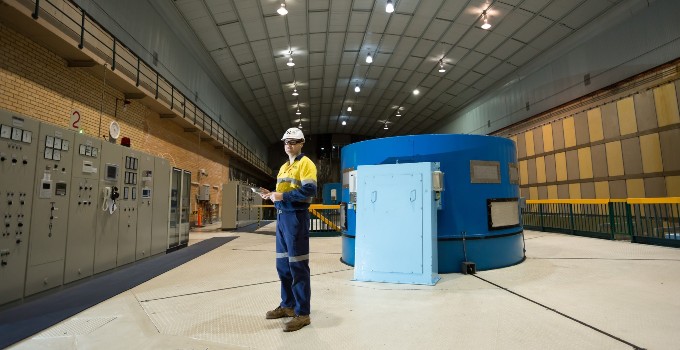
Compared with other clean energy technologies, hydropower is a long-distance runner. Many hydropower facilities have an expected lifespan of up to a century. An increasing challenge, however, is that many of these facilities are already well progressed on their life journey. With much of the world’s hydropower fleet already at or beyond mid-life, effective asset management is key to enabling these plants to perform successfully into the future.
But times change – so the way these plants operated decades ago may not be the way they can best serve us now or into the future. Changing energy markets will present different demands and new opportunities that extend beyond the operational states for which some hydropower facilities were originally designed.
In this context, asset management can do more than maintain the functional status quo; it can become a strategic enabler of change, breathing new life into old assets in a rapidly changing landscape.
New roles for hydropower
Energy markets are in transition. The pursuit of clean energy targets, the declining costs of wind and solar power, retirements of coal-fired power stations, and volatility in supply and pricing of gas are driving rapid change. With large amounts of wind and solar, the market needs storage to smooth supply. It also needs ancillary services that maintain a stable, reliable and resilient electricity grid. Hydropower can provide both.
To meet these market needs and to take advantage of emerging opportunities, the way we operate some hydropower plants will need to change. This calls for a rethink about how we want our assets to perform. The focus of asset management should now be shaped around maximising market opportunities as well as maintaining reliability while also optimising performance and dispatchability. This focus can be applied to designing new hydropower developments as well as overhauling aging assets.
Getting the strategy right
Over time, asset management has become a catalyst for continuous improvement regarding asset stewardship, evolving beyond reactive and fixed-interval maintenance, through to far more proactive, preventative and risk-based approaches guided by international standards (ISO 55000). However, even advanced asset management approaches tend still to be geared towards replacing ‘like for like’ to maintain desired levels of reliability, capacity and performance.
We believe that what’s needed now is a new chapter for asset management; one in which we employ all the sophistication of existing asset management approaches but add a new focus on ‘designing for dispatch’ to meet the market need whenever opportunities arise.
Here’s how that might look:
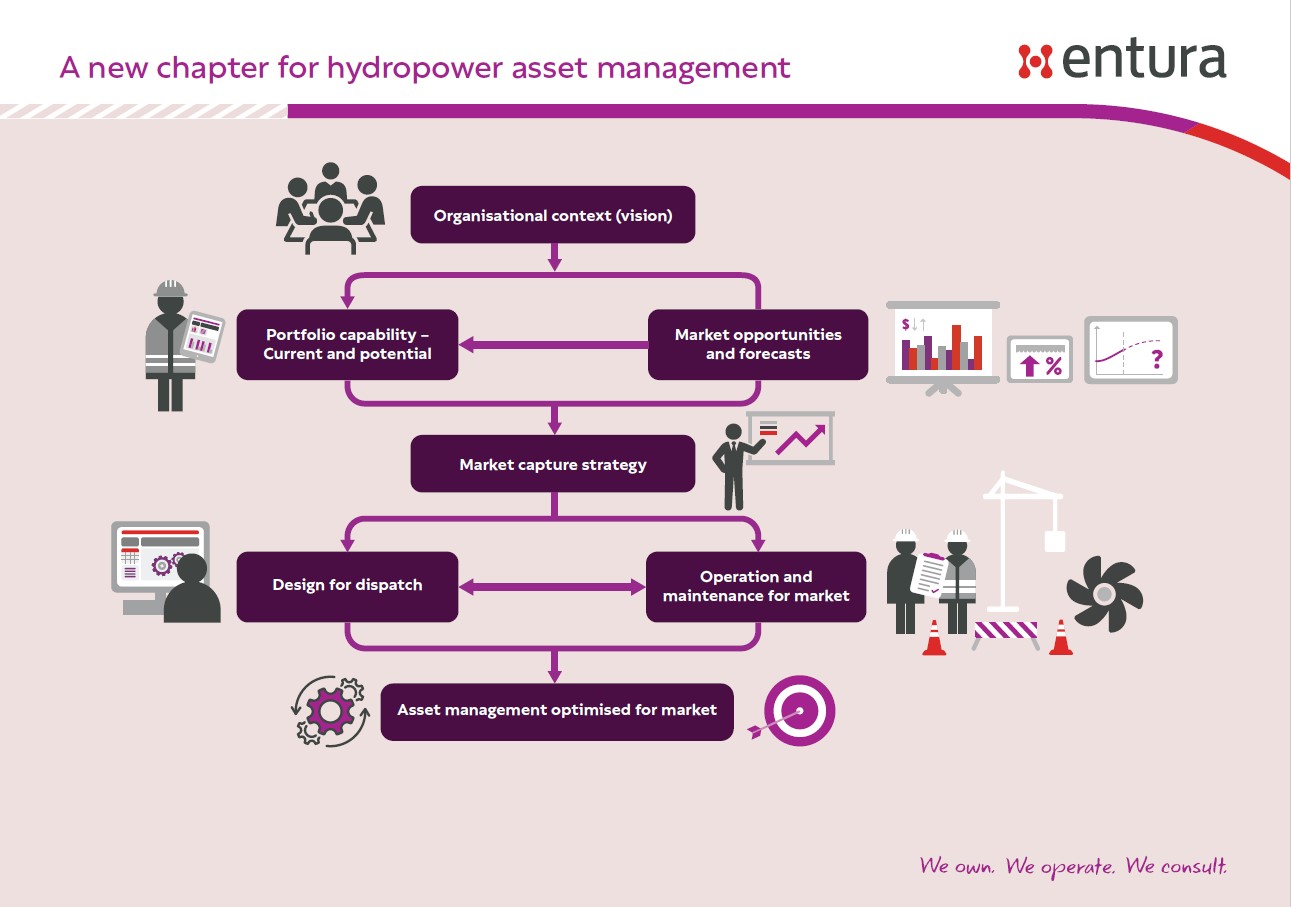
The starting point for the asset management strategy must be the organisational context. In other words, the asset management approach needs to enable the organisation’s vision, mission and business plans. But the organisational context cannot be a ‘set and forget’. It may shift due to changes in the broader operating environment, or it may change if there is a transfer of ownership of the organisation.
The next step is to understand the current and potential portfolio capability within the context of the organisational strategy. This means understanding how each particular machine and/or station is currently operating and performing, as well as how it would need to in future to deliver the desired outcome. Part of this process will be identifying any limitingfactors. These could be elements of the operational environment, such as weather patterns, rainfall events, or the relationship between one station and others in the cascade.
With a clear understanding of each asset’s performance and reliability requirements, asset management plans can be reviewed and adjusted to suit – or, in some cases, the asset may even need to be redesigned. The driving question behind the asset management strategy will be what each machine needs to be able to do in the market. Within the market opportunity, what are its strengths and weaknesses, and how will it interact with what the trading floor needs?
A market focus in practice
Let’s look at this in some real-world scenarios.
For an asset that largely performs as a baseload station, the asset management strategy may be to minimise the requirement for minor maintenance outages by designing in redundancy – such as having extra machines available in case of a failure.
Whereas, where an asset needs to operate mainly to meet peaks in the market, the components that suffer stress and wear from stop-start activities could be bolstered in their design, with failure modes addressed or eliminated. This may mean trialling new technologies in advance of the changed operation pattern, to be sure that the solution is robust. A change in style of operation from continuous generation to intermittent generation is also likely to call for changes in the monitoring and inspection regime.
It may also be worth changing the maintenance approach to better suit market dynamics. Rather than taking a machine out of service every 12 weeks to replace some relatively inexpensive components in a set, for example, it may be more cost effective to replace whole set at once and only take the machine down every 24 weeks to do so. The cost of the components may be outweighed by the extra revenue earned through less downtime.
We also have the opportunity to identify what part of the asset lets us down, and how we can engineer that in or out to be able to maximise the value of the market opportunity.
This is the approach that Hydro Tasmania is applying to the aging Tarraleah hydropower station, which previously operated inflexibly, based on the constant water volume that flowed slowly to it. A potential new design for Tarraleah may provide greater control of the outputs of the station, with controllable water flow and machines that are able to turn off and on rapidly as needed when the market requires.
The driver for design and asset management in this context becomes primarily dispatchability. Assets are designed and managed to meet the organisation’s vision and consequent dispatch strategy.
Asset owners that are thinking about dispatch are likely to want to take a lead role in the design phase, working together with original equipment manufacturers (OEMs) to design and customise machines to best meet the dispatch strategy and take advantage of market opportunities.
The outcome of the process we’ve outlined here should be an asset management program that optimises assets for the market and maximises their value for current and future operations. By optimising both asset management and dispatchability, hydropower assets can continue to operate efficiently and reliably, and to make very significant contributions to the stability and sustainability of the grid.
If you would like support to understand your dispatch opportunity, iron out barriers, and set up your operations and maintenance strategies to be dispatch-ready, contact Richard Herweynen or Phillip Ellerton.
About the author:
Leigh Smith is a specialist consultant with extensive experience and proven ability in asset management, condition assessment, risk management and project management in the power sector, particularly hydropower. He has over three decades of practical experience with hydropower assets and has successfully delivered and project managed many major projects in Australia and internationally. Leigh has produced numerous asset management plans to support financial modelling and feasibility of major hydropower projects, as well as detailed 30-year asset management and maintenance plans that have been critical to the progression of projects around the world.
MORE THOUGHT LEADERSHIP ARTICLES
Planning sustainable water infrastructure in a changing world
In an already water-stressed world and a rapidly changing climate, water is increasingly precious. To manage and control this vital resource, we must create and maintain safe, reliable and sustainable water infrastructure – and such a challenge calls for good planning.
The International Commission on Large Dams is working towards releasing new guidance for water infrastructure planning – and Entura’s Richard Herweynen is a member of the Technical Committee looking to develop a new ICOLD Bulletin on planning. In this article, Richard explains the importance and evolution of planning approaches.
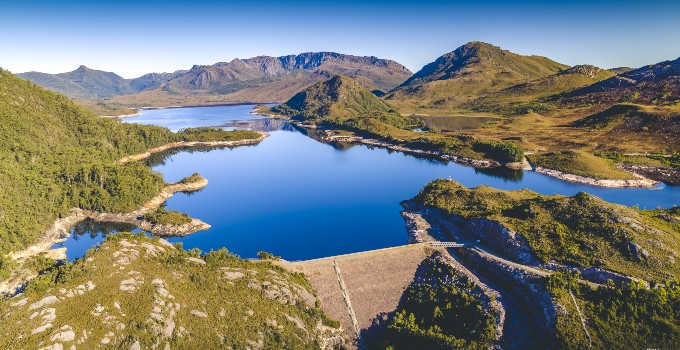
Water infrastructure projects deliver the dams, treatment plants, irrigation systems and distribution networks that provide water for homes, food production, industries and emergencies. They also create the structures integral for mitigating the effects of floods and droughts. But to maximise the benefits of this infrastructure, projects must be planned, engineered and managed for effectiveness, safety and sustainability.
These projects are far too important to approach in a haphazard way. Planning offers a structured, rational approach to solving problems – and it is the start of the ‘pipeline’ for addressing water resource needs and competing demands. In fact, for civil works programs, everything begins with planning.
Without a good plan, where are we?
Without careful planning, it can be difficult to achieve creative, cost-effective solutions to water needs. The planning stage helps decision-makers identify water resource problems, conceive solutions and evaluate the inevitably conflicting values inherent in any solution. Planning is best done by a team that brings together specialists in many of the natural, social and engineering sciences.
At the planning stage, all of the following points should be thought through:
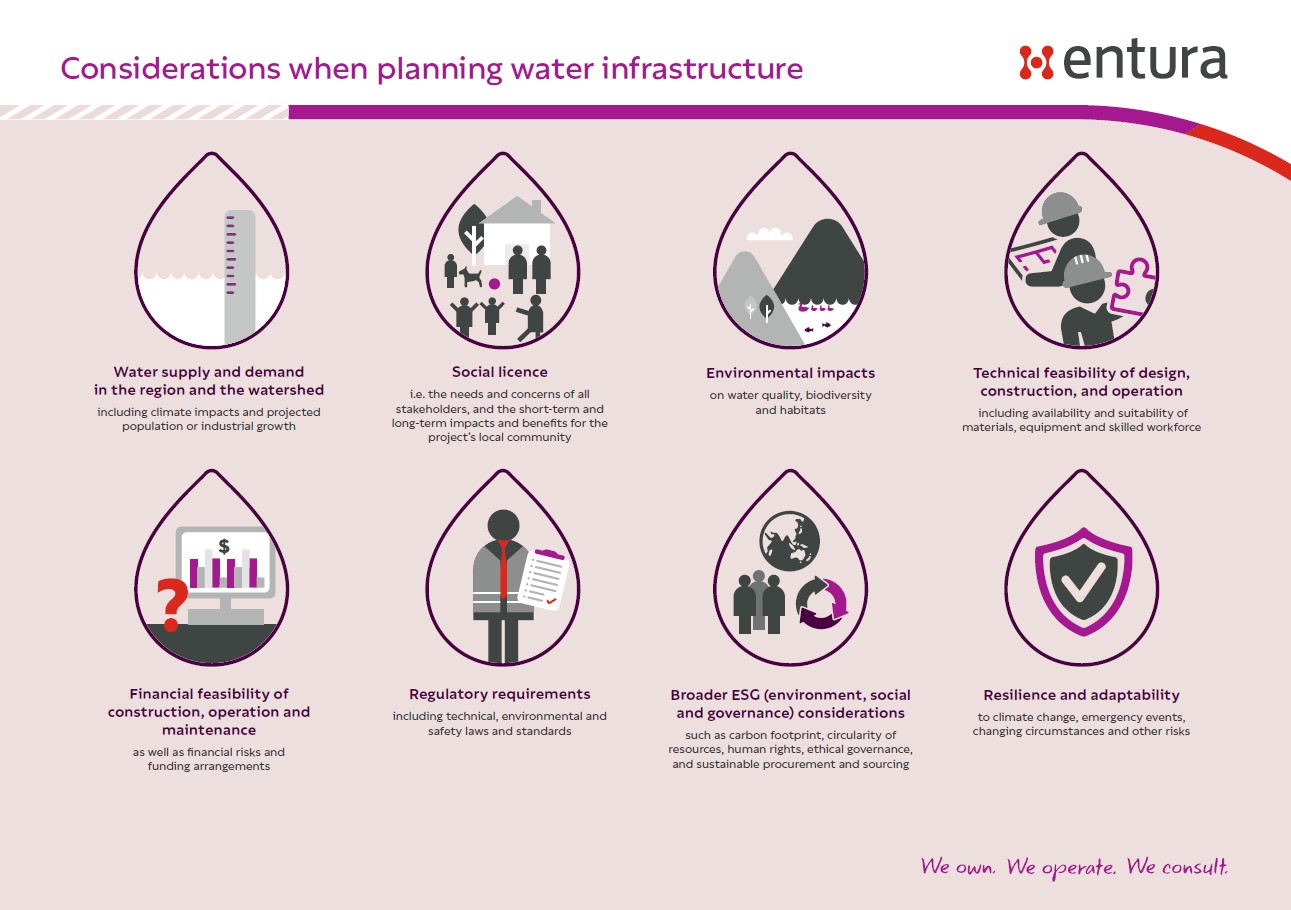
Guidance for better planning
In 2007, I became the ANCOLD-nominated member on a new Technical Committee for the International Commission of Large Dams (ICOLD) entitled ‘Engineering Activities in the Planning Process for Water Resource Projects’. In 2009 we put forward a position paper setting out an ‘Improved Planning Process for Water Resource Infrastructure’ based on ‘comprehensive vision based planning (CVBP)’.
At the next ICOLD Annual Meeting in Sweden in June 2023, our committee will be meeting to work on an updated framework that takes into account the rapid change we’ve witnessed over the last decade and the many cross-cutting issues that are impacting the planning process, such as risk-informed decision-making, climate change, sustainable development, environmental concerns, and river basins/systems.
What is ‘comprehensive vision-based planning’ (CVBP)?
Before we talk about updates, let’s take a quick look at our existing approach to CVBP, as articulated in 2009.
CVPB is a comprehensive, transparent planning process based on a shared vision for sustainable water resource development. It aims to achieve a better ‘triple bottom line’ outcome, with optimum economic, social and environmental outcomes.
Whereas many past projects were planned on a case-by-case basis, CVBP looks beyond the immediate project to the broader regional vision and watershed goals (which may also cross national borders), taking projected changes in water supply and demand into account. It draws on integrated water resources management (IWRM) to consider multiple points of view about how to manage water and to view each water infrastructure project in relationship to the other existing infrastructure in the region.
CVPB also incorporates much greater attention to the realistic options and cost-benefits of mitigation of environmental impacts – and it draws in more interdisciplinary engineering, cost estimating, and stakeholder/community engagement.
CVBP is, therefore, a holistic, integrated and collaborative approach to planning and a much-improved pathway towards successful outcomes.
The 8 steps of CVBP
As currently articulated, CVBP has 8 defined steps – but it’s an iterative process in which steps 2 to 7 are repeated multiple times, as necessary. The 2009 ICOLD bulletin goes into much greater detail than we can in this article, but this will give you an overview:
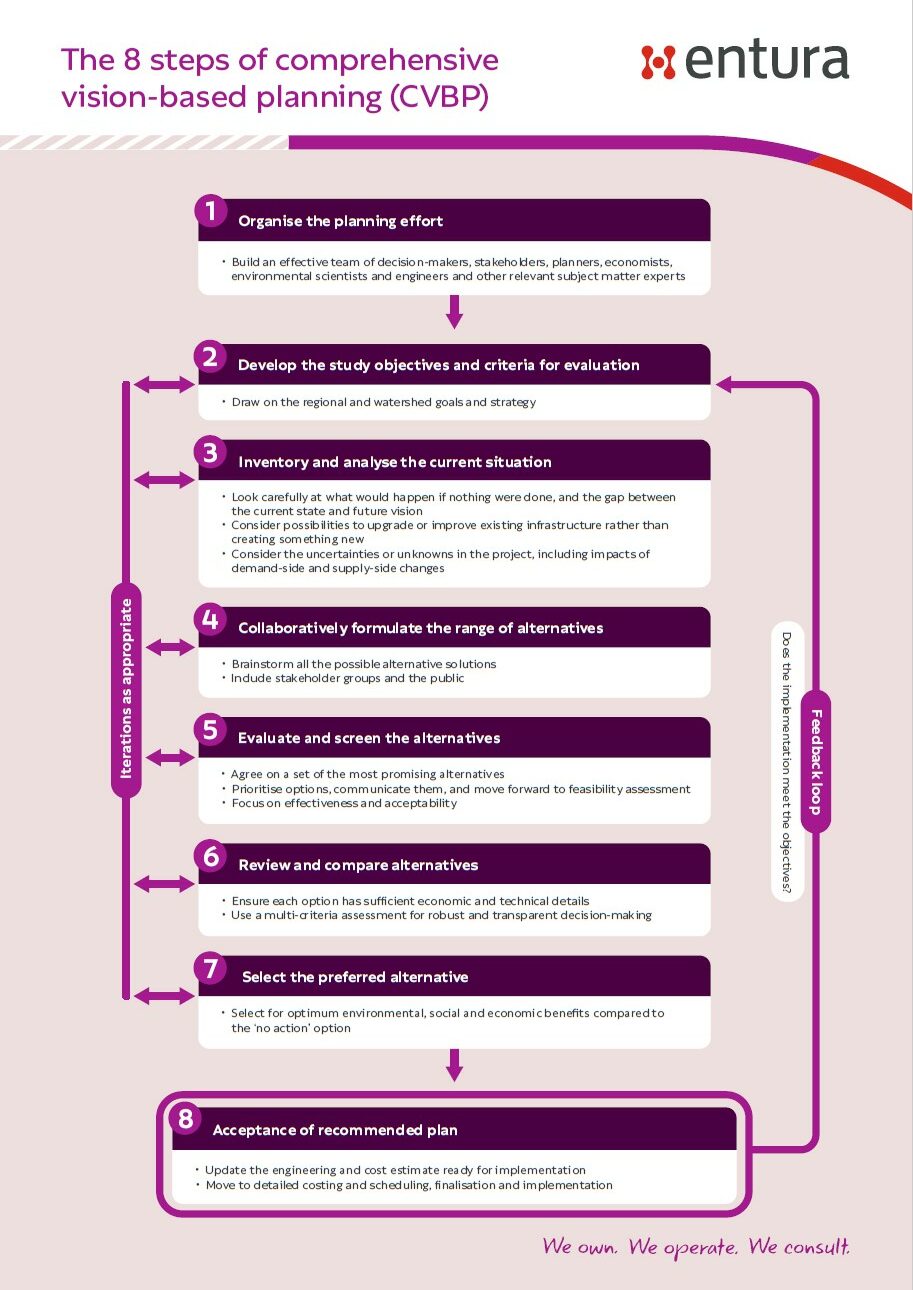
Changes moving forward
It is time to update the planning process and guidance in the light of the rapid changes we are experiencing in our environment, innovations in technologies, and an increasing awareness of sustainability and ethics.
In the past, much water infrastructure has been planned within a reasonably near-term political and social lens and timeframe, and from a perspective of relative stability. But we know that change is constant and rapid, so our planning approaches need to shift to an even greater appreciation of uncertainty, risk and the intensifying potential for extreme events. There is also an urgent need to apply a deeper and broader awareness of the many considerations that make for greater environmental, social and economic sustainability.
Important factors here will be an uplift in stakeholder involvement and governance, a very clear focus on the costs and benefits that can’t easily be quantified or monetised, and reinforcement of the fundamental principle of ‘do no harm’.
It will also be important to take an adaptive approach to regional planning objectives, with a strong awareness of different regional and cultural values, goals, expectations, methodologies, financing arrangements and roles of government.
We should expand the planning scenarios to also explore non-structural options, dam removal plans, and scenarios based on failure modes. We also need to improve early data collection by finding and filling data gaps, improving the ways in which we preserve historical information, and improving data portrayal.
It is very important to involve the right people. Ideally, the planning team should be more than ‘multi-disciplinary’ or ‘interdisciplinary’. It should aspire to be ‘transdisciplinary’, in which all disciplines work seamlessly and collectively and achieve a level of insight that is ‘greater than the sum of its parts’.
This year, our Technical Committee will continue to build on some of these elements as we review and rearticulate CVBP, working towards a new ICOLD Bulletin to guide water infrastructure planning.
In a changing world, our approaches to infrastructure cannot stagnate. Designing, articulating and applying new planning frameworks is an important step towards creating and maintaining the sustainable, reliable water infrastructure our planet so urgently needs.
If you’d like to talk with Entura about your water or dam project, contact Richard Herweynen.
About the author
Richard Herweynen is Entura’s Technical Director, Water. Richard has three decades of experience in dam and hydropower engineering, and has worked throughout the Indo-Pacific region on both dam and hydropower projects, covering all aspects including investigations, feasibility studies, detailed design, construction liaison, operation and maintenance and risk assessment for both new and existing projects. Richard has been part of a number of recent expert review panels for major water projects. He participated in the ANCOLD working group for concrete gravity dams and is the Chairman of the ICOLD technical committee on engineering activities in the planning process for water resources projects. Richard has won many engineering excellence and innovation awards (including Engineers Australia’s Professional Engineer of the Year 2012 – Tasmanian Division), and has published more than 30 technical papers on dam engineering.
MORE THOUGHT LEADERSHIP ARTICLES
When is the best time to invest in deeper understanding? An example from hydraulic modelling
With projects and operations, like life, knowledge is power – the power to make informed decisions and manage risk. That knowledge can be gained in different ways, at different costs, and at different stages of a project. In an era of ever-more-sophisticated digital tools, how do we decide what’s best for the project?
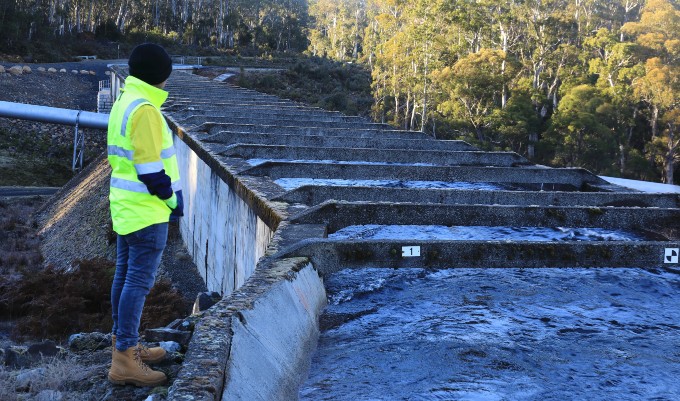
The understanding of when to invest in more accurate assessments is changing. Traditionally, more accurate assessments were time-consuming and costly, and left to later in a project’s life. Now, however, improved techniques and computing power make greater accuracy both possible and affordable earlier.
Here we look at the issue of when to invest in more accurate assessment tools using the example of where hydraulic modelling is a key part of projects, often in the development of water infrastructure.
As a project evolves or a system is operated, different levels of knowledge will be needed to make informed, defensible decisions. This knowledge comes from experience and from assessments specific to the project. With water modelling, these assessments vary in complexity and data requirements. They also need to be integrated into the design and approval for the development.
Investing too early in a detailed assessment can be wasteful, as there usually isn’t the data to support the approach. Even if the data is available, a high-cost investment too early in the project can be wasteful if the project is stopped or changes direction. However, investing too late in gaining a better understanding of the system and risks can lead to poor decisions and rework later, as the design may have advanced on poor assumptions for critical elements.
There is, therefore, always a balance to be found in the timing and the approach to take. If there are too many options for solutions late in the project life, there’s a danger of analysis paralysis. Knowledge gaps, too, can paralyse a project.
Increasingly sophisticated modelling is becoming more widespread and available
Understanding the behaviour of water as it moves around us, our environment and our structures is based on physics and statistics. Hydraulic modelling of water systems can range from a single line equation that takes only seconds to calculate, to complex numerical models that take months to work through.
In the past, with limited or no computing power, modelling required hand calculations. As techniques improved and computing power increased, it became possible to conduct numerical modelling with a simplified set of physics. For surface and pressurised water systems, these were called one-dimensional models. Over time, it became practical to use two-dimensional models, then limited three-dimensional models, and then full three-dimensional ‘CFD’ models. Computational fluid dynamic (CFD) models are the current state-of-the-art tools for hydraulic modelling.
CFD and physical modelling can provide such competitive advantage that there are now rules to limit the use of these tools in the racing car industry. This is because the tools are costly, so less affluent teams are disadvantaged by not having access to them. To level the playing field, the top teams are required to use less than the bottom teams.
In the world beyond racing cars, there are also limits on using state-of-the-art tools. Limits can be financial, skills, suitable input data and time. But as they become easier to use, CFD tools are finding their way into the early stages of projects.
In hydraulic modelling, not every engineer has access to a hydraulics laboratory in their office, although we all wish we did! So when there are uncertainties about how a system may work, it’s not usual to make a physical scale model and test things to get the insights needed to fill any knowledge gaps. To give engineers early insights into a system’s behaviour – which helps us find the best solution faster – we used to use simple hand calculations or one-dimensional models, but it is now becoming more common to use CFD and other advanced tools earlier in a project’s life.
Advantages of CFD in practice
Let’s look at a real-world example: understanding the overtopping of a dam wall with an upstream parapet wall during an extreme flood.
In this project, only hand calculations were to be used to work out the relationship between water flow rate and water depth above the wall. But during the hand calculations, it wasn’t clear if the water, after flowing over the parapet wall and then flowing over the rest of the crest, would build up and affect the upstream water levels by submerging the parapet. If the parapet was submerged, this would change the hand calculation method. There was a knowledge gap.
Initially, some testing was done with a one-dimensional numerical model, but this didn’t provide much insight into the hydraulic behaviour. So a simple CFD model was quickly built based on some hand sketches. The CFD model made it clear that there was no submergence of the parapet, allowing the use of the correct hand calculations. It filled the knowledge gap.
Now that the CFD model had been built, it could also be used to help validate the key inputs to the flow–depth relationship over the dam. The CFD model therefore benefited the qualitative understanding of the system’s physical behaviour as well as providing a second approach to solving the initial problem and improving confidence in the solution.
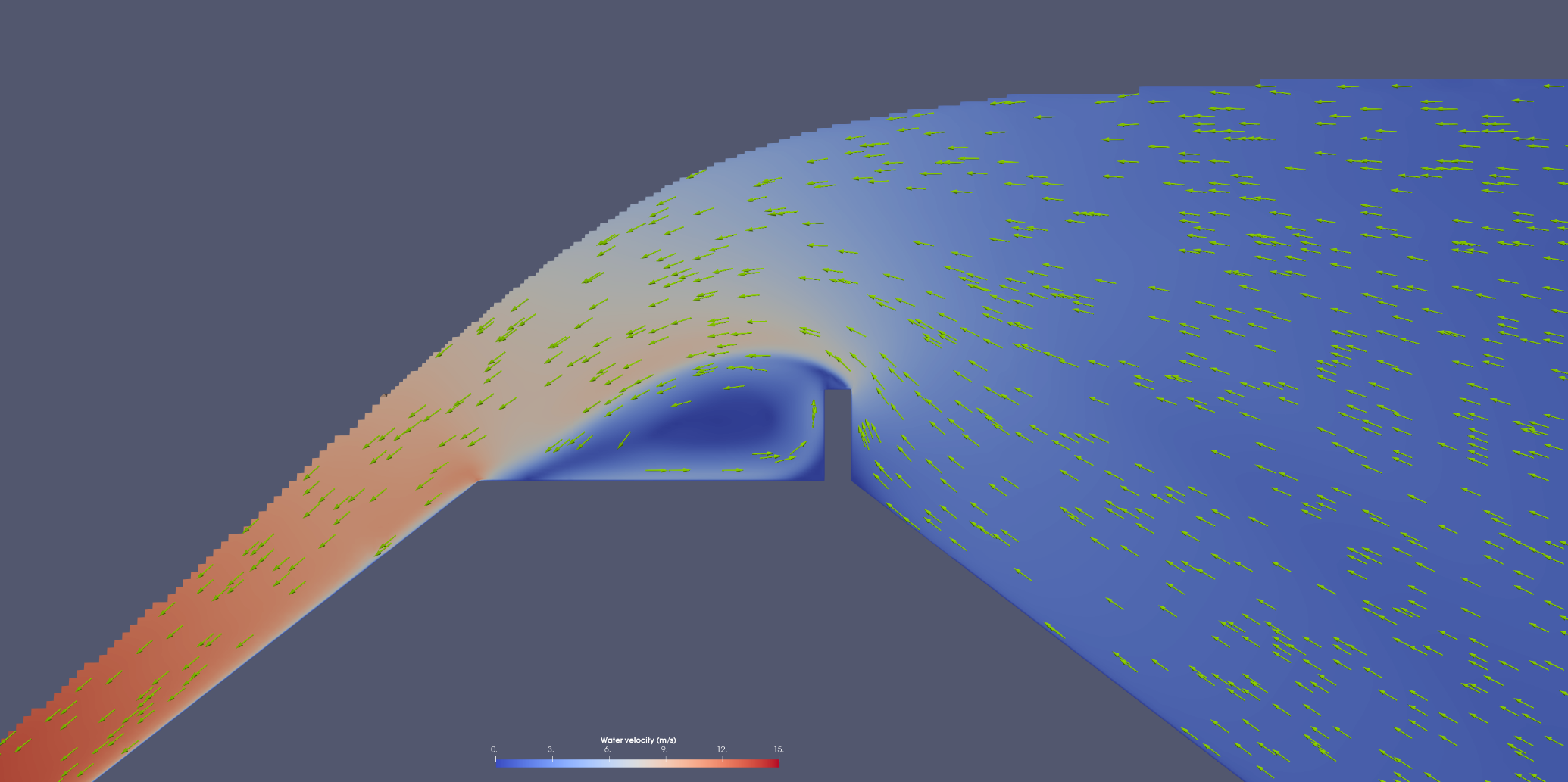
So what’s the lesson here?
CFD wasn’t initially considered when the overall project was scoped, as CFD was traditionally considered to be too expensive. In the end, though, it was a valuable key to filling a knowledge gap and provided unplanned secondary benefits.
CFD isn’t going to be the answer for every hydraulic modelling project – but the general solution is to use the most accurate method that can be afforded as early in a project or operation as possible. There will always be a balance to be found in when to invest in accurate assessments, but the decision should be based on the contemporary lower effort to use and get results from these approaches, and the power gained by the extra knowledge they can provide.
If you’d like to talk with Entura about your water or dam project, contact Richard Herweynen.
About the author
Dr Colin Terry is a civil engineer at Entura with three decades of experience in Australia and New Zealand. His experience includes modelling, planning, design and construction support. He has worked on multidisciplinary projects across various parts of the water cycle including catchment management, water supply, hydropower, land development, transport, and water quality in natural systems – with a focus on surface and piped water.
MORE THOUGHT LEADERSHIP ARTICLES
How robust is your emergency preparedness?
The old adage of ‘a company’s greatest assets are its people’ is never more true than in an emergency situation. The success of any emergency plan depends upon the skills, training and willingness of the people involved. It also relies on robust emergency preparation that takes as many scenarios as possible into account, and builds in a range of backups and alternatives for maximum agility and resilience.
All responsible dam owners have dam safety emergency plans (DSEP) which are carefully created and tailored to the needs of the company, its assets and its available resources.
If called upon in an extreme event, these plans will likely be pushed to their limit – but it’s vital that they perform as intended to reduce risk and consequences downstream.
The ultimate test of the emergency plan is how well it can cope with outages of power and/or communications. ‘Stress testing’ emergency plans for outage scenarios and implications is key to achieving a robust plan.
Power and communications outages
Where dams have moving parts, such as valves or floodgates, backups are needed to counter power outages. Are backup generators in place, or can a portable generator be brought to site at short notice? Is there a clear, safe access route to site during emergency conditions (e.g. not flooded or blocked by fallen trees)? Where this is not possible, can the valves or floodgates be operated by hand? A further question is whether these components are readily operable and exercised regularly.
Many dams are located in remote areas, and in some cases mobile phone reception is unreliable. In these situations, can satellite phones be made available? Landline phones may be available but depend on poles and lines remaining intact and operable during emergency conditions.
Communications are vital to ensuring the emergency plans are enacted under the direction of the incident controller. Where communications with remote resources are limited or not possible, those involved must fall back on their training and on lessons learnt from exercises and site-based, staged events involving scenarios of outages of power and communications. The DSEP can be updated with suggested actions for the on-site operators and emergency management team to follow in the worst-case scenario.
Alternative means of communication and access
In situations where check-in communications are required with those working remotely, alternative means must be considered in case of an outage of communications. In the absence of satellite phones, this could involve a messenger driving to site, but this relies on clear, safe access routes and careful consideration of the time required. In extreme cases, the only means of reaching a remote site may be by helicopter. This would require pre-arrangement with the closest helicopter providers regarding emergency availability.
The situation is similar with suppliers of plant and materials that may be required to assist with conditions at or downstream of the dam. How can they be contacted, and is there clear, safe access to site? Consider having emergency stockpiles at site or nearby and ready access to earthmoving plant.
Decision-making in a SCADA outage
If a power outage results in a localised SCADA outage, there will be no current instrumentation data available to guide critical decisions. In such circumstances, decisions must be based on likely behaviour during emergency conditions or on forecasts from before the emergency is declared. This would likely require detailed knowledge of the dams and their components, which highlights the importance of regular routine monitoring and detailed studies such as comprehensive surveillance reviews and dam safety reviews.
Company culture, teamwork and support
Where there is a ‘no blame’ company culture in which employees are encouraged to speak up, point out flaws in systems and processes and identify faults with assets, there is a greater likelihood that employees will participate successfully in staged exercises and events and provide useful information regarding how an incident response team will perform during an emergency.
Another important aspect of company culture is working together as a team. It is possible that a person may become fatigued but cannot convey this due to a communications outage. It is also conceivable that during an emergency a person may be unwilling to ‘leave their post’ until the job is done, becoming fatigued in the process.
It is important to have backup resources and to limit time in any role during the emergency to minimise the chance of mistakes being made. The emergency plan is only as strong as the weakest link in the chain of command.
For all resources, including external resources, provision of backups should take into account leave, prolonged illness and the need to ensure replacement when employees leave the company.
Where a company has a strong and positive safety culture and team ethos, detailed knowledge of its assets, regular inspection and exercising of valves and gates, and a commitment to team-based emergency training, employees are more likely to overcome the challenges posed by outages of power and communications during emergency conditions. They will find a way.
No one can predict and plan for every emergency scenario, but we believe that the tips we’ve shared here can help dam owners to develop and maintain robust emergency plans that have a higher likelihood of success when called into action.
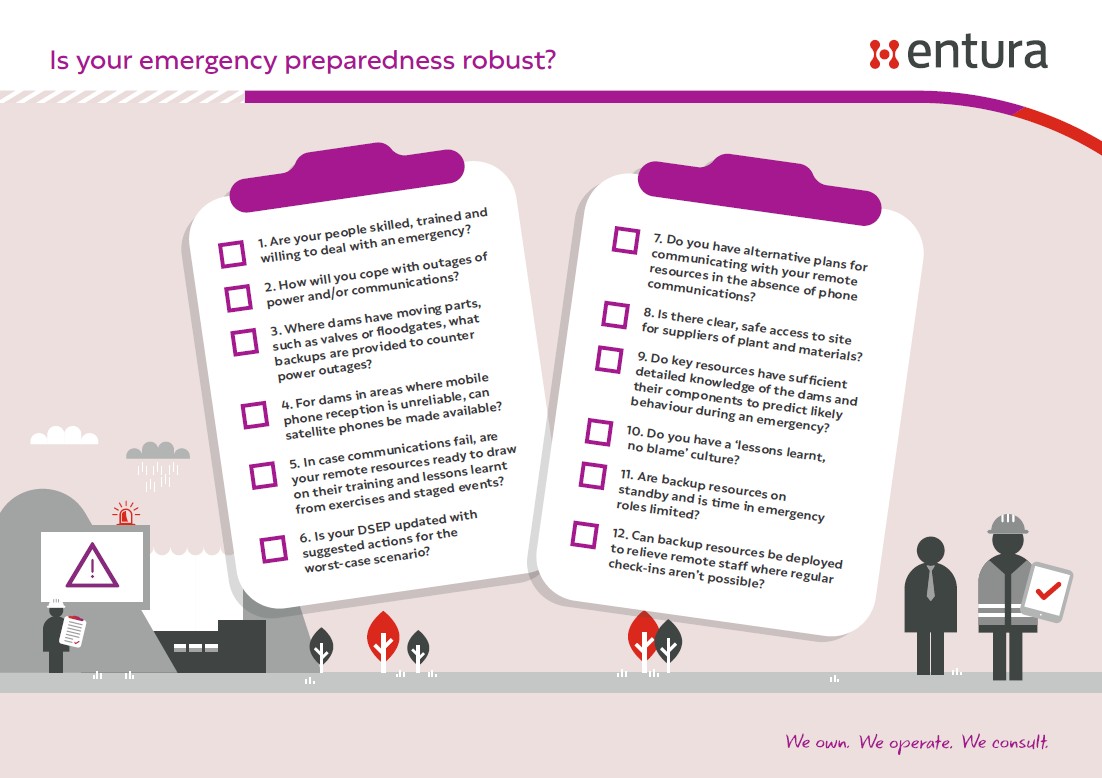
If you would like support with your emergency planning, contact Richard Herweynen or Phillip Ellerton.
About the author
Jamie Cowan is a senior dams engineer at Entura with over 2 decades of civil engineering experience in the UK and Australia. His experience includes the management of investigation, design and construction projects in the civil, dams and water industries. He has worked across all stages of project delivery, from feasibility to the commissioning of assets. He has provided construction support roles during dam construction and upgrade projects, and conducted intermediate and comprehensive inspections of dams for water authorities in Victoria.
MORE THOUGHT LEADERSHIP ARTICLES
Is there still a role for run-of-river hydropower projects?
In 2000, a major report by the World Commission on Dams shone a spotlight on large dams. At that time, some people argued that smaller, run-of-river hydropower could be a more sustainable solution than large dams with large reservoirs. Is this true? And is it still relevant more than twenty years on?
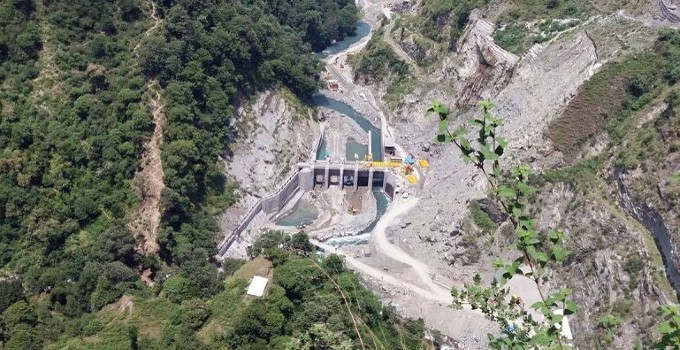
Run-of-river hydropower projects have little or no storage, which means that they don’t require the construction of a large dam, and don’t need to inundate a significant area with a large reservoir storage. Run-of-river hydropower may therefore have lower social and environmental impacts. A diversion weir is less likely to be a barrier to sediment transport, fish passage, or navigation; however, because run-of-river hydropower still involves constructing a structure in the river, these schemes are unlikely to have zero environmental impact. It is interesting to note that run-of-river hydropower projects and other small projects that do not involve the construction of large dams account for more than half of the hydropower projects supported by the World Bank.
Despite potentially having a lower environmental and social impact, run-of-river projects do have a significant disadvantage compared to large reservoir hydropower. For run-of-river projects, not all of the energy is ‘firm’, as the ability to generate depends on the availability of flow in the river. If a river catchment is highly responsive to rainfall, the daily variation of generation from a run-of-river hydropower scheme could be highly variable (similar to wind and solar).
If annual rainfall is highly seasonal, with a dramatic wet season and dry season, then a run-of-river hydropower scheme will generate much more power when seasonal river flows are high, and significantly less during drier months. So a run-of-river scheme will not necessarily be able to play the increasingly important role of firming variable renewables, and is more likely to be considered an additional source of variable renewable energy.
Run-of-river may not offer storage, but it can still have a place
But this doesn’t mean there’s no longer a place for run-of-river hydropower, as it is still a valuable and clean form of energy. In some situations, the lack of firming capacity doesn’t necessarily matter too much due to the existing diversity within the generation portfolio, or the type of generation that is being displaced. Run-of-river hydropower can still be a viable option in these circumstances:
- where the run-of-river hydro scheme is part of a larger portfolio of hydropower assets, which already has storage within the overall system – in this situation, the various hydropower generation assets can be operated together as a dynamic, integrated system, using the various assets to deliver an optimum output
- where the run-of-river hydro scheme is part of a diverse portfolio of variable renewables, including solar, wind and run-of-river hydro – in this case, it is unlikely that the mix of variable renewables will be highly correlated (i.e. it is unlikely that when there is no water in the river, there is also no wind or sun), and therefore less energy storage will be required to firm the variable generation
- where the run-of-river hydro is displacing expensive thermal generation – such as the displacement of diesel-powered generation on an island or a remote off-grid site.
Achieving sustainable storage
If there is potential to add storage to a hydropower scheme in a sustainable manner, then this is likely to create more long-term value, especially in an escalating clean energy transition. Storage will make the hydropower more flexible, agile and responsive, and able to ‘firm’ more variable renewable energy sources. With storage, hydropower can match generation with the demand for electricity. Essentially, storage can ‘unlock’ more renewables, and underpin a faster energy transition.
But the key is to make sure that any larger-scale hydropower projects with storage are developed right. In a previous article, we argued that a successful hydropower project requires:
- understanding the current water resource and how it might change – and building in climate resilience
- thoroughly investigating the geological and geotechnical conditions
- projecting future demand in the context of industrial development and population change
- getting the power to where it is needed through appropriate transmission and distribution infrastructure
- carefully considering the project’s stakeholders, community and environment
- securing project finance.
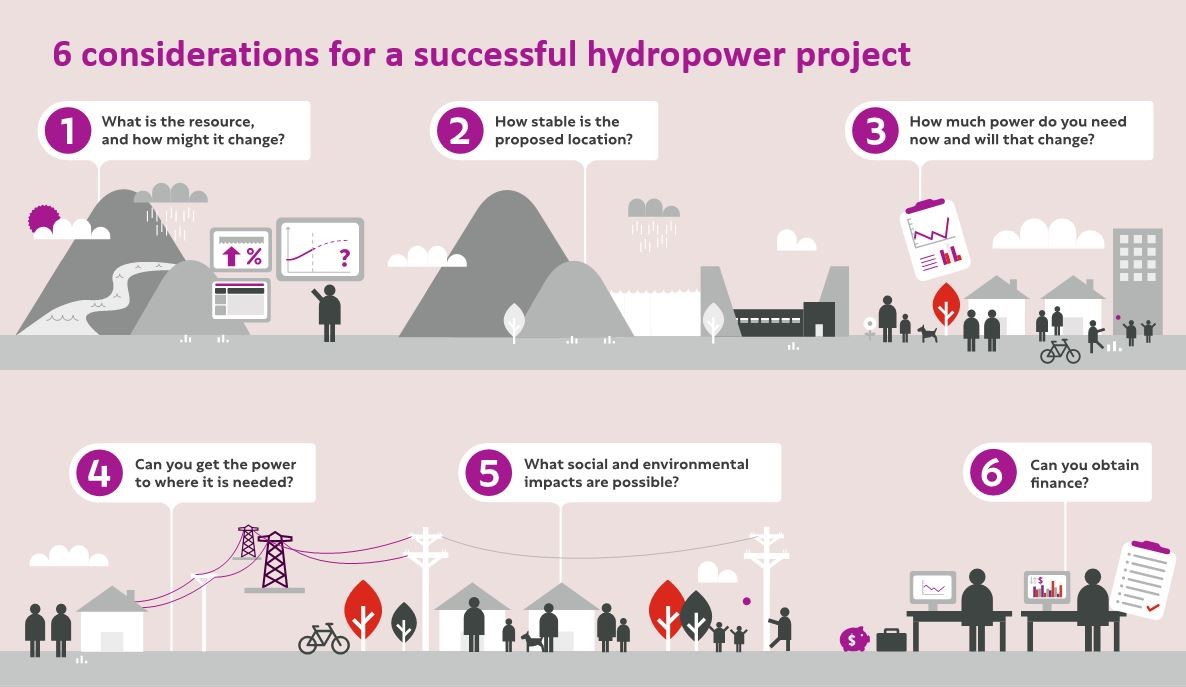
All of these aspects contribute to minimising risks throughout the project lifecycle and increasing the sustainability of the project in the long term, so that it can deliver social, environmental and economic benefits.
The best way to ensure that your hydropower project is developed in a sustainable manner, from the earliest stages of consideration through to operation and end-of-life, is by applying the international Hydropower Sustainability Standard.
Talk to us about achieving the right mix of renewables for your needs, and getting hydropower projects right.
About the author
Richard Herweynen is Entura’s Technical Director, Water. Richard has three decades of experience in dam and hydropower engineering, and has worked throughout the Indo-Pacific region on both dam and hydropower projects, covering all aspects including investigations, feasibility studies, detailed design, construction liaison, operation and maintenance and risk assessment for both new and existing projects. Richard has been part of a number of recent expert review panels for major water projects. He participated in the ANCOLD working group for concrete gravity dams and is the Chairman of the ICOLD technical committee on engineering activities in the planning process for water resources projects. Richard has won many engineering excellence and innovation awards (including Engineers Australia’s Professional Engineer of the Year 2012 – Tasmanian Division), and has published more than 30 technical papers on dam engineering.
MORE THOUGHT LEADERSHIP ARTICLES
‘No dams’ or ‘right dams’? – that is the question
The construction of large dams may be controversial, particularly if the social and environmental impacts appear to outweigh the benefits. How can we create the right kind of dams in the right places to deliver maximum benefit with minimal impact?
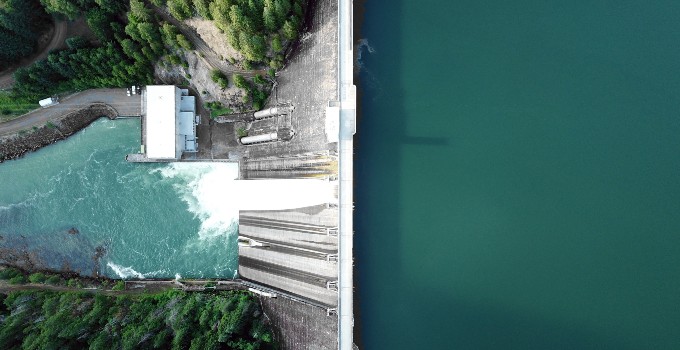
I recently watched Franklin, a documentary in which eighth-generation Tasmanian and environmentalist Oliver Cassidy retraces his late father’s 14-day expedition to attend the Franklin River blockade in Tasmania in the early 1980s. The blockade aimed to stop the damming of the ‘Gordon below Franklin’. This was a divisive time, when many cars on the roads displayed a ‘No Dams’ sticker.
Indeed, some rivers have such high environmental and cultural heritage value that they should not be developed. However, given that water storage is a critical global issue, especially in a changing climate, is ‘No Dams’ a realistic stance?
Dams play an important role within communities by providing much-needed storage for water supply, irrigation and power generation. With greater hydrological variability due to climate change, more water storage will be vital to provide the same level of security for water, food and energy. The security of water, food and energy are inextricably linked, and all three are critical. For example, approximately 50 per cent of all large dams are used for irrigation. Without sufficient water storage, irrigated agriculture, which supplies 40 per cent of the world’s food, is at the mercy of changing patterns of rainfall and runoff. In our view, more water storage is needed for a sustainable future.
However, there are good dam sites and there are bad dam sites. In 2003, the World Bank, through its Latin America and Caribbean region, prepared a sustainable development working paper. This paper, titled Good Dams and Bad Dams, recognised that not all large dams are alike, particularly in terms of environmental and social impacts. It concluded that the level of environmental impact is largely determined by siting. It argued that while dams at good sites may be defensible, dams proposed at inappropriate sites are likely to remain problematic, even with proper implementation of all feasible mitigation measures, and are best left undammed.
Deciding on a site is not simple, and that is because sustainability challenges are complex. To help with decision-making about dams, the World Bank prepared environmental criteria for selecting sites for hydroelectric projects, building on its earlier work towards greater sustainability of dams throughout the 1980s and 1990s. In addition, the World Commission on Dams had been born out of a meeting in 1997 jointly sponsored by the World Bank and the World Conservation Union, and released its framework for dam decision-making in 2000.
International good practice has continued to evolve – and some principles are encapsulated in the Hydropower Sustainability Standard and assurance framework governed by the Hydropower Sustainability Council (drawing on the International Hydropower Association’s own tools and other sustainability principles) and underpinned by the San José Declaration on Sustainable Hydropower. Although these frameworks were created for the hydropower industry, they can be applied to any dam project.
So now, guided by these sustainability frameworks and motivated by the urgency of the clean energy transition and the multiple benefits of dams and hydropower, the challenge is to find the ‘good’, least-impactful dam sites, to enable more water storages to be developed sustainably. The need for more storage is particularly pressing in many developing countries – where there are critical needs for electrification, drinking water and flood mitigation, and where numerous and varied dam sites are available.
How do we do this? Clearly, site selection cannot simply be about cost-effectiveness alone, given that so much of what we value in life cannot be measured in dollars. At the recent Australian National Committee on Large Dams (ANCOLD) Conference, one of the keynote addresses was delivered by Gigi Foster. As an economist, she argued the importance of choosing the right ‘currency’ when making key decisions for society. She argued that we should judge a society by the extent to which it enables people to experience lives that are both long and of quality and wellbeing. A term used for wellbeing over one year is a ‘wellbeing year’ or WELLBY. Ideally, we should seek to maximise the number of future WELLBYs for people in the present generation, but also for future generations.
Arguably, the best dam sites may be those that maximise future WELLBYs – but this might be difficult to calculate. They may also be the dam sites which are the best based on a multicriteria assessment in which environmental and social risks are fully considered. There will be some potential dam sites where the environmental or social impacts are too great, and a dam cannot be justified. Good site selection is the most effective environmental mitigation measure.
Given that we need more water storage, we can:
- Explore opportunities to increase the storage capacity of existing reservoirs by raising dams or by improving interconnection between storages to enable them to work together in a flexible and effective manner. Often, this can be more cost-effective and have lower environmental impacts than a new dam project. Where the benefits are high and the impacts are low, the WELLBYs are likely to be high.
- Identify dam sites, either on-stream or off-stream, that will minimise environmental and social impacts. The simple quantitative indicators proposed in the 2003 World Bank Good Dams and Bad Dams paper could be used for an early preliminary rating and ranking of potential dam projects in terms of their possible adverse environmental or social impacts until more information is generated through detailed environmental and social impact assessments. The environmental and social considerations must be given appropriate weighting in the site selection multicriteria assessment, along with the financial, technical and other criteria typically included. If the assessment is well balanced, it is more likely to reach a positive outcome.
After many decades of controversy about dam development, and with increasing understanding of impacts and far greater sophistication of internally accepted sustainability protocols, it is now up to developers and planners to heed the lessons of the past and find the right dam sites for nature and communities.
If you’d like to discuss how we can assist you with planning, designing and constructing safer dams, please contact Richard Herweynen, Paul Southcott or Phillip Ellerton.
About the author
Richard Herweynen is Entura’s Technical Director, Water. Richard has three decades of experience in dam and hydropower engineering, and has worked throughout the Indo-Pacific region on both dam and hydropower projects, covering all aspects including investigations, feasibility studies, detailed design, construction liaison, operation and maintenance and risk assessment for both new and existing projects. Richard has been part of a number of recent expert review panels for major water projects. He participated in the ANCOLD working group for concrete gravity dams and is the Chairman of the ICOLD technical committee on engineering activities in the planning process for water resources projects. Richard has won many engineering excellence and innovation awards (including Engineers Australia’s Professional Engineer of the Year 2012 – Tasmanian Division), and has published more than 30 technical papers on dam engineering.
MORE THOUGHT LEADERSHIP ARTICLES
What are some of the challenges of hydropower in South East and East Asia?
Entura’s Rajeev Raina, Resident Director India, discusses the challenges of hydropower developments in South East and East Asia, as well as how these are being overcome. This video is part of a broader discussion about the role of hydropower in a changing renewables landscape, lifted from an Entura webinar to celebrate Global Hydropower Day on October 11, 2022.
If you would like to discuss how Entura can help you with your hydropower project, please contact us.
About the author
Rajeev Raina is Entura’s Resident Director India, managing the team there and overseeing our work in the region. He has over 20 years of experience in civil engineering, specifically in detailed design for various power plant projects. Rajeev has in-depth knowledge of structural analysis and has worked on numerous hydropower developments throughout Asia, the Pacific and Australia.
MORE THOUGHT LEADERSHIP ARTICLES
Why is hydropower important for deep storage?
Entura’s Donald Vaughan, Technical Director, Power, discusses the role of hydropower in deep storage, and how this will become increasingly important in a future renewables landscape. This clip is lifted from an Entura webinar to celebrate Global Hydropower Day on October 11, 2022, where our Technical Leaders and Executive Team came together to discuss the future of hydropower.
If you would like to discuss how Entura can help you with your hydropower project, please contact us.
About the author
Donald Vaughan is Entura’s Technical Director, Power. He has more than 25 years of experience providing advice on regulatory and technical requirements for generators, substations and transmission systems. Donald specialises in the performance of power systems. His experience with generating units, governors and excitation systems provides a helpful perspective on how the physical electrical network behaves and how it can support the transition to a high renewables environment.
MORE THOUGHT LEADERSHIP ARTICLES
What role does hydropower play in the race to net zero?
Dr Amanda Ashworth, Entura’s Director of Strategy, Sales and Commercial, discusses the role that hydropower plays in the race to net zero. This discussion took place during the webinar held by Entura to celebrate Global Hydropower Day on 11 October 2022, where our Executive Team and Technical Leaders came together to explore the future of hydropower in the renewable energy landscape.
If you would like to discuss how Entura can help you with your hydropower project, please contact us.
About the author
Dr Amanda Ashworth holds a PhD, Graduate Diploma in Environmental Studies and Bachelor of Arts. She brings together Entura’s corporate marketing, sales and commercial functions, providing direction to these teams and areas of the business, and leads strategy development and achievement. She is also the manager of the Entura clean energy and water institute. Amanda has 25 years’ experience in multi-disciplinary research and practice on a wide range of environmental, social and economic topics. She has spoken at numerous international conferences and is the author of several peer-reviewed papers.
MORE THOUGHT LEADERSHIP ARTICLES
Getting your renewable energy project through planning and approvals
The planning and approvals system is complex, and its potential impact on the cost, timeframe and overall success of your renewable energy or storage project should never be underestimated.
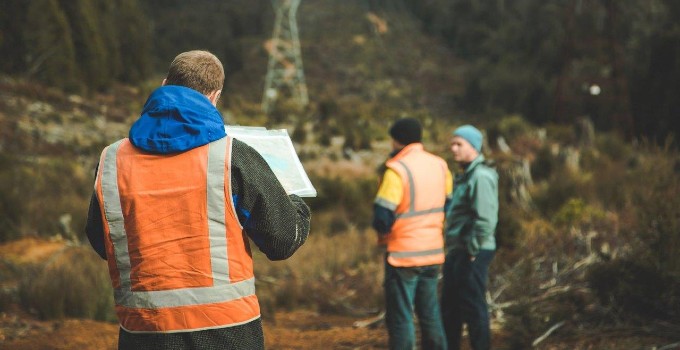
Investing time and energy in planning for project approvals makes it more likely that your project will get off the drawing board and into reality. The following principles can help you smooth the process and avoid common pitfalls.
Understand constraints and impacts
The planning system tends not to differentiate between various forms of renewable energy generation, constraining all forms due to the perception and experience of those forms with greater perceived impacts (such as wind farms). Yet each project is unique, as is every piece of land – so each development will bring different values, impacts and benefits into play.
Getting the earliest possible understanding of the environmental and approval constraints over the development site will help reduce risk and avoid a later re-design.
All developments have potential impacts. Communities may be concerned about potential impacts on human health, biodiversity, heritage impacts, visual amenity, noise, changes in land use, construction impacts, just to name a few. However, it is generally ecology and heritage that make or break a project because there may be underlying regulatory requirements associated with existing overlays that prohibit or limit development.
Particularly in the Commonwealth jurisdiction, but increasingly across all state jurisdictions, developers must clearly demonstrate how the project has avoided and reduced impacts, rather than merely offsetting them by purchasing parcels of land elsewhere. Some states actually require the developer’s option analysis process to be documented. Only when the authorities are satisfied that the project has actively avoided and reduced impacts, will they negotiate what mitigation methods are preferable.
Communities are often concerned about visual amenity, so this analysis should be done early as part of identifying ‘red flags’ or constraints. When used properly, visual impact assessment can be a powerful way to design sensitively and responsibly, reducing impacts on views.
The overall impact assessment often takes into account the context of the new development, such as whether it is in pristine environment or existing built-up or industrial areas. An increasing trend is to redevelop brownfield sites for renewable energy or storage projects, instead of focusing solely on greenfield prospects. There is enormous potential to re-use existing infrastructure, former industrial sites or degraded sites, such as mine sites which are no longer viable or operational or former thermal power station sites. This can complement the existing management and rehabilitation regime for these sites which often have very poor environmental conditions, making projects rewarding for the developer and the community.
Get to grips with the regulatory landscape
Depending on the scale, location and potential impacts of the project, approvals may be required at the Commonwealth level (through the operation of the Environment Protection and Biodiversity Conservation Act 1999), the state level (through the implementation of state environmental protection legislation), and the local level (through the implementation of a local development control plan or planning scheme).
These three levels interact differently in each state and for different processes. Some states have very streamlined and integrated approvals processes for large-scale projects which can coordinate Commonwealth requirements and facilitate local government discussions, making the process easier for the proponent or consultant. In other states, consultants often coordinate the different levels of processes, navigating the greater potential for conflicting or onerous requirements across the Commonwealth, state and local level.
Don’t launch into writing the approvals document without first conducting a mapping exercise and developing an approvals strategy. The approvals strategy helps map out all Commonwealth, state and local government requirements across each project component (e.g. a transmission line on a road reserve will often have different environmental values and require different approvals than a transmission line across a farm paddock). This will help you understand what approvals will likely be required and where dependencies exist. Your approvals strategy should be a live document, reviewed whenever there are changes to the project or legislation.
Building a transparent and honest relationship with the regulator/s is a worthy investment, and a consultant can lead this relationship for you. By listening to the regulator/s, paying attention to their advice, and changing the project’s design accordingly, a developer may be able to pre-empt or avoid conditions being applied to the project.
Develop a solid submission
Once the approval requirements are confirmed, detailed technical studies are essential for clearly demonstrating that the issues are understood and that the development (and any mitigation or management measures) is appropriate.
Target the application documentation to match and address the requirements of the relevant development control document, drawing on the conclusion of the technical studies. Include a summary of the proposal that identifies the key issues and mitigation measures, as well as the detailed technical studies underpinning the planning assessment.
Manage conditions
When permits are issued, it is common for there to be a number of conditions requiring further actions or additional documentation. Once you have a permit, create a conditions management plan to lay out clearly what all parties involved in the project need to do. Determine when the conditions apply (e.g. pre-construction, construction, post-construction or during operations) and who should be responsible. This will reduce the risk of not complying, which may be an oversight but could result in action by the responsible authority or, in some cases, lapsing of the permit.
Take the community with you, right from the start
It is important to differentiate between planning for and planning with communities. Those who will be impacted – whether positively or negatively, and over the short or long term – need to be involved in the process. A developer, owner or operator should identify and meet as many different stakeholders in the community as possible to get to know their individual interests and needs.
Engaging with the host community early in the development stages is key to a successful project and developers may be required to demonstrate that they have done so, even before submitting a permit application. This will help assure authorities (and potential buyers) that the project has a ‘social licence’ to operate.
By engaging early, the developer will have time to explain how the technology works, outline the construction process, and conduct a social risk assessment. Engagement should preferably be face-to-face and consistent. People are far more likely to accept projects when they feel that they have been included, heard and respected.
A particular consideration for large-scale developments is that sites are often located in areas outside of council jurisdiction, some of which are state-owned and can be subject to existing leasing arrangements. More remote areas also have greater potential to involve existing Native Title rights. Planning with genuine respect and acknowledgement of Indigenous communities is crucial, but often undervalued. First Nations/traditional owner groups should not be treated like any other stakeholder but as a land-owner (because they are, and governments are increasingly recognising this).
The task of building the community’s confidence in a project is sometimes difficult. The best approach is to communicate any foreseeable short-term and long-term impacts as early as possible and in an open and non-defensive manner. Listening to the community and working together to identify social and environmental risks will help build trust between the project team and stakeholders, and result in a development the community are proud of.
Give your project the beginning it deserves
Ultimately, there’s nothing to be gained by cutting corners or rushing these processes. Your best chance of planning success is through exploring and understanding – at the very earliest opportunity– the development control provisions, permits, consents and the levels of assessment that are required, obtaining high-quality and comprehensive specialist studies, and getting off on the right foot with the project’s stakeholder and community. Your project and your reputation will benefit from doing at least what is required and, preferably, even more. What you put into your ‘once upon a time’ will dictate whether you can reach a ‘happily ever after’.
If you would like to discuss how Entura can help you with your environmental or planning project, please contact us.
About the author
Bunfu Yu is an Environmental Planner with experience across multiple Australian jurisdictions, including Commonwealth, Victoria, New South Wales, Tasmania and Queensland. She advises on a variety of land use and development issues, and scopes environmental and planning projects with a focus on water, energy and electricity infrastructure for a range of clients, including private developers, state utility providers and government agencies. She has qualifications in planning and science, is a sessional lecturer at the University of Tasmania, and serves as a committee member for the Planning Institute of Australia Tasmanian Division and a member of the National Policy and Advocacy Committee of the Planning Institute of Australia.
MORE THOUGHT LEADERSHIP ARTICLES
Keeping close tabs on your dams
Access to quality long-term records is crucial for dam safety. Read what our specialists have to say about keeping your records under control.

The ANCOLD (Australian National Committee on Large Dams) guideline on dam safety management recommends regular reviews on different timescales – including routine inspections undertaken by the operator (daily to monthly), intermediate inspections by a dams engineer (annually), comprehensive inspections undertaken every five years by a dams engineer and other specialists (e.g. mechanical engineers specialising in gates and valves), and dam safety reviews at least every 20 years. For these less frequent dam safety reviews, the ability to access quality long-term records is crucial.
Because dams are such large structures with a very long service life, they need to be reviewed regularly to ensure that any community risks are mitigated appropriately. Dam safety reviews assess the current condition and performance of the dam in depth, and reassess the design and construction of the dam against modern standards.
When the time comes to conduct a dam safety review, dam owners need good records at their fingertips. Poor recordkeeping can lead to significant extra costs and time to conduct the review, but can also compromise a dam owner’s duty of care.
To properly analyse the performance of a dam and assess it against modern design and construction criteria, the dam engineer needs a thorough understanding of the original design and construction, any modifications to the dam since its original build, and a complete set of surveillance and monitoring data.
For some dam owners, when the time comes to complete a dam safety review, all or some of the records are missing – they may have been lost or destroyed through corporate restructures or a failure to understand the importance of the historical records, or the records may never have been created at all.
Which records are important?
In our work as dam safety consultants, we’ve encountered numerous cases in which poor recordkeeping – across many areas and disciplines – has resulted in costs for our clients. The following are critical records to keep in good order and close to hand.
Hydrological records
Records from stream flow and rainfall gauges in the dam catchment provide key hydrological information for dam safety reviews. The streamflow data can be used directly to statistically analyse the probability of the more frequent floods. It can also be used to calibrate rainfall runoff models used to estimate extreme floods for which dam spillways need to be designed. Without this data, flood studies are more difficult because data needs to be extrapolated from nearby catchments. This not only adds cost, but also reduces the reliability of the data, which may potentially lead to oversizing or undersizing the spillway.
Dam break and consequence assessment records
In Australia, dams are classified according to the consequences of failure – from very low (minimal impact on the community, environment and dam owner’s business) to extreme (catastrophic impact on the community, environment and dam owner’s business). The consequence categories are used to define the level of design (e.g. spillway capacity), the surveillance and monitoring requirements and, in some states of Australia, the regulatory requirements. Where these studies are not available, ‘rule of thumb’ methods may be used to estimate the inundation extent as an interim step, but much more confidence can be obtained by using a flood hydraulic modelling package with good survey data. These studies should be reviewed regularly for currency, especially when development is occurring in the downstream catchment.
Geological and geotechnical records
A detailed understanding of the geology of the dam foundations is essential for assessing the risk of excessive leakage (piping), the presence of any low-strength zones that could cause instability, and the potential for landslides around the reservoir that could cause a wave able to overtop the dam. Investigations undertaken before construction as well as mapping and recording of the foundation during construction provide the best possible information for assessing these potential failure modes.
When these records aren’t available, it is often necessary to undertake extensive and expensive geological investigations into the foundation of the dam, usually while the dam is operational. Such investigations need to be carefully planned to preserve the safety of the dam.
The starting point is review of existing geological records of the site, including geological maps, aerial photographs/satellite images and geological/geotechnical reports from nearby locations. This should be followed by geological mapping to confirm the information obtained from the desktop search, including the rock types and joint and defect orientation spacing. From this, a preliminary geological model of the site can be developed. To reduce the uncertainty of the model, intrusive test pitting and drilling investigations can be conducted. Careful consideration of the dam safety risks of undertaking these investigations is needed, including contingency plans to deal with unexpected conditions (e.g. high-pressure water intersected in boreholes or instability of ground around test pits). ANCOLD has produced a very good guideline on geotechnical investigations of dams, their foundations and appurtenant structures, which should be considered an essential guide for dam owners.
Design records
If records of original design information are unavailable, the dam safety reviewer won’t be able to fully understand the designer’s intent and assumptions. The information required includes the design drawings showing the overall arrangement and key dimensions, as well as the specifications and the design report. If drawings aren’t available or are illegible due to poor quality scans, detailed surveys of the structure may be required to determine the actual constructed geometry. To assess the stability of the dam, the material properties of the dam will be required; but if no data is available, sampling and laboratory testing may be needed.
Construction records
To understand the types of defects that may be present in the dam, it’s important to know how the dam was constructed, whether it was actually constructed to the design, and what issues were encountered during construction. Key construction records include construction reports detailing progress, changes to the design and issues; results of quality testing; as-constructed drawings or mark-ups on the design drawings; and photographs of the construction process. If these records are not available, it may be necessary to confirm as-constructed details through survey, sampling and laboratory testing.
Surveillance and monitoring records
Time-series data – such as regular inspection reports, photographs and instrumentation readings – are invaluable in establishing if there are trends or changes over time that may indicate deterioration of the dam. Without these long term records, it can be difficult to assess whether observed features are longstanding (e.g. present since construction) and what recent developments may indicate about the condition of the dam. Without the full time-series of monitoring data, it can be difficult to observe trends and to understand the relationship between various performance parameters (e.g. leakage versus reservoir level).
Keeping your records under control
If adequate records can’t be located, a dams engineer will need to spend a great deal of time searching archives or undertaking investigations to build a historical picture of the design and construction of the dam in order to assess its safety. When records are well managed, dam owners can save time, money and frustration. To keep your records under control, make sure that they are:
- as complete as practical – which may require extensive archive searches and investigations to fill in the gaps
- securely stored (electronically as well as the original paper records) and retained for the long term (so investigations don’t have to be repeated)
- readily retrievable through efficient indexing and archiving systems.
A good dam may outlast generations of engineers, operators and owners. This makes recordkeeping a fundamental part of maintaining the safety and performance of the dam over its long service life and a key responsibility of every dam owner as part of your duty of care.
About the author
Paul Southcott has more than 34 years of experience in civil and dam engineering, as well as expertise in geotechnical, foundation, structural, hydraulic and hydropower engineering. Paul’s dam engineering experience spans geotechnical and hydrological investigation; feasibility and options studies; concept, preliminary and detailed design; engineering assessment, consequence assessment and risk assessment; safety reviews; monitoring and surveillance; and emergency planning. He has extensive experience in dam risk assessment and was a member of the ANCOLD committees that issued the Guideline on Consequence Categories for Dams in 2012 and drafted the Guideline on Geotechnical Investigations for Dams. Paul pioneered the development of a dam risk assessment methodology for concrete-faced rockfill dams (CFRD). He was the Engineers Australia (Tasmania Division) Engineer of the Year in 2021.


 +61 429 705 127