
LATEST NEWS
Entura helps power Hydro Tasmania’s award-winning EV transition
25 June, 2026
Entura congratulates Hydro Tasmania on winning the Australasian Fleet Management Association’s (AfMA) 2026 Fleet Environment Award, recognising the organisation’s progress in the transition to electric vehicles.
Entura is proud to be part of Hydro Tasmania’s journey, helping develop the charging infrastructure that makes the transition possible.
Hydro Tasmania’s target is 130 electric passenger vehicles by FY2030/31, comprising about 45 per cent of its total fleet. Reaching this goal requires strategic charging infrastructure planning based on capacity and flexibility to support operations across a dispersed fleet.
“Our primary challenge is the remote locations of some of our sites,” says Nick Stowe, Hydro Tasmania’s Fleet Lead. “Many of our sites are also far apart, so our drivers need reliable charging infrastructure in addition to public charging networks, giving them confidence that they can perform their work with minimal disruption.”
The charging infrastructure will enable the EVs to be powered by the renewable energy Hydro Tasmania generates.
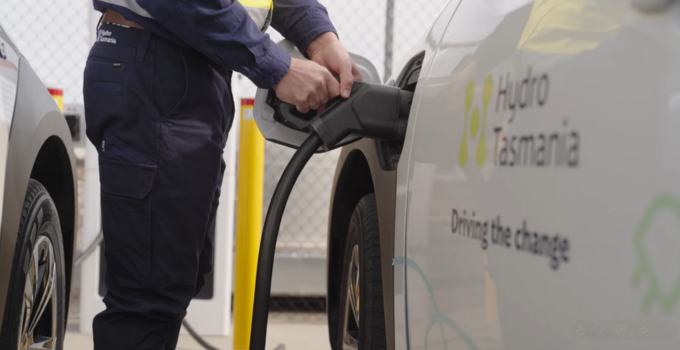
Entura’s role in the EV journey
Working closely with Hydro Tasmania’s fleet and infrastructure teams, Entura is supporting site investigations, concept and detailed design, construction documentation, contractor coordination, commissioning and integration of the chargers.
Kristian Payne, Renewables Engineer and Entura’s project manager for the rollout, explains that designing and delivering EV charging solutions is far from plug-and-play.
The process begins with identifying strategic locations and understanding what each site can support.
“Even though the power stations generate megawatts of electricity for the grid, the stations weren’t designed to draw a lot of power for themselves, generally just enough for basic station needs. EV chargers can sometimes be the biggest electrical loads on site, so we need to investigate the existing electrical infrastructure and available capacity and then design solutions that are fit for the future and won’t compromise how the power station operates.”
A major milestone so far has been the completion of charging infrastructure at the Cambridge workshop, the largest site delivered in the program to date, including two 200 kW DC, two 50 kW DC and eleven 22 kW AC chargers (with an allowance for ten more AC chargers in the future), along with substantial new infrastructure and cabling works.
The site also includes advanced load management (EVLM), which allows charging demand to be balanced dynamically with other site loads.
“If all the cars are charging at the same time and the workshop turns on its cranes and lathes and welders and the power starts increasing, the computer that’s monitoring the cables picks up that change in power and will start to curtail how fast the cars are charging,” explains Kristian. “By balancing the system in real time, we avoid a risk of tripping and there’s no risk to the site.”
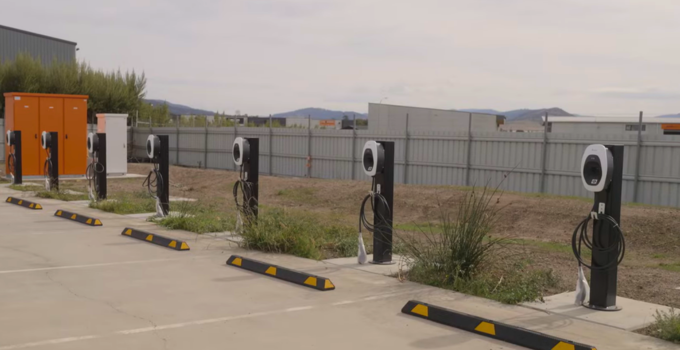
While Entura contributes specialist expertise in electrical engineering, we also bring extensive knowledge of Hydro Tasmania’s sites, assets and operating environment.
Kristian says, “Because Entura has worked across Hydro Tasmania’s power stations, workshops, offices and villages for many years, we understand both the technical realities of the sites and the broader organisational context. That means we can help connect fleet needs with infrastructure planning and broader site works, while helping bring the right people together along the way.”
Nick Stowe acknowledged Entura’s contribution to Hydro Tasmania’s achievements in his award submission.
“Entura’s team are extremely keen and proud to be part of this transition and are bringing great professionalism, expertise and passion in electrical and renewables engineering. Their input into futureproofing sites through electrical supply upgrades enables our team to capitalise on opportunities. We rely on their technical knowledge and recommendations to drive down costs and improve efficiency for installation and use. We also benefit from their extensive site knowledge and established contractor relationships, making Entura a very capable resource to draw on.”
Hydro Tasmania’s charging infrastructure will do more than power its own journeys. At Pedder Wilderness Lodge, Waddamana Heritage Museum and Tarraleah Village, the public will have free access to chargers shared with Hydro Tasmania’s operational vehicles.
“Entura is always pleased to work together with our Hydro Tasmania colleagues to develop robust infrastructure that supports a more sustainable future,” said Wayne Tucker, Entura’s General Manager. “This work shows what is possible when we combine Hydro Tasmania’s vision and commitment with Entura’s engineering expertise, deep knowledge of the sites and shared focus on practical, future-ready solutions.”


