
Life cycle of a dam – Phase 5: Upgrades – Renewing dams for a safe future

By Sally Fracalossi and Dr Shao Ng
A dam’s lifecycle moves through inception, design and construction, first filling and ongoing operation, surveillance and maintenance before, in most cases as needed, progressing to upgrade works. Upgrades may be needed because a dam is ageing, standards or knowledge have changed, or its operating environment and risk profile have evolved.
In this article, Principal Civil Engineer Shao Ng and Senior Civil Engineer Sally Fracalossi share their insights into the fifth stage in a dam’s life cycle, and how risk-based upgrades can efficiently improve dam safety and extend the useful life of existing assets.
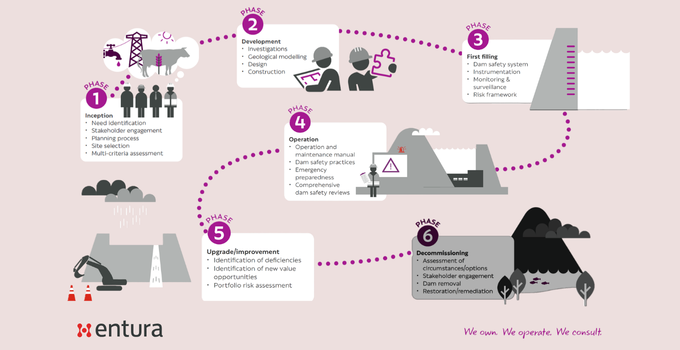
An upgrade brings the dam life cycle full circle. The owner returns to investigation, options assessment, risk assessment, design and construction, but this time the project revolves around an existing asset that may need to remain operational throughout.
An upgrade typically aims to achieve effective life safety risk mitigation. It may respond to a specific failure mode, deterioration, operational or maintenance deficiency, new knowledge about floods or earthquakes, climate change, changing standards, increased downstream consequences, or the upgrade may be in response to an opportunity to change or extend the dam’s purpose.
Whatever the trigger, the task is to determine the interventions that will achieve the most meaningful improvements within the available resources and the complex realities of the site.
Understand the asset and the owner
Any upgrade should start with a clear understanding of the existing asset: how it was designed and constructed, how it has been modified, how it has performed and how conditions have changed.
Historical design information, surveillance records, instrumentation data, previous assessments and operational experience can reduce uncertainty and focus investigations on the issues that matter most. Good records are particularly valuable and should be supplemented by the institutional knowledge held by operators and dam safety personnel, as people and organisations change over a dam’s long life. Where the project team is unfamiliar with the dam, sufficient effort must be allowed to review its history, capture this knowledge and identify gaps requiring further investigation.
Understanding the owner is equally important. Not every owner has specialist dam expertise or knows from the outset what investigations or upgrade scope will be required. A good consultant must help the owner to identify and refine that scope, while ensuring the solution responds to the dam safety risk, the owner’s needs and the way the asset is intended to be operated.
Let risk drive the priorities
For dam owners who maintain a large portfolio of dam assets, a portfolio risk assessment can help identify which dams require priority attention, while a detailed risk assessment for an individual dam can identify the most significant failure modes and direct investment to where it will deliver the greatest benefit.
Once an intervention has been completed, the risk assessment can be updated to understand the risk reduction achieved, identify the remaining risks and determine whether additional measures could bring the residual risk to ‘as low as reasonably practicable’ (ALARP).
Stage risk reduction where appropriate
Staging can enable the most dominant risks to be addressed first, spread expenditure over time and allow information gained during early works to inform later interventions.
If an assessment identifies a critical or immediate risk, the first stage may be an interim measure that reduces exposure while a permanent solution is investigated, designed and delivered. Each stage should form part of an overall strategy, with a clear pathway to the permanent upgrade and appropriate management of the residual risks between stages.
Test constructability and affordability early
A technically sound upgrade design must also be feasible to build around an operating dam. Without sufficient construction input, a solution that appears fit for purpose during design could prove prohibitively expensive or difficult to deliver when tested by the construction market.
Formal early contractor involvement (ECI) can help the design team to examine access, construction methodology, sequencing, temporary works, plant requirements, materials and environmental controls during the early design stage while the design is still flexible. Where formal ECI is not appropriate, an experienced contractor or construction specialist can undertake a constructability assessment during design.
Construction activities can also introduce temporary risks that do not exist during normal operation. Excavation, dewatering, heavy plant movements and changes to reservoir operation should therefore be considered before works begin, with appropriate controls in place. At no stage during the construction should the existing dam risks be compromised.
Bring the owner and reviewers along
An informed design process should involve the owner throughout, not only at project initiation and final approval. At key stages, the design team should explain what is proposed, what the owner will receive, what uncertainties and trade-offs remain and whether the solution meets the owner’s needs. Concerns raised early can usually be addressed more effectively than concerns discovered at the final design stage.
Independent reviewers should also be engaged early and kept informed as design and construction progress. While remaining independent of the design team, they provide technical assurance by testing key assumptions, decisions and options against the project objectives and accepted practice. Their involvement helps identify potential gaps or concerns before they become embedded in the design or implemented on site.
Good outcomes are more likely when the owner, operators, designers, reviewers, regulators and contractors share an understanding of the project objectives through effective stakeholder engagement and are brought along as the solution evolves.
Protect and verify the design intent
The condition and configuration of existing dams can’t always be fully understood until elements are exposed during construction. Actual foundation levels, subsurface material properties, groundwater conditions or the condition of buried structures may differ from the assumptions made during design.
Some redesign during construction may therefore be unavoidable. Flexibility is appropriate where it responds to the conditions encountered, but decisions should not be made hastily due to the pressure of personnel and equipment waiting on site. Good engineering judgement combines responsiveness and flexibility with disciplined decision-making, documentation and communication.
Inspection and test plans, hold-point verifications, foundation mapping, test results, revised drawings and construction records provide evidence that the completed works meet the required quality and design intent. These records then become part of the dam’s permanent history and support future surveillance, maintenance and reviews.
Continue surveillance, monitoring and forecasting throughout the upgrade
Dam owners must continue monitoring and surveillance throughout the design and construction of an upgrade. These activities may need to be intensified where the works introduce temporary risks. Flood forecasting is crucial for managing the flood risk during construction, ensuring the safety of existing assets, construction workers and the public downstream, and protecting infrastructure and the environment from major flood damage.
After the upgrade is commissioned, the owner must review the surveillance regime and update inspection and monitoring requirements, operating procedures and the operation and maintenance manual to reflect the modified asset.
A dam will continue to evolve after its upgrade. Good records, updated operating documents and ongoing monitoring ensure that the knowledge gained during the upgrade project is not lost. The upgraded dam then becomes part of the continuing story as the dam moves into its next phase of safe operation.
UPGRADE PRINCIPLES IN PRACTICE: EDGAR DAM
Edgar Dam, in Tasmania’s south-west, forms part of Hydro Tasmania’s Gordon-Pedder hydropower scheme. The dam is located near Lake Edgar Fault and parts of the embankment are founded on fluvioglacial sandy gravels potentially susceptible to liquefaction. As understanding of the seismic risk evolved, Hydro Tasmania initiated investigations to quantify the risk and develop appropriate mitigation measures.
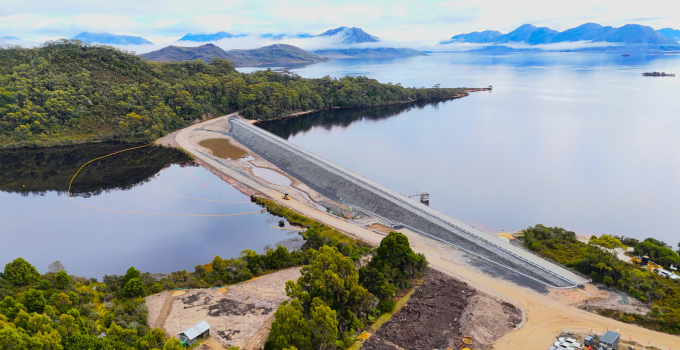
The resulting upgrade was the culmination of more than a decade of investigation, dam safety review, risk assessment, options studies, design and planning. Entura contributed geotechnical investigations, hydraulic and consequence assessments, surveying, GIS mapping, civil and structural engineering, environmental and planning support, detailed design and Principal’s Engineer services.
Constructability was a major consideration. The project involved dewatering ponded water at the downstream toe, excavating to bedrock, maintaining public road access and working in a remote location within the sensitive Tasmanian Wilderness World Heritage Area. The works had to balance dam safety, environmental requirements, site access and practical construction needs.
The solution involved removing the downstream concrete face, excavating to foundation level and constructing a filter and rockfill buttress to improve the dam’s seismic resilience. During construction, Entura’s geotechnical engineers inspected and mapped the excavations so that actual foundation conditions could be used to verify the design assumptions as the works progressed.
As Principal’s Engineer, Entura reviewed work methods, responded to requests for information, developed design changes and conducted inspections to witness and verify hold points. This allowed the team to respond to emerging conditions while ensuring the design intent and maintaining a clear construction record.
The completed upgrade significantly reduced the dam’s seismic risk within a tolerable level and improved the safety, reliability and resilience of Hydro Tasmania’s renewable energy infrastructure. The principal contractor, Hall Earthmoving, completed the works four months ahead of schedule in 2026.
UPGRADE PRINCIPLES IN PRACTICE: UPPER RESERVOIR DAM
Upper Reservoir Dam, near Hobart, is an 18 m-high puddle-clay-core zoned earthfill embankment constructed between 1885 and 1888. It is one of 3 dams in TasWater’s Waterworks System, together with Lower Reservoir Dam and Ridgeway Dam.
A 2017 dam safety review identified an unacceptably high risk of piping failure, principally associated with the outlet tunnel, together with a high risk of flood overtopping. The resulting assessment found that the societal and individual risks were unacceptable when assessed against the relevant ANCOLD risk guidelines.
TasWater adopted a staged approach to the upgrade. The first stage targeted the most dominant failure mode by constructing a localised filter around the outlet tunnel to reduce piping risk. The risk assessment was then updated to assess the reduction achieved and identify the next priorities.
The second stage addressed flood overtopping by raising the embankment crest. This also created an opportunity to incorporate a crest filter trench, providing additional protection against piping through the upper embankment. Considering the failure modes together enabled the planned works to deliver greater overall risk reduction in achieving ALARP.
Entura’s long involvement with Upper Reservoir Dam provided valuable continuity, including knowledge of its history, previous investigations, performance and earlier works. This helped the project team in identifying uncertainties and knowledge gaps, and focusing further investigation and design effort where it would add most value.
Entura supported the project through geotechnical investigations, hydrology and hydraulic assessment, heritage and environmental studies, stakeholder consultation, updated risk assessment, detailed design, tender support and construction supervision. Entura also served as Principal’s Engineer during the construction, providing technical support, construction verification and sign-off.
The Upper Reservoir Dam upgrade shows how detailed asset knowledge and a staged approach can help an owner to identify the dominant risks, act on the most urgent first and use each intervention to inform the next step in the dam’s ongoing improvement.
A further upgrade is currently underway, focusing on the reservoir’s outlet system.
In our next article in this series, we will consider the final stage in a dam’s life: decommissioning or repurposing.
To see the full picture of the life cycle of a dam, all in one place, read our overview article.
ABOUT THE AUTHORS
Sally Fracalossi is one of Entura’s senior dams engineers. She joined Entura’s Dams and Geotechnical Team in 2020, following 5 years in a multinational private consultancy where she gained broad civil engineering and project management experience. Sally is experienced in numerous aspects of dam engineering, including dam design, dam safety assessments and inspections, risk assessment and construction support. She has also been involved in developing dam safety emergency management plans, operations and maintenance manuals, and is actively involved in facilitating dam safety training as a certified trainer through the Entura clean energy and water institute (ECEWI).
Dr Shao Ng is a principal civil engineer at Entura and has almost 30 years of experience in civil and dam engineering in Australia and internationally. Shao has considerable experience in project management, dam design and construction, geotechnical investigations, inspections and surveillance reviews, emergency planning, and dam operation and maintenance. Shao also has extensive experience in dam portfolio risk assessment. His practical experience is complemented by 7 years as a lecturer in the School of Engineering at the University of Tasmania. He is highly regarded as a certified trainer with the Entura clean energy and water institute (ECEWI).
5 October, 2026


 +61 427 319 887